

Inside an MIT lab, a robot smaller and lighter than a paperclip recently hovered in midair for nearly 17 uninterrupted minutes — long enough that the graduate student running the experiment later described it as the slowest 1,000 seconds of his life.
For years, insect-scale robots have fallen embarrassingly short of the real thing, unable to match a bee’s endurance, speed, or control. This new machine flew more than 100 times longer than any comparable robot before it, completed aerial flips mid-flight, and showed no loss of precision throughout. Something in the design changed — and the implications may reach well beyond the laboratory walls.
A robot that finally flies like it means it
The numbers alone are striking. MIT’s redesigned robotic insect can hover for more than 1,000 seconds — nearly 17 minutes — without any measurable loss of flight precision, a figure more than 100 times longer than anything the field has previously demonstrated. According to senior author Kevin Chen, the total flight time logged in this single paper likely exceeds the entire accumulated flight time of comparable robots across the entire research field.
Speed and agility match the endurance gains. The robot reached an average flight speed of 35 centimeters per second while executing body rolls and double aerial flips mid-flight, and it can trace the letters M-I-T in the air with enough precision that the trajectory stays clean from start to finish. All of this from a robot that weighs less than a paperclip.
The tension in the lab during that milestone flight was real. Chen described his graduate student Nemo’s experience running the 1,000-second test as “the slowest 1,000 seconds he had spent in his entire life” — a reminder that behind every benchmark is a researcher watching a fragile machine and hoping nothing goes wrong.
What went wrong with the old design
To understand why this result matters, it helps to know how badly earlier versions struggled. Previous robots were built from four identical units, each carrying two wings — eight wings total, arranged in a rectangular frame roughly the size of a microcassette tape. No insect in nature uses eight wings, and that mismatch turned out to be more than cosmetic.
When the wings flapped, they pushed air into each other, cutting the lift each wing could generate. The assembled robot consistently performed worse than any of its individual units tested in isolation. That was a fundamental design flaw no amount of tuning could fully correct.
The artificial muscles driving those wings compounded things further. At the high flapping frequencies required for sustained flight, the soft actuators began to buckle, bleeding away power and efficiency. The robot was, in effect, working against itself.
The redesign: fewer wings, smarter mechanics
The solution was counterintuitive: cut the wing count in half. Each of the four units now carries a single wing pointing outward from the robot’s center, an arrangement that stabilizes airflow, eliminates the interference problem, and meaningfully boosts lift. Fewer wings also cleared interior space — room that could eventually hold batteries or sensors.
The team also redesigned the mechanical transmissions connecting wings to actuators. More complex but far more durable, the new transmissions reduce the strain that previously caused buckling, tripling control torque compared to the old robot — which directly enables the precise, acrobatic flight now on display.
One of the most painstaking elements was a newly designed wing hinge — roughly 2 centimeters long but only 200 microns in diameter. Fabricating it required a meticulous multi-step laser-cutting process; even minor misalignment during production would skew the hinge and distort wing motion. After many attempts, the technique was perfected.
Still outclassed by the bee — for now
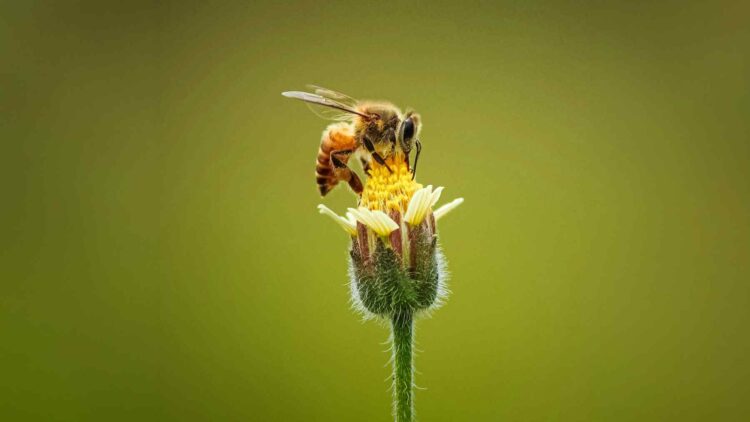
Progress is real, but the researchers are careful not to overstate it. A honeybee operates with just two wings, controlled by a muscle system capable of rapid, finely tuned adjustments that no current robotic design can replicate. Across autonomy, sensory integration, and adaptive behavior, the gap between mechanical and biological pollinators remains significant.
Chen is candid about this. The fine-tuning of bee wing muscles, he says, “truly intrigues us, but we have not yet been able to replicate” it. That honesty matters — it frames the achievement accurately as a major step forward, not an arrival.
The research is published in Science Robotics and was supported in part by the U.S. National Science Foundation.
From lab curiosity to crop pollinator
The long-term vision driving this work is specific: robotic insects swarming from mechanical hives to pollinate fruits and vegetables inside multi-level indoor vertical farms. That model of agriculture could increase yields and reduce the environmental costs associated with conventional farming — but only if pollination can be reliably mechanized at scale.
The team’s next target is 10,000 seconds of sustained flight, roughly ten times what they’ve already achieved. Beyond endurance, they want robots precise enough to land at the center of an individual flower. Over the next three to five years, Chen says integrating onboard sensors, batteries, and computing for fully autonomous outdoor navigation will be the central focus.
The 1,000-second hover was a proof of concept. What comes next is the harder work of turning a lab milestone into something that can operate in the real, unpredictable world — one flower at a time.