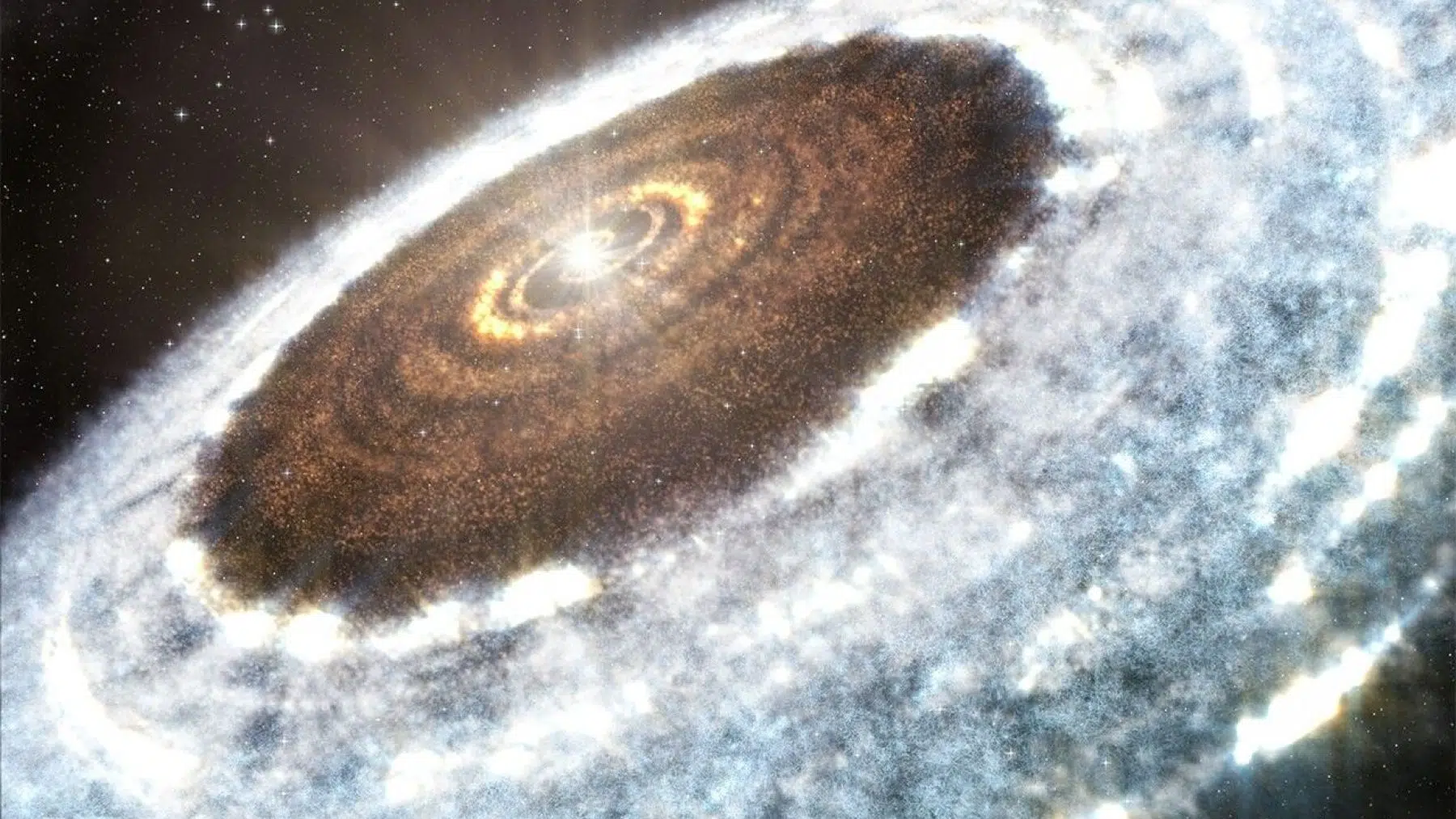
The first image of a water snow line in the universe has been captured by a team led by Lucas Cieza (Universidad Diego Portales, Santiago, Chile). The team has given us our first resolved image of a water snow line around a young star. A discovery of this magnitude can change the way we view the universe and how planets are formed. With the latest images from space telescopes stunning the world, this new discovery has a similar weight to it. What does this mean for us?
How did the researchers find this new snow line in the universe?
The discoveries being made in our everyday lives are truly remarkable. One might wonder what the early thinkers would have thought of mankind’s ability to look into the furthest reaches of space. The level of innovation that the space race has brought to modern day society can no longer be ignored. The secrets of the universe are being revealed to us all, finally.
Albeit bit by bit, our understanding of the universe and in particular how planets are formed has changed recently. The observations were made using the Atacama Large Millimetre/submillimeter Array (ALMA) in Chile, a ground-based telescope array that has made remarkable discoveries in the study of planet-forming disks. The infrastructure that we have built on the earth has had more time to be adapted to suit our needs.
The space race and launching telescopes into the sky is only a recent venture, relatively speaking. But we have been observing the universe and the night sky for thousands of years. Long before we ever thought of going into space, we were developing ways to look further and deeper into the sky and perceive what was out there.
What does space snow mean exactly? Is it like earth snow?
What the researchers in Chile were able to see is amazing. The star V883 Orionis is surrounded by a disk-like shape containing a water snow line. This makes it unusual and unlike anything we have seen before. The star had a dramatic increase in its brightness — making it 400 times brighter than our sun — that resulted in the water snow line being pushed outwards to 40 AU, creating a snow-like effect visible to astronomers.
This is the first time we have ever witnessed something like this. Young stars that are forming are normally surrounded by dense, rotating disks of gas and dust, known as protoplanetary disks, from which planets are born. The heat from this normally keeps the snow line close in. However, the sudden increase in the star’s brightness resulted in the snow line expanding far enough to be resolved for the first time.
The world is making leaps and bounds in the study of the universe. Our understanding of the planetary system in our own galaxy is influenced by studying systems in other galaxies. Their stars and protoplanetary disks give us much needed insight into the answers to the questions we have all been yearning for. This new space snow line is just the newest view of our universe.
What could we find next in the vastness of space?
The innovation happening on earth is a promising sign that, despite the global political climate, the best minds in the world are solely dedicated to searching the universe for answers. We can rest assured that the human race can collectively pursue a future in the stars. The discovery of this water snow line has given us a different understanding into how planets are formed. What we once thought to be true is changing every day. The question we all must face is, what do we do when, yes when, we find life out there? A question that needs to be answered.
Read the whole thing?
Get the week's signal, not the noise
Our sharpest reporting on energy, climate and nature — free, once a week.