Typhoon Faxai came ashore over Chiba in the dark.
Beneath the wind, more than fifty thousand solar panels lay moored flat on a reservoir.
They had floated there without trouble for eighteen months.
By daylight, the outer edge of the array had torn free.
By afternoon, black smoke was rising off the surface of the water.
What let a single torn row drag two thirds of a floating power plant down with it?
What actually let a few bolts bring down a power plant
The array’s outer row sat closest to the open stretch of reservoir, where incoming gusts hit hardest. Engineers had built in resin bolt connections linking float to float, each one carrying a small share of the load the whole chain needed to resist. The ministry investigating the failure concluded that the leading cause was anchor failure, with seven anchors coming loose on the central southern end of the array during the storm.
That single failure did not stay contained. Anyone picturing a static plant should instead picture a chain reaction, because the load the lost anchors had carried did not vanish. It simply shifted to the next connection down the line.
So the bolts next in sequence took on force they were never sized for, and they failed too. After the anchors failed, the resin bolts began to collapse because the wind loads were now dissipated more unevenly, and after each collapsed bolt the loads on the adjacent ones increased, carrying the chain reaction through the array.
How a flat lake turned into a pile of curling glass
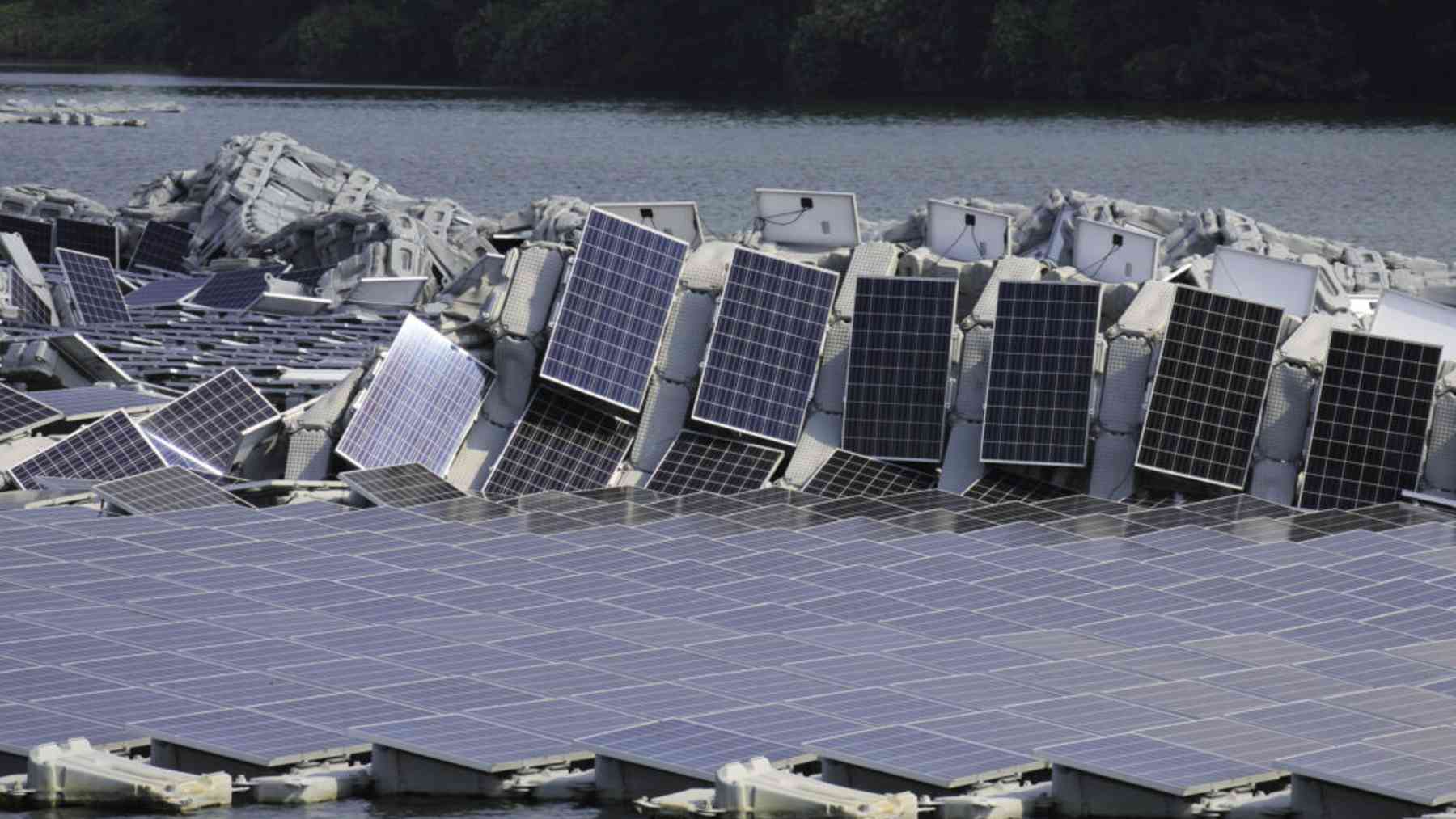
Once the outer row ripped loose, it lost the ballast weight that had kept it pressed flat against the water and resistant to wind uplift. With the wind-facing edge no longer ballasted against uplift, modules and floaters began to curl upward, catching more wind and drifting toward the panels still moored behind them.
Loose floats and anchored ones met and jammed together. Japanese media reported that the wind tore several modules off the project and stacked them, and firefighters said contact between loose panels and those still moored to their mounting structures overheated the modules and created the conditions for a fire. The ignition itself was never pinned down as precisely as the structural failure was.
Reports at the time described crews struggling to contain a blaze on open water, one involving electrical components rather than a building or a brush line. The fire involved around 50 panels out of the 50,904 modules covering about 44 acres of water, a small fraction of an array that had already been pulled apart by the wind.
What the investigation actually found
Japan’s Ministry of Economy, Trade and Industry opened a formal investigation into the exact failure mode behind the destruction at the Yamakura Dam floating installation once the fire was out. Investigators traced the collapse to the shape of the floating island and the uneven anchor arrangement, since mooring wires connected only to the outermost floats around the perimeter, while the floats behind that fixed row were linked to each other only by resin bolts.
Because the plant had been built as one continuous raft rather than smaller linked sections, a failure anywhere could travel everywhere. The array had 112 anchors on the northern end, 107 on the western side and 133 on the eastern edge, but only 68 on the southern perimeter, where the anchors gave way. The array was ultimately ripped into three parts, with the southern sections staying roughly in place while the northern half was blown clear.
No injuries were reported from the fire or the storm that caused it. A Kyocera spokesperson said the fire was extinguished at around 5.20pm local time, hours after the typhoon itself had passed through Chiba.
Where floating arrays have struggled since
Chiba was not an isolated case. Only two weeks later, a typhoon hit the Kyushu region at an average wind speed of about 90 miles per hour, destroying the 2.4 MW Shintaku Tameike floating installation, reinforcing the idea that a single continuous float was a liability in high wind. Elsewhere, floating platforms have faced gentler but still measurable pressure from the water itself, including sites where floating platforms sharply reduced light reaching the water below without raising its temperature.
Anchoring has become its own specialty since. Some newer floating platforms lean on multiple independent anchor points rather than one shared frame, the same logic behind designs where nine separate anchors spread load across a turbine instead of concentrating it.
What changed and what still has to be tested
By early 2021, roughly 16 months after the storm, the Chiba plant was being rebuilt into smaller floating islands. One island with a complex outline became several smaller ones with square shapes, which the platform supplier said avoided stress concentration and increased safety factors, though the reconstructed portion had not resumed commercial operation at that point.
The wider lesson drawn afterward was about redundancy. A working group reviewing the failure concluded that design standards should build in fail-safe margins, since the loss of only a few anchors was enough to set off a failure chain through an entire floating system.
What the Chiba fire mostly proved is less dramatic than it sounds. A plant built from thousands of small parts is only as strong as whichever connection has the least margin left, and on one September day in 2019, the reservoir found it first.
Read the whole thing?
Get the week's signal, not the noise
Our sharpest reporting on energy, climate and nature — free, once a week.