Solar power is evolving rapidly—and this time, it’s taking flight. A team of researchers in Austria has successfully combined solar panels with drone technology, and the initial results are promising: sustained flight, powered entirely by sunlight. The solar industry is already leading the charge in renewable energy growth, and this is another step toward making clean energy more versatile. With these solar panels in the market, drones used for everything from environmental monitoring to delivery could fly longer, further, and more sustainably.
Renewable sources of energy
Solar, wind, geothermal, and wave energy—all of them harness power directly from the environment. These renewable sources have long been part of the conversation, especially as the damage from fossil fuels becomes increasingly harder to ignore. Burning oil and gas releases carbon emissions that heat up the planet and disrupt natural systems.
Traditional power sources—like batteries, fossil fuels, and even some renewable technologies—still come with trade-offs. They are bulky, tied to stationary charging, harmful to the environment, or just do not deliver enough power to justify their use in small, mobile devices.
Recently, the team tested their solar panels on drones, and the outcome could shift how we think about flight. The drones stayed aloft, recharging as they flew, requiring no return to base for battery swaps or plugs. While the idea of drones that never land might still be a stretch, this test shows we’re getting closer to aircraft that can stay in the sky for far longer than before, especially in sunny regions.
The flying solar panel
The breakthrough comes from Johannes Kepler University in Linz, where scientists are developing solar cells that are extremely thin—20 times thinner than a human hair—that barely add weight to the aircraft. Despite their size, these ultra-light solar panels generate up to 44 watts per gram, making them ideal for airborne applications.
That’s where a new solar technology using perovskite comes in. Researchers have developed ultra-thin, flexible solar cells that are just 2.5 micrometers thick—around 20 times thinner than a human hair. Despite their size, these lightweight panels deliver an impressive 20.1% efficiency and crank out a power density of 44 watts per gram, far beyond what older solar materials can manage.
The real challenge was making them not just efficient, but durable. To protect the cells from moisture and air—two things that can quickly kill performance—scientists added a transparent aluminum oxide layer and fine-tuned the solar material itself. The result is a stable, flexible panel that’s light enough to mount on a drone without weighing it down.
The Solar Hopper
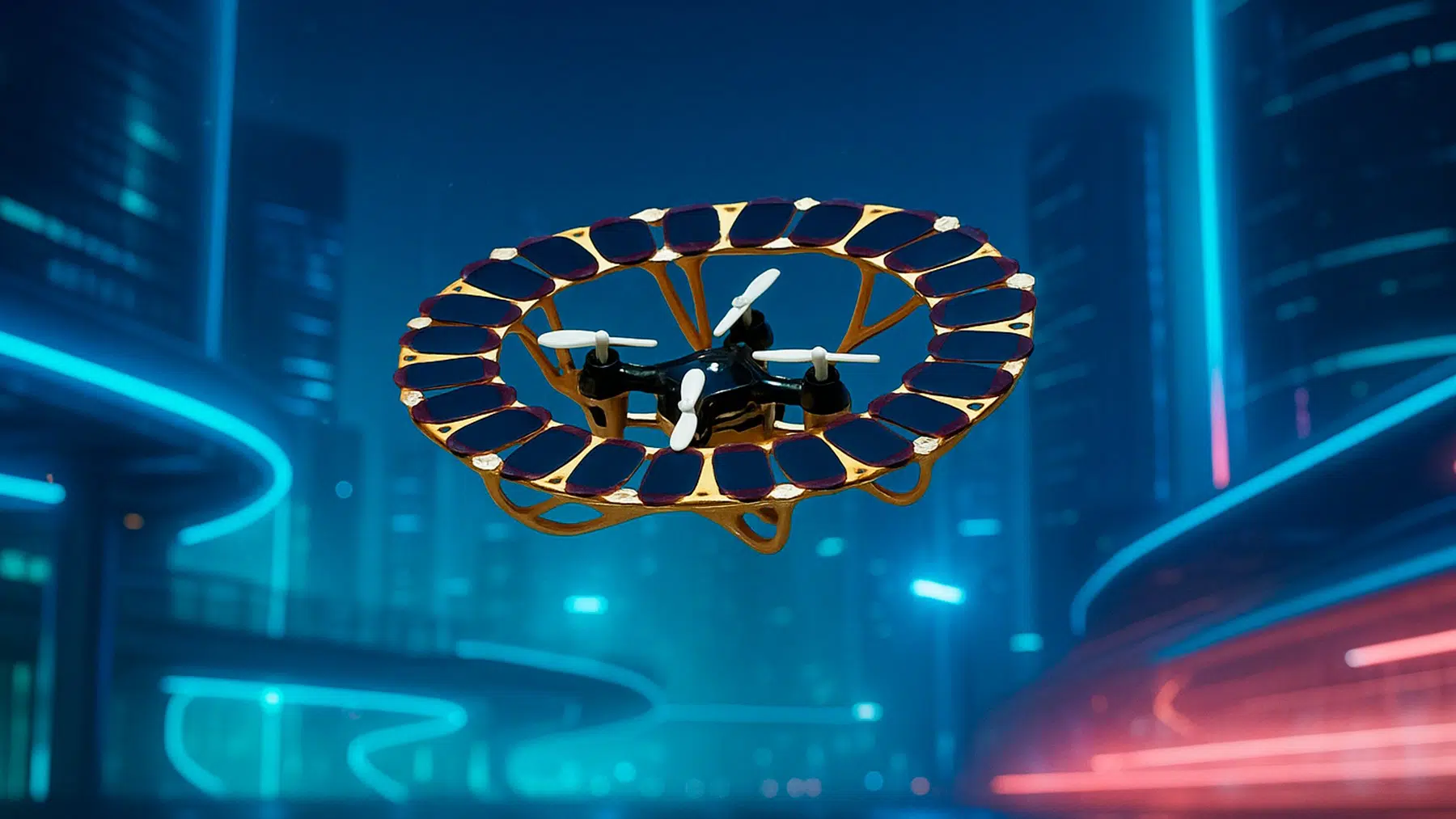
A team fitted 24 of these panels onto a CX10 miniature quadcopter—just 1/400 of the drone’s total weight—and launched what they now call the Solar Hopper. It was able to fly, recharge midair, and repeat the cycle—all without plugging in. That makes it a significant step forward in self-sustaining flight.
The potential goes far beyond drones. Think search-and-rescue missions in remote regions, long-range mapping, solar power in orbit, and even aircraft for planetary exploration. NASA’s Ingenuity helicopter already showed what solar-powered flight can do on Mars. With technology like this, we might be looking at a future where solar-powered aviation plays a leading role in pushing science deeper into space.
Another project with the cells
Perovskites are also making waves in another corner of solar panel innovation. The material is being used to build layered solar cells that capture more sunlight by stacking different wavelengths. Some of the latest models are reaching efficiency rates near 50%—a huge leap compared to what traditional solar panels can do. That kind of performance is exactly why researchers see perovskite as a key player in the future of clean energy.
Read the whole thing?
Get the week's signal, not the noise
Our sharpest reporting on energy, climate and nature — free, once a week.