

Every time you walk across your lawn, 1,800 miles beneath your feet stand mountains five times taller than Everest.
They have been there for hundreds of millions of years, in total darkness, and nobody had ever mapped how far they reach.
They are not made of rock the way a mountain range is.
The strange part is not their size.
It is what they are made of.
The planet we thought we knew
Ask anyone what Earth looks like inside and you get the same answer from grade school.
A crust on the outside, a rocky mantle in the middle, a liquid outer core beneath that, and a solid iron ball at the center.
It is a tidy picture.
For generations it held up well enough that scientists drew neat diagrams and moved on.
But the deeper you look, the messier Earth gets.
The differences in composition between those deep layers are greater than those between the solid rock under your shoes and the air above it.
That gap between the textbook and the real thing is exactly where the important discoveries hide.
A listening post buried in the ice
To see what was really down there, a team did something remarkable.
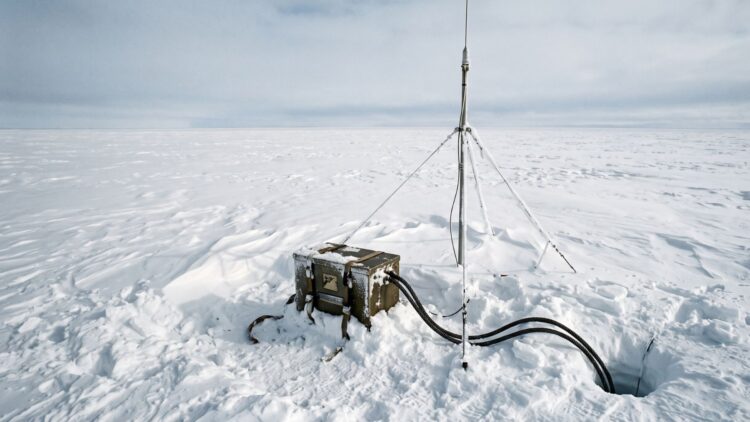
They used 15 monitoring stations buried in Antarctic ice, tracking seismic waves from earthquakes across three years.
Each earthquake sends out ripples that travel all the way through the planet and bounce back, like sound echoing inside a giant bell.
Nobody drills down there, so the planet has to be read by ear.
The speed those waves travel, and the way they slow or scatter, tells geologists what kind of material they passed through.
The stations sit in Antarctica precisely because the isolation keeps interference low.
The signal stays clean enough to finally trust.
Thousands of recordings later, the picture that came back was not the tidy one.
Mountains five times taller than Everest, and nobody knew how far they spread
What the data showed stopped the researchers cold.
The layer sitting on the core is not flat, and it is not smooth.
Some formations rise more than 25 miles from the boundary, five times the height of Mount Everest, in darkness and heat no living thing could survive.
Seismic waves slow down dramatically wherever they cross this layer, which is why geologists call it an ultralow velocity zone.
Until now these zones had turned up only in isolated patches.
The Antarctic data found them almost everywhere the team looked.
The layer itself is thin, measured in tens of kilometers against a planet 8,000 miles wide.
Which raised the obvious question, what could possibly be sitting on top of a ball of molten iron?
The ocean did not vanish, it moved
The answer is the floor of an ocean that no longer exists.
When tectonic plates collide, one slides beneath the other, dragging seafloor down with it.
That slab carries the cold, dense crust of a vanished sea.
Geologists had long assumed that subducted seafloor simply mixed away into the mantle and ceased to exist.
It did not.
It sank all the way, roughly 1,800 miles down, until it came to rest against the core, and it is still lying there.
Slowly flowing mantle rock then pushed that material into heaps, which is why it forms mountains instead of an even coat.
The seafloor that once held ancient seas now wraps the innermost skin of our planet like a buried relic.
Lead author Samantha Hansen said seismic imaging keeps showing a structure that is vastly more complicated than once thought.
Why this matters from volcanoes to the magnetic field
This is not a curiosity locked away from the world we live in.
That buried layer helps govern how heat escapes the core, and the core is what powers the magnetic field shielding us from solar radiation.
Where the heaps pile highest, they may help decide where mantle plumes form, the columns of hot rock that rise all the way to the surface.
Those plumes feed volcanoes and drive the plate motion that shapes every coastline on the map.
Hawaii and Iceland exist because something rose from far below.
So the lost ocean floor does not just sit there, it may quietly steer the machinery that builds mountains and opens new seas.
The researchers are careful to say the ancient seafloor idea is the strongest current explanation, not the only one.
More stations, better algorithms and deeper drilling will sharpen the picture.
There is something quietly moving in the idea that the oceans we lost did not really vanish, and the same is true of the deep ocean floor we can still visit today.
They went somewhere far more permanent, holding the planet’s core like a hand around a stone, and the past turns out to be buried, not gone.