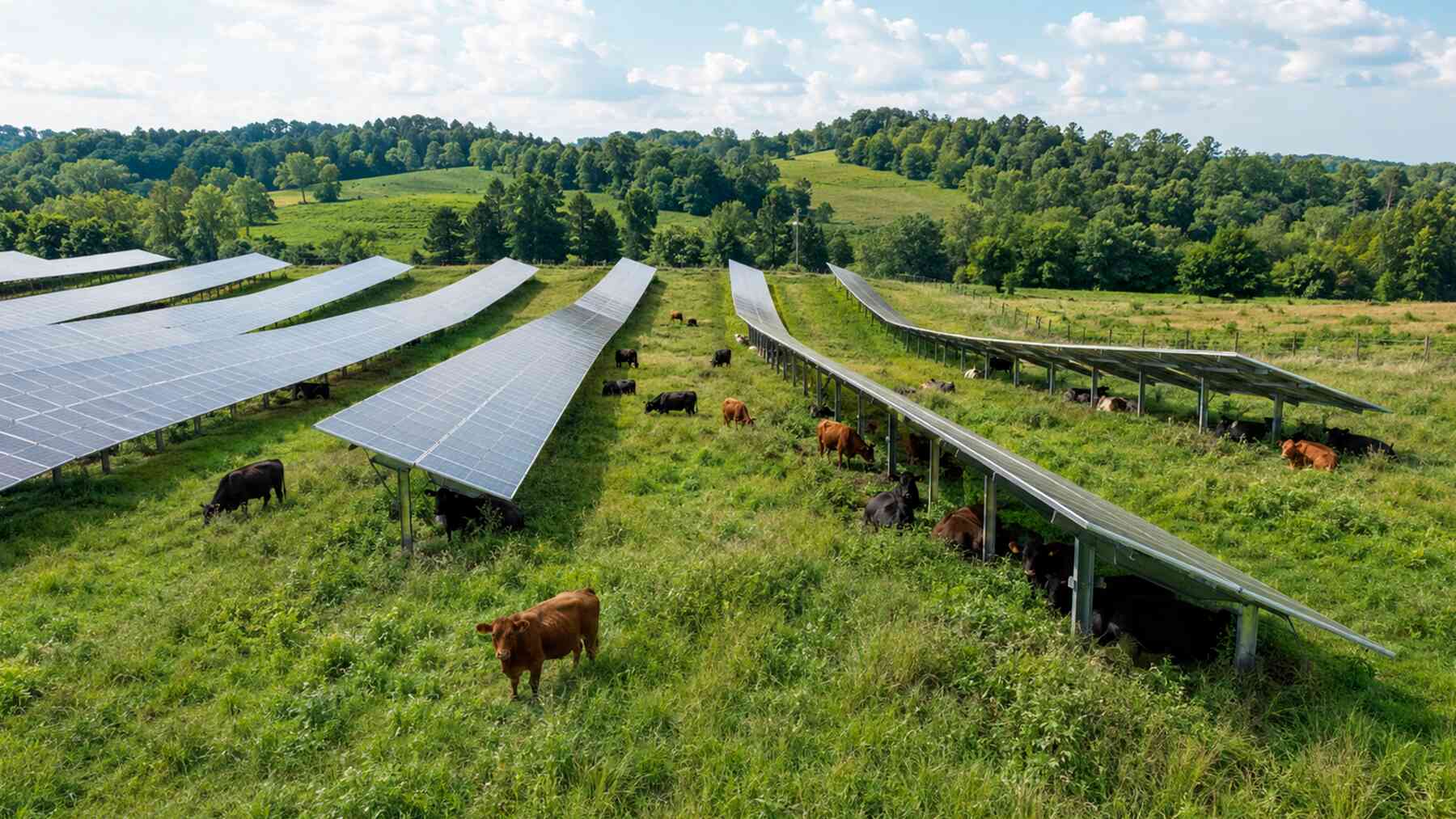
A gate opens on a solar field in middle Tennessee and there are cattle standing between the rows.
Ten cows and their calves, grazing in the shade with the panels overhead lying almost flat.
The flatness is not an accident, and neither is the height of the steel holding those panels up.
Both were designed that way because an adult cow does not fit under an ordinary array.
And the reason anybody bothered has almost nothing to do with the cows themselves.
What they actually changed
The site is at Christiana, southeast of Nashville, and it sells its power to a rural electric cooperative.
The whole farm runs to about 40 acres and roughly 5 megawatts, of which a 20 acre block carrying over 4 megawatts is the test bed.
Two things were rebuilt. The racking was raised so the tables sit high off the ground, closer to a solar carport than a normal field array.
Then the tracker software was rewritten. When cattle are in a row, the panels rotate close to horizontal and stay there, which opens the headroom underneath.
The company’s chief technology officer describes it plainly, which is that the animals need room to move around.
The herd belongs to the operator rather than to a neighbouring farm, which matters, because this is a demonstration built to be watched.
That rotation is the compromise at the heart of it, because a panel lying flat is a panel making less power.
Why sheep were the default
Grazing a solar site is not a new idea, and it is not a small one either.
By 2024 more than 130,000 acres of American solar land were being grazed, and the animal doing it was almost always a sheep.
Sheep are the obvious choice because they simply fit. They walk under a standard array without anybody having to raise anything.
The problem is that the United States is not a sheep country. The national flock is around 5 million head.
Cattle are a different order of magnitude, with roughly 88 million head spread across more than 732,000 farms.
So if solar keeps landing on pasture, it has to work with the animal already standing on that pasture rather than one imported for the job.
Putting 1,200 pounds next to glass
Here is the point where the enthusiasm usually gets a long way ahead of the engineering.
A cow is not a gentle neighbor for hardware. She weighs over half a ton and she looks for something solid to rub against.
Anything at shoulder height gets used as a scratching post, and any loose cable at nose height gets investigated with the teeth.
That is precisely the risk the raised racking answers, along with reinforced structures and wiring run inside protective sheathing.
None of that is a bonus feature. It is the cost of admission for putting cattle inside an operating power plant.
Anyone selling the scratching as helpful has it backwards, because rubbing on an array is the thing the whole design exists to survive.
What the cows actually do for the panels
Their real job is a good deal duller than the headlines suggest, and considerably more useful.
Grass under a solar farm grows all summer, and grass tall enough to shade a panel costs real output.
Somebody has to cut it, and the usual answer is mowing, which throws dust onto the glass and can flick a stone hard enough to crack a module and take a whole string offline.
Cattle do the same job without either problem, as the project at the site sets out.
What they do not do is clean the panels or contribute to generation, and the company makes no such claim.
It is the same trade seen at an offshore array or a fenced solar site, where the animal is not a mascot but part of the maintenance.
What is still being tested
Researchers have been working this ground since 2023, and the wider program runs for 39 months with university partners attached to it.
The immediate goal is narrow. One year of showing that full sized cattle can do well on a solar site rather than merely survive one.
Alongside the animals, the soil and the forage are being measured too, because shaded and grazed ground under panels behaves differently from open pasture.
The company already has close to 15,000 acres under grazing across its sites, almost all of it sheep, so this is one block against a large existing operation.
If it holds up, the land under an array stops being a maintenance bill and goes back to being a farm.
That is a modest claim rather than a revolution, and it is the one the evidence currently supports.
Read the whole thing?
Get the week's signal, not the noise
Our sharpest reporting on energy, climate and nature — free, once a week.