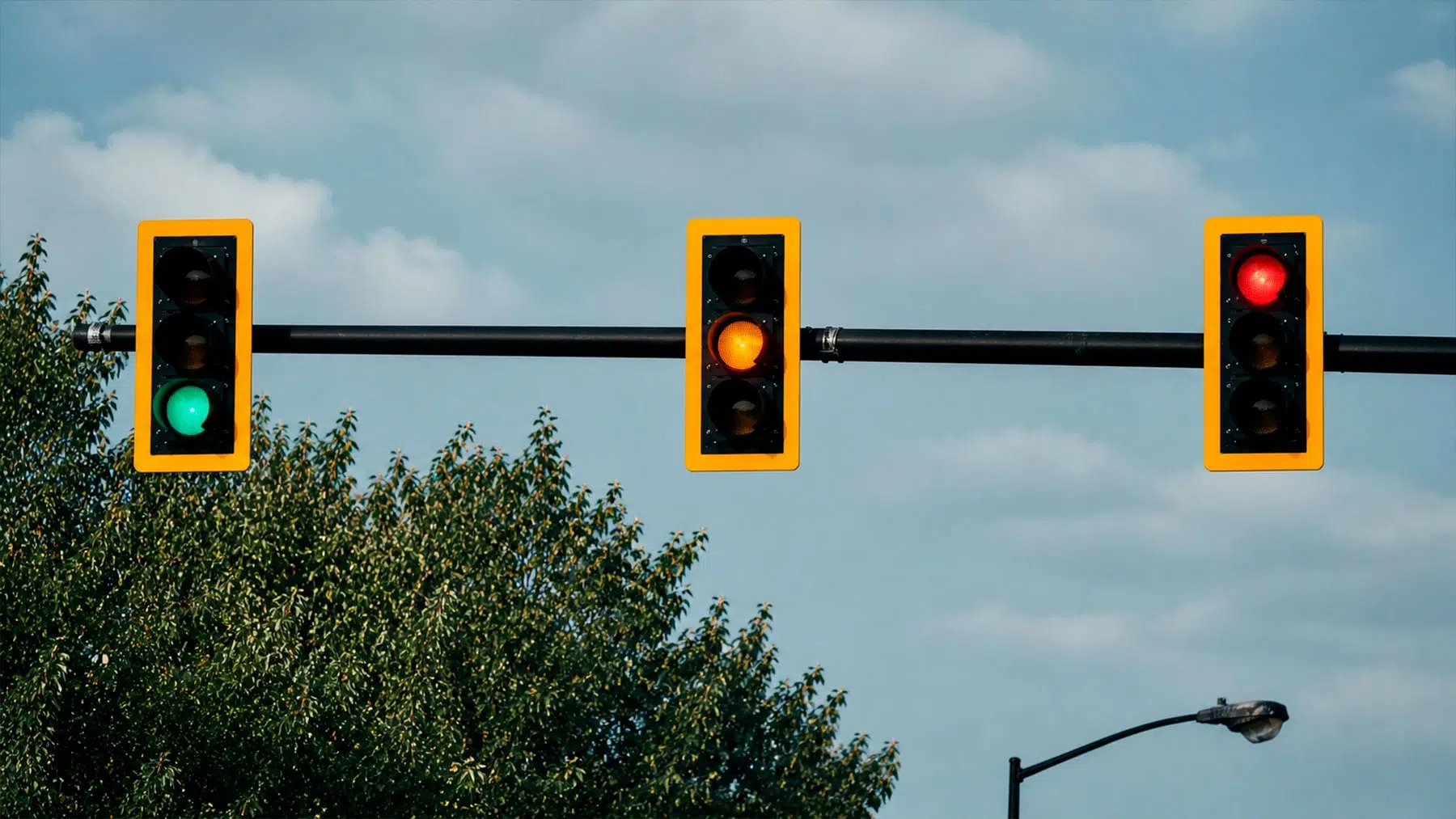
A thin yellow border around a traffic light doesn’t sound like much of a change.
But in Iowa, it made drivers react differently.
Officials weren’t just chasing aesthetics. They were targeting something far more serious.
Missed signals and traffic collisions.
Now, data is revealing that drivers are reacting faster. And that is exactly the point.
What changes to drivers’ reactions are emerging in Iowa thanks to the yellow borders?
How a simple yellow border is reshaping drivers’ behavior in Iowa
Drivers often miss signals until the last second, especially in jammed intersections.
That’s where this new yellow border comes in. It creates a much-needed contrast.
It helps lights stand out against the background. And the change matters.
Especially at busy intersections around Iowa.
Engineers in the state added the yellow borders to improve recognition distance.
The goal was a simple one.
Give drivers more time to react appropriately to traffic lights. That extra second changes everything.
It also helps during low-light conditions. Such as fog, rain, and dusk.
The yellow border cuts through these conditions. Like a visual anchor for the driver’s eyes.
But visibility alone doesn’t tell the whole story.
What matters is how drivers in Iowa are responding.
Early results from the yellow borders in Iowa are promising, to say the least
Driver and pedestrian safety is paramount.
Some states and cities have painted their sidewalks to increase safety. But in Iowa, things are slightly different.
Initially, the change seemed almost too simple.
A simple border surely could not affect drivers’ behavior so drastically?
Data showed drivers were doing something differently.
Drivers weren’t just seeing the border; they were reacting faster.
That shift reduced last-second decisions by a profound timeframe.
Even a one-second improvement can prevent collisions.
And that’s where the real change began.
City officials started tracking patterns among Iowa drivers.
Many drivers spotted signals far earlier than normal
But another shift was taking place.
Reaction time.
Drivers seemed to approach intersections more cautiously.
That was definitely not part of the new design.
No new speed limits. Yet the change in the driver’s behavior was noticeable.
How was this possible? Especially considering the change wasn’t intended.
An official statement from the City of Des Moines has revealed what is going on in Iowa.
What Iowa drivers actually did, and why it could now spread across the nation
Some states have transformed certain regions into automated speed traps.
But what is happening in Iowa goes beyond catching speeding drivers.
The most important factor in this story is not the yellow borders.
It’s how drivers are now reacting to them. And how it could spread nationwide.
The brighter outline made signals visible sooner. And drivers slowed down far earlier than before.
Data shows that earlier response reduced sudden braking and questionable decisions.
Crash data showed regions with the yellow borders had signficantly less collisions.
Fewer rear-end crashes were also reported at these upgraded intersections.
The visual cue worked exactly as they had hoped.
Drivers needed no additional instructions. Their behavior just changed naturally.
That is what makes this so special.
No penalties or fines. No increased law enforcement.
Just a simple yellow reminder that speed can kill.
How the system may spread across the entire nation soon
Federal agencies are reviewing Iowa’s data as a model for national changes.
The crash data from Iowa serves as their best evidence.
Evidence that not only does the system work, but it also changes driver behavior.
Traffic signal designs in the U.S. are guided by the Manual on Uniform Traffic Control Devices.
Nationwide adoption of the system depends on consistent data.
Color can drastically influence driver behavior. And Iowa may have already proven it works.
But what about the rest of the nation?
Read the whole thing?
Get the week's signal, not the noise
Our sharpest reporting on energy, climate and nature — free, once a week.