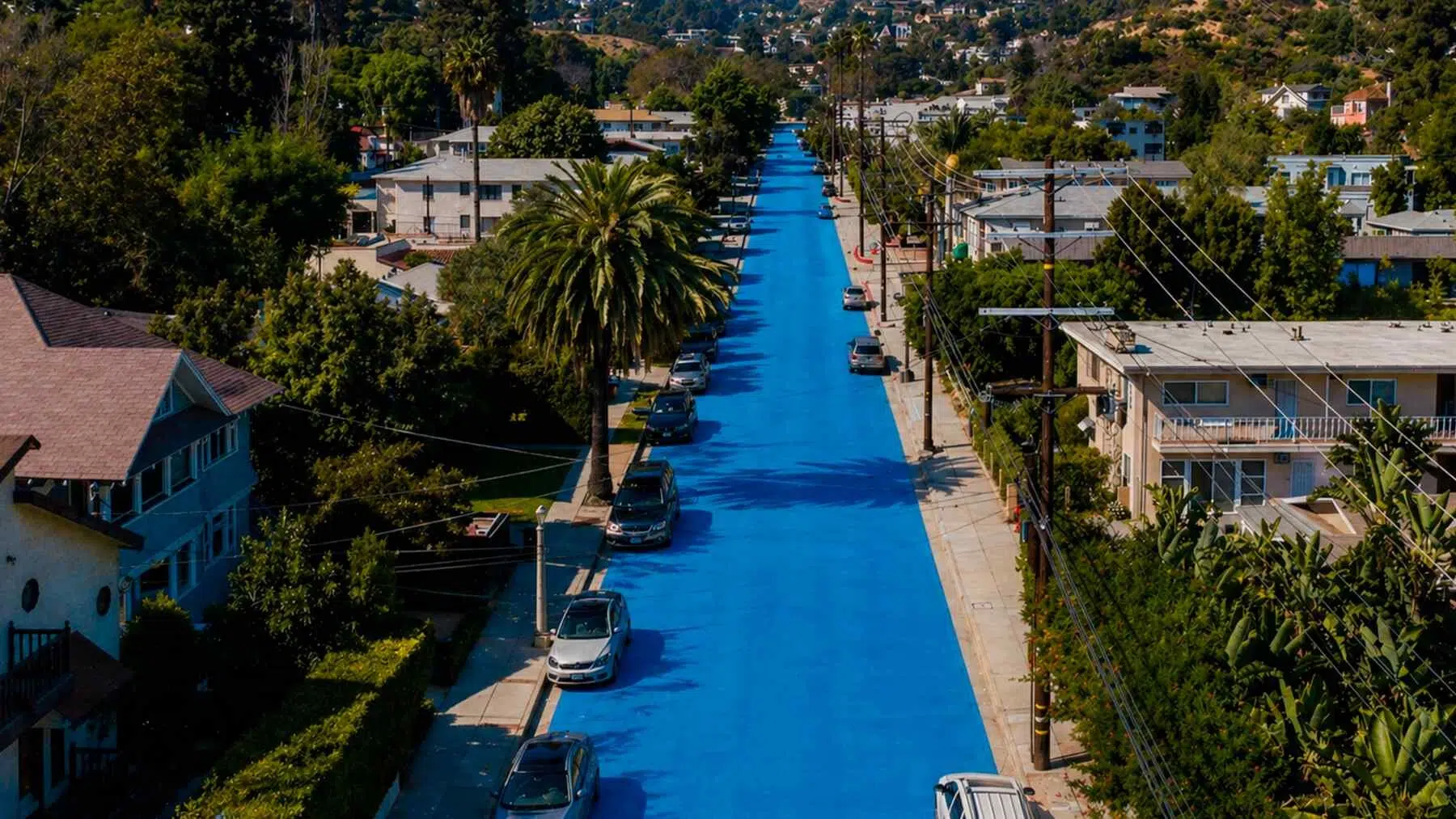
Pacoima is baking under the California sun.
To fight the heat, Los Angeles coated its black asphalt with a special blue-tinted material.
This simple science reflects sunlight back into space. Surface temperatures plummeted by nearly 22°F.
It is a bold shield against the urban heat island effect. Residents now walk on cooler streets that protect the community’s health.
But what happened after Los Angeles painted its roads blue?
Reflecting the sun: How blue streets break the heat cycle
Los Angeles has spent decades fighting extreme heat.
The now-infamous dark asphalt makes this issue worse.
Standard roads absorb up to 95% of solar radiation, turning streets into thermal batteries.
Once night emerges, this stored energy is released back into the atmosphere, creating a “heat island” that keeps neighborhoods dangerously warm.
That is where the oddly blue roads came in—a small clue to a cooler future.
In Pacoima, the GAF Cool Community Project coated 700,000 square feet of pavement with StreetBond, a water-based epoxy.
While some coatings look gray, many appear blue to maximize solar reflectance without creating a blinding glare for drivers. This simple science reflects sunlight into space, slashing surface temperatures.
This technology protects vulnerable residents from heat-related illness.
But what happened after Los Angeles painted its roads blue?
What scientists found when the sun hit these new blue roads
A study was undertaken to focus on urban heat and cool pavement technology.
Researchers aimed to measure how blue roads responded to sunlight.
Including surface temperatures, reflected heat and energy, as well as thermal effects nearby.
Urban environments can create heat traps and bubbles.
The difference in temperatures on these blue roads was not imaginary. The streets behaved far differently.
However, cooler roads do not always result in cooler drivers.
They did help reduce the heat trapped by the roads. Which could ease nighttime heat for drivers, too.
In other parts of the world, roads are painted red. This was supposed to make driving safer.
But even those red roads created new heat islands.
But where did the heat go?
Cooling a specific surface can’t erase heat completely.
Researchers weren’t just studying the blue roads.
They studied what happened after the road turned blue.
Their findings have been detailed in the study, “Micrometeorological effects and thermal-environmental benefits of cool pavements: findings from a detailed observational field study in Pacoima, California,” published in Environmental Research Communications.
A 22-degree difference: The science behind LA’s famous blue pavements
The now-famous blue roads were part of a city-wide cool pavement strategy.
LA applied these blue reflective coatings to some roads. The aim was to fight the urban heating island effect.
The color change was a clue about the new impact on the roads. The coating (StreetBond/DuraShield-SR) works by reflecting Near-Infrared (NIR) radiation.
Drivers noticed that stretches of road were far cooler than others. Surface temperatures plummeted by as much as 22°F (12.2°C).
But only those with the new blue coating.
The effect of these blue roads was almost immediate. In the afternoons, roads felt like an open oven ready for baking.
Meaning that more heat was escaping in the late afternoon. Making the night far cooler for drivers.
Less heat was trapped by the road surface. Leading to a much cooler driving experience.
The Physiological Equivalent Temperature (PET)—how humans actually feel the heat—dropped.
Data points to the fact that hot nights are often deadlier than hot days.
California regularly faces extreme heat.
Which has led to exceptionally high temperatures, even when temperatures should be far cooler.
It’s all in the name of saving lives
Thankfully, city officials have turned to blue roads to address city-wide heat island issues. Reducing heat released during the evening can actually save lives.
As Los Angeles expands this “blue shield” across its hottest neighborhoods, could this simple change in color be the key to saving lives in a warming world?
Read the whole thing?
Get the week's signal, not the noise
Our sharpest reporting on energy, climate and nature — free, once a week.