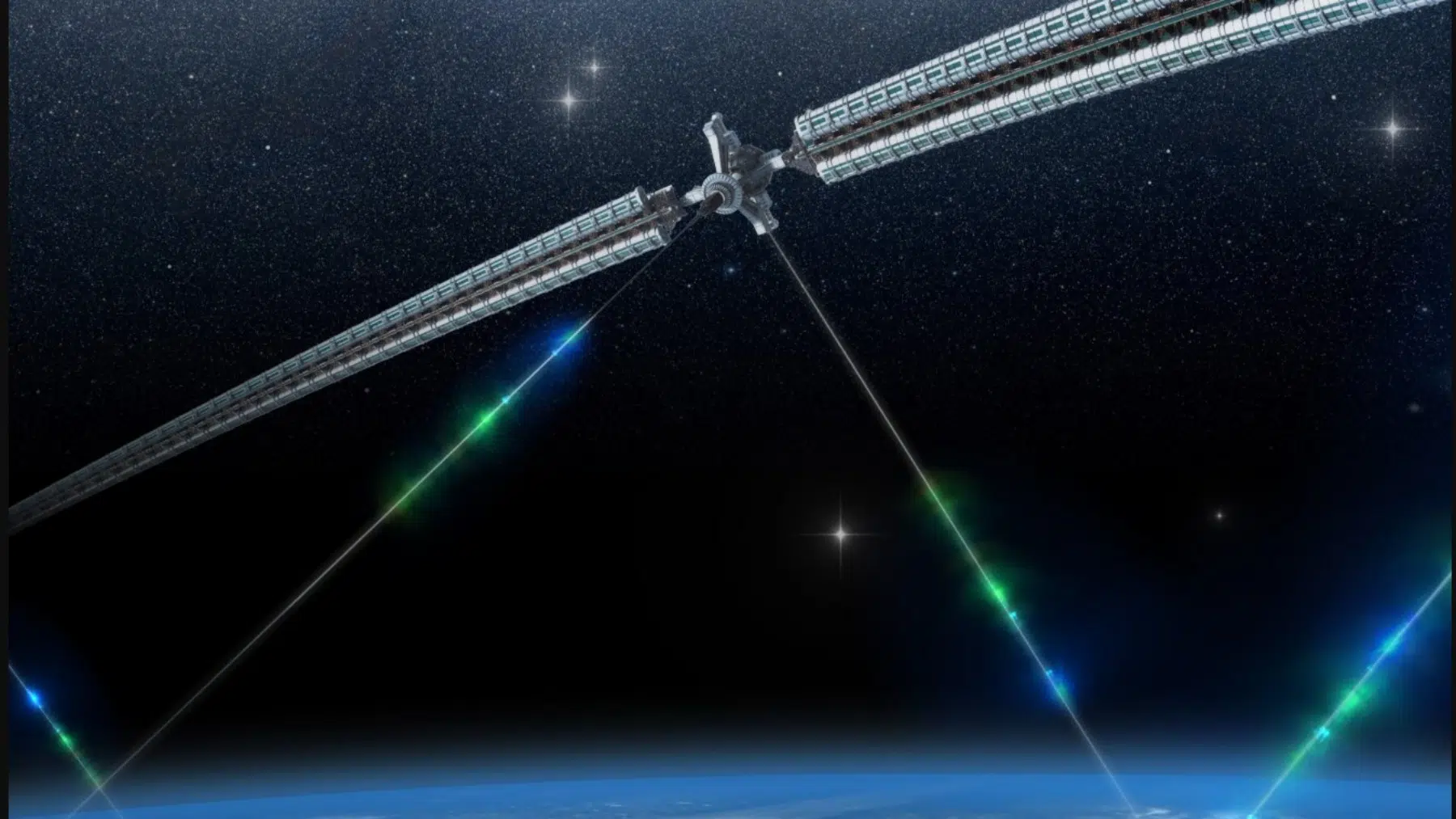
A revolutionary solar panel technology has been tested in space: German researchers have made a daring step forward with triple-junction metal wrap-through (MWT) solar cells. This invention has the potential to transform how we use solar energy on Earth and beyond.
These solar cells are designed to resist the harsh conditions of space, unlike conventional solar panels. They are made to resist the harsh conditions of space, and because of their performance in space, they may soon set the standard for solar technology on Earth, boosting energy production and lowering dependency on fossil fuels. The latest invention from Germany could hold the secret to maximising solar power’s potential.
SPACE Solar Cells: Azur Space’s state-of-the-art solar cells
High efficiencies are available with space solar cells, ranging from the 28% class to the 32% high-end cell class. The most recent triple and quadruple junction technology, in which III-V layers are formed on a Germanium substrate, is incorporated into all solar cells. The entire product line benefits from years of experience in the space market.
AZUR SPACE has already supplied solar cells to a variety of clients. Apart from their standard solar cells, AZUR SPACE provides a range of customised product options based on specific needs.
The way triple-junction solar cells are revolutionising the industry
For nanosatellites, a group of German researchers from the University of Stuttgart and Azur Space Solar Power has created a miniature solar cell experiment. According to PV Magazine, it was used to test samples of new multijunction solar cells created by Azur Space, including innovative triple-junction metal wrap-through solar cells. This is different from traditional solar panels that rely on single-layer silicon cells, which can only absorb a limited portion of sunlight.
The team’s novel instrumentation successfully sampled more than 5,000 IV-curves, cell temperatures, sun error angles, and total ionizing dose measurements. The data gathered in orbit was used to validate temperature and solar simulator characterisation tools in the lab on the ground.
Markus T. Koller, the research’s corresponding author, stated that the experiment has demonstrated that solar cell testing on nanosatellite platforms with high mass, size, and power constraints is capable of delivering adequate solar cell characterisation results that stand up to the sophisticated and bulky space solar simulators on Earth.
The 4G32 quadruple-junction solar cell has efficiencies of 32% and open-circuit voltages of 3.45 V, while the 3G30 triple-junction cell has a 30% efficiency. The standard versions of these multijunction cells have flown on many spacecraft to date, according to Koller.
As part of a cutting-edge research mission, the cells were tested in space, demonstrating their resilience to the harshest environments. These trials’ success raises the possibility that they will soon be utilised to power future satellites and space stations, and perhaps one day even applications here on Earth.
Why there are chances that this solar technology could replace conventional panels
This discovery has far-reaching consequences beyond space travel. Germany’s innovative solar cells have the potential to significantly lower the cost of solar energy, increasing its accessibility and viability for mass use. Large tracts of land or rooftops are needed to produce a significant amount of electricity with conventional panels. These new cells, however, can generate the same amount of energy in a significantly smaller area, making them attractive for urban settings and high-energy demand locations.
Furthermore, because they can function in harsh environments, they may be used in places where traditional solar panels are ineffective, like deserts, high altitudes, and areas that frequently see severe weather. Germany’s state-of-the-art solar panels may play a significant role in lowering carbon emissions and hastening the switch to renewable energy sources as the globe moves towards greener energy options.
As the EIVE satellite is scheduled to re-enter the Earth’s atmosphere sometime in late March 2025, Koller remarked that the initial intention to collect data from the satellite for as long as feasible will be shortened. During the so-called solar maximum in 2024, high solar activity increased atmospheric drag on all low-Earth orbit spacecraft.
Read the whole thing?
Get the week's signal, not the noise
Our sharpest reporting on energy, climate and nature — free, once a week.