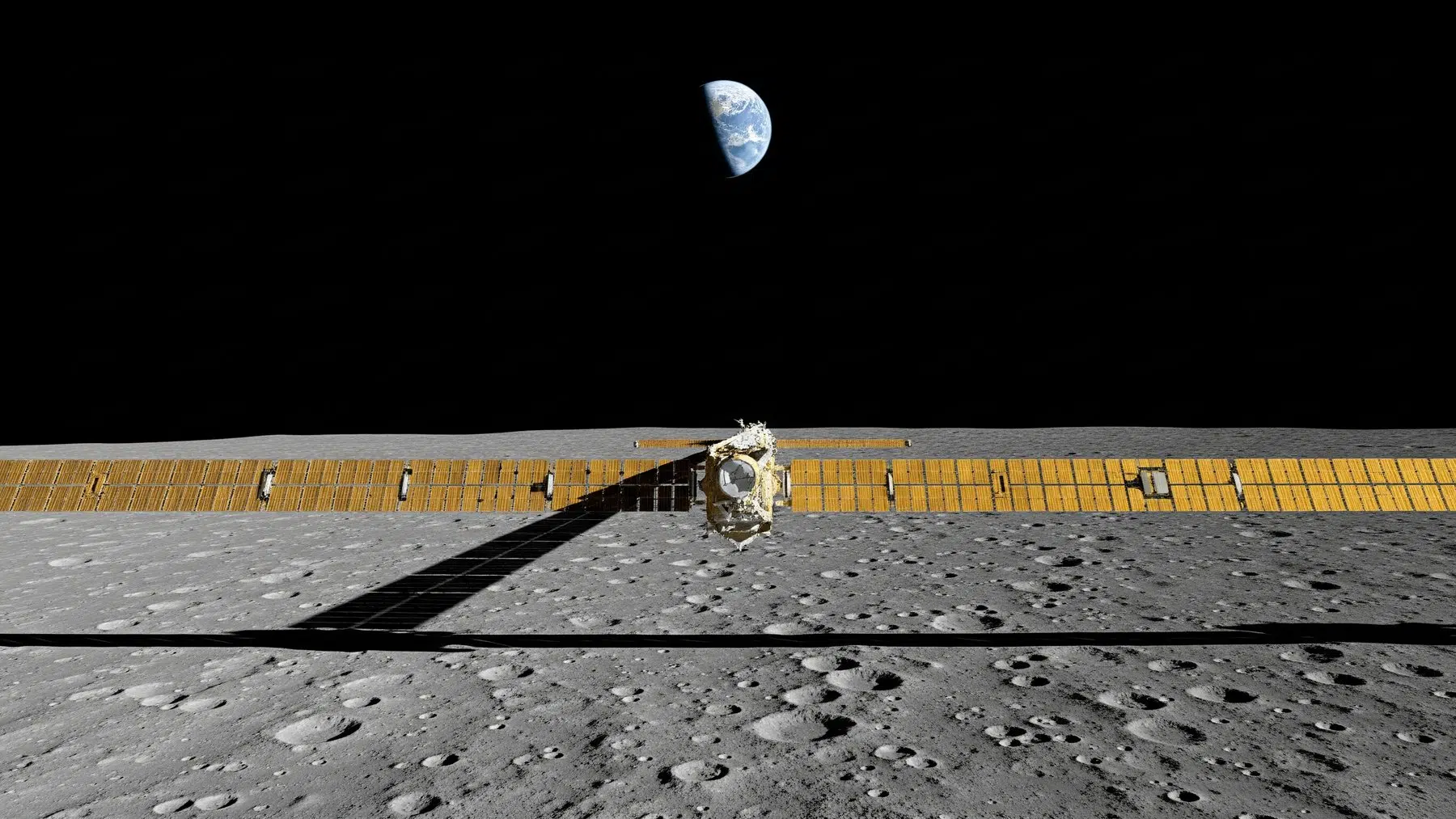
Picture the Moon on a clear night, hanging over your backyard. Now imagine a continuous belt of solar panels running all the way around its middle, stretching across 11,000 kilometers of crater-dusted rock.
That is not a scene from a movie. It is the serious, published proposal from one of Japan’s oldest engineering firms, and the mechanism it uses to send that power home is unlike anything operating on Earth today.
The company behind it has been building things since 1804
The Luna Ring was proposed by Shimizu Corporation after the 2011 Tōhoku earthquake and tsunami, which severely damaged the Fukushima Daiichi Nuclear Power Plant and created a surge of public opposition against nuclear energy , making it relevant for a country searching for alternatives.
Shimizu is not a startup chasing venture capital. The firm has been in continuous operation since 1804, when Kisuke Shimizu I, a carpenter from what is now Toyama Prefecture, launched the business in the Kanda Kajicho district of Edo.
The company put forward a concept called the Luna Ring: a continuous belt of solar panels stretching 11,000 kilometers around the lunar equator, converting sunlight into electricity and beaming it back to Earth as microwaves and lasers.
The plan calls for arrays ranging from a few kilometers to as much as 400 kilometers in width. The idea emerged into public debate as Japan sought safer energy alternatives, and the scale of ambition behind it is genuinely hard to absorb.
Why the Moon, and not just more panels in a desert somewhere
The Moon has one extraordinary advantage over any rooftop or solar farm on Earth. A ring of solar cells along the lunar equator would face the Sun without interruption.
Solar panels on the Moon’s surface would receive unfiltered sunlight with no atmospheric absorption, no cloud cover, and no weather. The lunar equator offers near-constant illumination on one hemisphere or the other.
Solar panels in space receive sunlight at greater intensity than on Earth, free from clouds or atmospheric scattering. A satellite in geostationary orbit is illuminated for 99 percent of the year, generating continuous power that ground-based renewables cannot match without massive battery storage.
That changes the arithmetic of clean energy entirely. The question is how you get the electricity from there to here, across nearly 239,000 miles of empty space.
The journey electricity would take from the Moon to your home
Solar cells on the lunar equator would convert sunlight into electricity, and built-in cables would carry that power to the near side of the Moon, the face that always points toward Earth.
There, transmission facilities would convert the electricity into microwave beams and high-energy lasers aimed at receiving stations on the ground. Those stations, called rectennas, convert microwaves back into usable DC electricity.
The system could also use the energy to produce hydrogen fuel for storage and transportation. The Moon, in that vision, would not just power the grid. It would fuel vehicles and heat buildings too.
The Luna Ring’s numbers are staggering, and so are its obstacles
Shimizu claimed the system could generate up to 13,000 terawatts of power, roughly 500 times the world’s current electricity consumption. Even a fraction of that would reshape global energy.
Construction would be handled primarily by robots under the control of operators on Earth, using materials mined from the Moon itself. Lunar sand would be processed for concrete, and glass fiber and structural blocks manufactured in place to build and support the ring.
Beaming gigawatts of power across 238,855 miles of space with pinpoint accuracy is still in the research phase. The microwave and laser beams would require guide beacons on Earth to ensure they hit their receiving stations , a feat never attempted on this scale.
One economist with the Institute of Energy Economics in Japan told ABC News that lunar solar power sounds good in theory but costs too much , and that Japan should focus on geothermal power instead, which is already available and far cheaper.
Still, Caltech’s MAPLE project successfully demonstrated beaming detectable power to Earth from orbit in 2023, and engineers working on offshore wind and orbital solar say the physics have never been the problem. The bill has.
The Moon as a power station might sound wild, but the race is already on
As of 2026, the sector has moved beyond paper studies into hardware testing, with several projects successfully demonstrating key components of the technology.
Japan Space Systems is advancing the OHISAMA project, with a plan to launch a 180-kilogram satellite into low Earth orbit to demonstrate wireless solar power transmission from space to Earth.
China has announced plans for kilometer-scale space solar arrays by the 2030s, and the UK has backed its own orbital design with government funding.
Back on Earth, every ground-based solar farm uses land, needs maintenance, and goes dark every single night. The Luna Ring sidesteps all three problems in one move.
Shimizu’s proposal is genuinely audacious, and commercial Moon-based power is still decades away at best. As of 2026, the Luna Ring remains exactly what it was when first published: a concept on a corporate website. No funding has been secured, and no government has endorsed the project.
But the idea that the Moon could one day act as a power station for the entire planet, beaming clean electricity down through the dark, is no longer purely the stuff of science fiction. The engineering teams working toward it, from Shimizu’s own published concept to Caltech’s MAPLE experiment, are very, very real.
Read the whole thing?
Get the week's signal, not the noise
Our sharpest reporting on energy, climate and nature — free, once a week.