In the early universe, some galaxies grew to enormous size at breathtaking speed — then abruptly went dark, ceasing to form stars almost as fast as they had begun. For decades, astronomers suspected powerful winds were the culprit, but no one had caught one in the act.
Now they have. A distant galaxy system, observed as it existed just 1 billion years after the Big Bang, has been found venting a colossal plume of gas into space — fast enough to drain its star-forming reserves in under 100 million years.
A galaxy caught in the act of dying
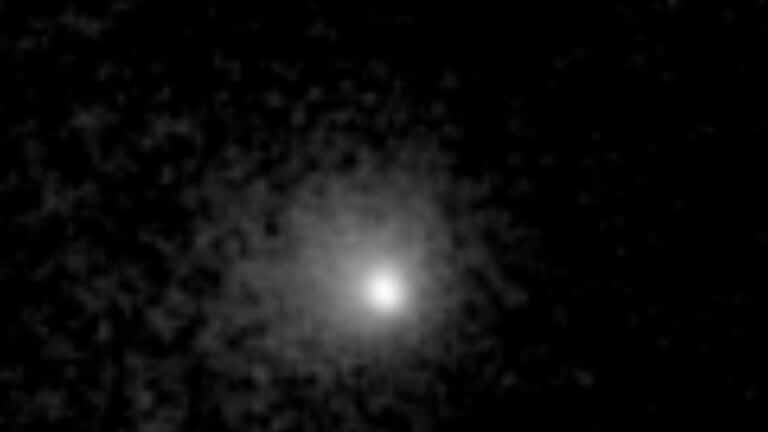
The galaxy system at the center of this story is called CRISTAL-02. It existed just 1 billion years after the Big Bang, and its stellar mass is roughly 10 billion times that of the sun. Using the James Webb Space Telescope alongside the Atacama Large Millimeter/submillimeter Array (ALMA) in Chile, astronomers detected an immense plume of gas escaping into space at hundreds of miles per second.
That outflow is no minor leak. It carries approximately 1.5 billion solar masses of material — nearly as much as the galaxy system itself contains — and CRISTAL-02 is losing more than 500 solar masses of gas every year. That is roughly 20 times faster than typical massive galaxies of comparable size.
How colliding galaxies ignite their own destruction
CRISTAL-02 is not a single galaxy. It represents the latter stages of a multi-galaxy collision, and that merger is driving something extraordinary. When galaxies collide, massive gas clouds are compressed and shocked into forming new stars at an accelerated rate. CRISTAL-02 is producing around 260 new solar-mass stars per year — three times the rate of galaxies with similar masses and ages.
The problem is what follows. The most massive newborn stars burn fast and die violently, exploding as supernovae within just a few million years. Their intense stellar winds energize and disperse the cool molecular gas clouds that gravity would otherwise collapse into new stars. A self-defeating cycle. As first author Rebecca Davies noted, “the galaxy has a powerful wind that is ejecting material twice as fast as the galaxy forms stars.”
Solving a long-standing cosmic mystery
JWST has repeatedly surprised astronomers by revealing massive, already-quiescent galaxies in the early universe — galaxies that stopped forming stars far sooner than existing models predicted. The new study, published June 10 in Monthly Notices of the Royal Astronomical Society, offers the first direct observational evidence that star-driven winds can quench galaxies at such an early cosmic stage.
This may not be a rare occurrence. “Almost half of early massive galaxies are interacting with other nearby galaxies, suggesting this isn’t a quirk but a widespread cosmic phenomenon,” Davies said. If the outflow in CRISTAL-02 continues at its current rate, the galaxy will exhaust its star-forming gas in less than 100 million years — brief by any cosmic measure.
The black hole question: an open debate
Not everyone agrees that stars alone can explain galaxy quenching. Previous simulations have pointed to outflows driven by active supermassive black holes as the primary engine. Starburst-driven outflows fade once star formation stops, whereas black-hole-driven outflows can persist for hundreds of millions of years — long enough to prevent any recovery.
The researchers acknowledge they cannot rule out a black hole contribution. CRISTAL-02 may have hosted a powerful black hole that was simply inactive at the time of observation, leaving no detectable signature. Answering that question will require follow-up observations targeting both stellar and black-hole feedback signatures across similar early-universe systems.
A preview of the Milky Way’s far future
To test whether CRISTAL-02 represents a broader pattern, the research team compared its outflow against a sample of 99 similar galactic outflows spanning 12 billion years of cosmic history. The finding was notable: outflow efficiency has remained roughly constant throughout that entire span, even as galaxies themselves changed dramatically.
That constancy suggests the same star-driven wind processes active in the early universe are still operating today — including in star-dense regions of our own galaxy. In roughly 4.5 billion years, the Milky Way is expected to collide with the Andromeda galaxy. Co-author Andreas Faisst noted that this merger “will likely trigger a starburst associated with strong stellar winds — maybe similar to what we see in CRISTAL-02,” adding that the resulting system “will subsequently likely become a large quiescent elliptical galaxy.”
That outcome is neither imminent nor certain. But CRISTAL-02 offers a grounding perspective: the forces that extinguished a galaxy near the dawn of time are not ancient history. They are the same forces shaping the universe today.
Read the whole thing?
Get the week's signal, not the noise
Our sharpest reporting on energy, climate and nature — free, once a week.