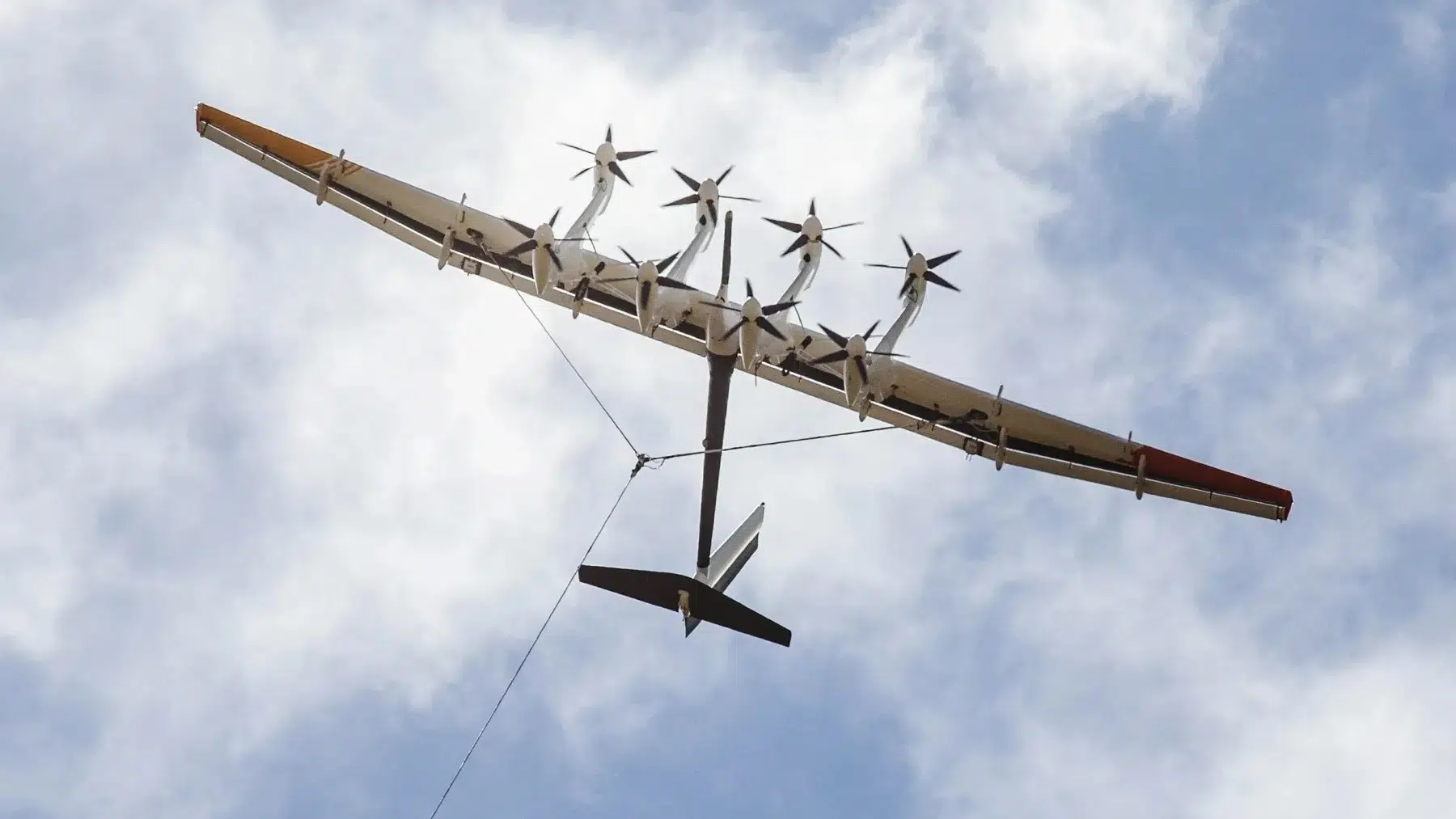
Is it a bird? Is it a plane? No, it is a winged energy kite! Well, at least it used to be. It is the first of its kind and 50% more powerful than a wind turbine. Some would call it ingenious, others would call it overly complicated. Of all the concepts to generate renewable electricity tested and tried, this one was among the more interesting.
The birth of the unconventional wind technology
It is the year 2006. A group of kitesurfers take to the water, seizing the day, until a bold idea strikes. “What if kites could harness enough wind energy to power the world?” Remember, in 2006, only 5% of the world’s energy was produced by wind. So, it was very innovative to imagine replacing massive steel towers of conventional wind turbines with lightweight hardware and smart software.
Enter Makani Energy. The early prototypes resembled kitesurfing gear and were made of fabric. These prototypes soon showed a lack of efficiency and control for large-scale energy generation. Eventually, rigid small-scale kites with rotors were built and tested in different environments and wind conditions. Key challenges included changing between vertical hover flight and generating energy in crosswind flight. The kites flew in acrobatic arcs to maximize power outputs.
After many replications for years, the M600 was produced. The M600 was a utility-scale, carbon-fiber kite with the wingspan of a small jet, which produced enough energy to power about 300 homes.
Why won’t we ever see the wind kite more powerful than a wind turbine?
Up until 2020, Makani Energy was funded by Alphabet, the parent company of Google. In February 2020, Alphabet announced that the technology’s funding by green dollars was completed. Not long after the announcement, a notice for auction was put up at the entrance to the hangar it was leasing at the corner of West Tower Avenue and Monarch Street at Alameda Point.
“Makani’s exit from Alphabet may have been hastened by the mixed results in test flights off the coast of Norway in September last year.” – Jason Deign, Green Tech Media
Green Tech Media reported that the 600-kilowatt Makani generator failed to return to its offshore launch platform and crashed into the sea. Deign stated that experts in the field started questioning the Makani founders’ faith in the concept, calling Makani’s method of producing an airborne wind engine “among the most complicated.”
The higher the tree, the stronger the wind
First, let us understand how the latest energy kite would work. It is made from lightweight carbon fiber, docked at a tower, and when the wind speeds up, the energy kite launches into the air with electrically powered motors. When the thin cables reached full restraint, the energy kite started rotating in the wind. The wind then turned the rotors, changing the motors into generators. The power produced by the generators is then sent back to the grid. The energy kite would land at the docking platform after the wind settled.
You can understand why experts would call it overcomplicated. Unfortunately, there were more complications as well.
- Sites to catch trade winds are limited. Deployment of agricultural land is not an option due to safety concerns.
- The potential impact of the kites on birds was not fully addressed. The cable is thin and flies through a cone at 130-140 kph near the wing, making it difficult for birds to perceive.
Makani partnered with Shell with hopes of commercializing the offshore deployment of its energy kite.
Almost like their wind kite, Makani’s last hopes hung on by a thread. As their journey officially ended in 2020, so did our chance to see the kite reportedly more powerful than a wind turbine.
Read the whole thing?
Get the week's signal, not the noise
Our sharpest reporting on energy, climate and nature — free, once a week.