
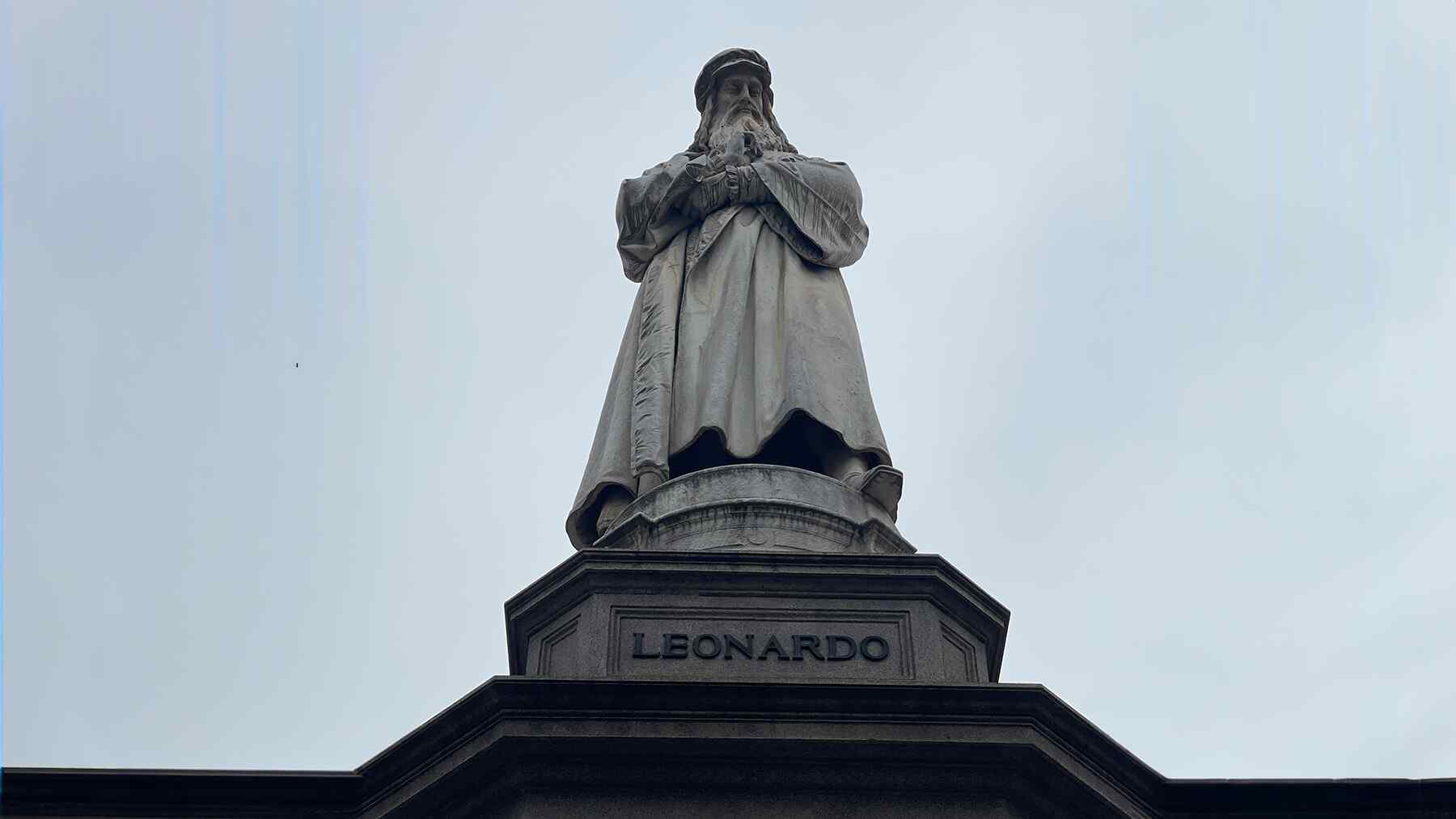
More than 500 years after his death, Leonardo da Vinci may be on the verge of sharing biological secrets he never knew could be taken.
A 30-year genealogical effort has mapped his family across 21 generations and identified living male descendants whose Y chromosomes carry a genetic thread traceable to the Renaissance. Now, archaeological excavations at a Da Vinci family tomb in Leonardo’s hometown of Vinci could supply the missing evidence — ancient remains that might make it possible, for the first time, to reconstruct the genome of history’s most studied genius.
A family tree spanning 21 generations
The foundation of this effort is a genealogical undertaking of remarkable scope. Alessandro Vezzosi and Agnese Sabato of the Leonardo Da Vinci Heritage Association spent three decades combing through archival records and historical documents, reconstructing a Da Vinci family tree stretching from 1331 to the present day. The result covers more than 400 individuals across 21 generations.
Their newly published book, Genìa Da Vinci: Genealogy and Genetics for Leonardo’s DNA, compiles these findings across 21 chapters, weaving together genealogy, geography, and history. It functions less as a family album than as a scientific foundation — the infrastructure needed to pursue something far more ambitious.
Among the most significant outcomes: the identification of 15 living male descendants linked directly through the paternal line to Leonardo’s father and his half-brother, Domenico Benedetto. Several of these branches had been entirely unknown to researchers before now.
Y-chromosome matches confirm a continuous lineage
With living descendants identified, genetic analysis became possible. David Caramelli and forensic anthropologist Elena Pilli at the University of Florence analyzed DNA samples from six of the male-line descendants. The results were telling.
Segments of the Y chromosome matched consistently across all six participants. Because the Y chromosome passes from father to son with minimal alteration over generations, those shared markers confirm a continuous paternal lineage reaching back at least 15 generations — well into the Renaissance. The living descendants don’t just share a surname. They carry biological evidence of a family line connecting, in an unbroken chain, to Leonardo’s own father.
An ancient tomb and the search for Leonardo’s DNA
Confirming that chain with ancient remains is now the project’s most pressing task. Excavations are underway at the Church of Santa Croce in Vinci, where a Da Vinci family tomb is believed to hold the remains of Leonardo’s grandfather Antonio, his uncle Francesco, and several half-brothers.
Anthropologists Alessandro Riga and Luca Bachechi have already recovered bone fragments from the site. One specimen, radiocarbon-dated to the appropriate period, has undergone paleogenomic testing and was identified as male. “Further detailed analyses are necessary to determine whether the DNA extracted is sufficiently preserved,” Caramelli noted. If the Y-chromosome profile from these remains matches that of living descendants, it would validate the lineage — and open the door to analyzing biological traces left by Leonardo himself.
What Leonardo’s DNA could reveal
The scientific ambitions here go well beyond confirming a family tree. Researchers hope Leonardo’s genetic profile could shed light on his remarkable visual acuity, his left-handedness, possible health predispositions, and the likely causes of his death.
The sources of that DNA may be closer than expected. Jesse Ausubel, project director at The Rockefeller University, has noted that even a fingerprint on a manuscript page could contain enough cellular material for sequencing. “21st-century biology is moving the boundary between the unknowable and the unknown,” he said. There’s also a practical application with significant implications for the art world: DNA recovered from contested works could help verify or challenge attributions, potentially reshaping how Leonardo’s legacy is evaluated.
Beyond genetics: rediscovering Leonardo’s world
The research has produced findings that extend well beyond the laboratory. Vezzosi and Sabato identified seven Da Vinci family homes in Vinci, along with two properties once owned by Leonardo himself — inherited from his uncle Francesco and later disputed by his half-brothers.
New archival work has also recast figures in Leonardo’s immediate family. His grandfather Antonio, long assumed to be a simple farmer, now appears to have been a traveling merchant operating between Catalan Spain and Morocco. His mother, Caterina, may have been an enslaved woman working for a wealthy Florentine banker — a hypothesis supported by wills and donation records dating to 1449.
Perhaps the most visually striking find is a large charcoal drawing — roughly 80 by 70 centimeters — discovered on a fireplace mantle in Vinci. Depicting a fantastical creature with a spiral horn, wings, hooked teeth, and a serpentine tail, the so-called “Unicorn Dragon” has drawn comparisons to Leonardo’s known drawings from the 1470s. Whether it’s an early Leonardo work remains unconfirmed, but scientific analysis and restoration are planned under cultural heritage supervision.
What comes next will depend heavily on the tomb. If the ancient bone fragments yield readable Y-chromosome data matching the living descendants, the project will have built a genetic bridge spanning more than five centuries — and analyzing biological traces on Leonardo’s manuscripts and artworks becomes a realistic, if still formidable, scientific goal. The small Tuscan town where Leonardo was born may yet deliver the final evidence needed to hear, as researchers have put it, his “genetic voice.”
Read the whole thing?
Get the week's signal, not the noise
Our sharpest reporting on energy, climate and nature — free, once a week.


