

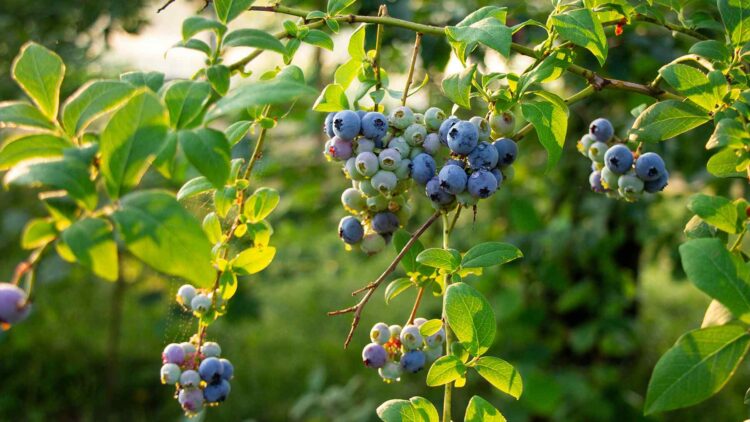
Last summer, the wild blueberry fields at Crystal Spring Farm near Brunswick, Maine, turned red too soon. The leaves were changing color prematurely — a sign, farmer Seth Kroeck knew, that the plants were under severe stress. Berries shriveled on the stem before anyone could rake them.
Standing in his fields this past April, Kroeck pointed at new growth still only inches high. His 2025 harvest had come in at roughly 7 percent of what he expected. “A lot of raking with not a lot to show for it,” he said.
It wasn’t the first time. And across Maine, it wasn’t just his farm.
Maine’s wild blueberry: a crop unlike any other
Wild blueberries aren’t what most Americans picture when they reach for a pint at the grocery store. They’re smaller, more intensely flavored, and genetically diverse — each patch a mosaic of subtly different plants rather than a uniform cultivated variety. “If you were to fly over our blueberry field while they’re fruiting, you’d see a lot of subtly different shades of blue and black,” Kroeck said.
Maine is the center of this industry. The state supplies nearly all of the commercially sold wild blueberries in the United States, harvesting close to 88 million pounds in 2023 and generating $361 million in revenue, according to the Wild Blueberry Commission of Maine.
The plants themselves are ancient — many patches have occupied the same sandy, low-nutrient soils for millennia, first tended by Indigenous communities and then by generations of farm families. They thrive where little else will grow. “Blueberry soil is not nutrient-rich. Nothing else wants to grow there,” said Rachel Schattman, a sustainable agriculture professor at the University of Maine. “But wild blueberries love it.”
That resilience, though, carries a built-in vulnerability: each bush fruits only every other year. One catastrophic season doesn’t just erase a single harvest — its effects carry forward into the next cycle as well.
A growing season thrown off schedule
Maine’s wild blueberry barrens are warming faster than the rest of the state, driven in part by rapid warming in the Gulf of Maine. Coastal growing areas are feeling it most acutely, according to 2021 research cited by Schattman.
The most visible consequence is a shift in harvest timing. Wild blueberries were traditionally ready for raking in early to mid-August. Now, most fruit ripens by late July — a change that’s caught farmers off guard and compressed the already-short labor window. Higher temperatures shorten that window further, meaning farms need more workers and equipment on hand to finish before berries deteriorate.
Kroeck said he was unprepared for early ripening in some years. Harvesting late meant lower yields and worse fruit quality. “As farmers, we’re very much attached to the season,” he said. “You kind of get into your ideas of when things need to be done.”
The seasonal rhythms that once guided farming decisions — knowledge passed down through families across generations — are no longer reliable. Lily Calderwood, a wild blueberry specialist at the University of Maine Cooperative Extension, said the farmers she works with have “absolutely no doubt” that climate change is already reshaping their livelihoods. Late-spring frosts now threaten flower buds just as they begin to form, and in some years warm autumn temperatures have triggered out-of-season flowering, draining plant energy before winter and reducing berry production the following year.
Drought, whiplash, and a $30 million loss
Maine’s recent weather history reads like a stress test for agriculture. Severe droughts struck in 2020, 2022, and 2025, while 2023 brought one of the wettest years on record. The rapid swings between extremes have left farms little time to recover.
The 2025 season was particularly damaging. A wet spring gave way to intensifying drought starting in June, which deepened through August and persisted into 2026. Calderwood called it “a classic example of climate whiplash.” The Wild Blueberry Commission of Maine estimates the industry lost $30 million that year. Many farms reported losing a third to half of their yields. “There were reports of many, many acres of blueberries going unharvested because the berries had basically dehydrated on the bush,” Schattman said.
At Crystal Spring Farm, the losses were steeper than most. Kroeck’s exceptionally sandy soil drains quickly and holds almost no moisture — a characteristic that suits blueberries in normal years but becomes a liability in drought. He recovered just 7 percent of his expected harvest.
The every-other-year fruiting cycle amplifies the damage. “A drought year is obviously going to affect the size of our fruit, but it’s also going to affect that other half that’s still in the vegetation state,” Kroeck said. Plants stressed during a drought year produce smaller, weaker growth — and a diminished harvest the season after.
What research says could help — and why it’s out of reach
At the Wyman’s Research Center in Old Town, Schattman leads a four-year study testing how irrigation, mulching, heat simulation, and genetic diversity affect wild blueberry resilience. The team is growing plants under a range of conditions — some irrigated, some mulched, some exposed to passively trapped heat or heating coils — to model what farms might face by the end of the century.
Early results point in one clear direction: irrigation shows the strongest promise for protecting crops during drought. Mulching helps by reducing soil temperatures, limiting weeds, and slowing moisture evaporation, but it can’t substitute for water during a severe drought like 2025. “It can be used as a buffer for drought,” Calderwood said, “but it cannot replace irrigation.”
The problem is cost. Wild blueberry soils — sandy, gravelly, low-nutrient — are poorly suited for drilling wells or laying irrigation pipe. Kroeck spent $90,000 on equipment and a new well that covers only about a quarter of his 72 acres. Most small growers don’t have irrigation at all. Federal support that might have bridged that gap has largely disappeared: USDA budget cuts have eliminated more than 2,000 NRCS staff positions nationwide, and Maine lost $15.5 million in federal grant funding intended to bring water management infrastructure to between 25 and 45 wild blueberry farms. “It needs federal funding,” Calderwood said plainly.
An industry under pressure from every direction
Climate stress is compounding an already difficult market. Wild blueberry farms are earning roughly 50 percent less per pound than they were just a few years ago, squeezed by low market prices and competition from cultivated blueberry producers, according to the Wild Blueberry Commission. Input costs — fertilizer, labor, equipment — have risen at the same time.
The industry has contracted. The number of farms and total commercial acreage have both declined in recent years, and even Wyman’s, one of the state’s largest producers, plans to sell nearly 800 acres of blueberry fields. Without sustained investment in climate adaptation, experts warn the industry could consolidate further — leaving only the largest producers with the capital to afford irrigation systems, mulching programs, and other protections. “Every farm needs irrigation, but they just simply can’t afford it,” Calderwood said. Some small growers, including Kroeck, are exploring fresh-market sales as an alternative to the frozen commodity market, a move that could improve margins but requires new equipment and additional labor investment.
What comes next for Maine’s barrens
The research underway at the University of Maine could eventually give farmers a clearer roadmap. Schattman’s team expects to complete its four-year study with data on which combinations of irrigation, mulching, and management timing offer the most protection under different climate scenarios. This summer, Calderwood will work alongside a large producer to study how irrigated and non-irrigated sections of the same farm respond during dry periods — helping to pinpoint when irrigation delivers the most benefit per dollar spent.
Whether that knowledge translates into action at the farm level will depend heavily on policy. State drought relief funds exist but reach only a small fraction of farms each year. Federal conservation programs have shrunk. The window for intervention is narrowing alongside the harvest window itself.
Calderwood remains cautiously optimistic about the plant. “Every year, there will be blueberries to harvest,” she said. Wild blueberries have survived in Maine’s barrens for millennia — but survival of the plant and survival of the farms that tend it are two different things. Whether small growers can afford the adaptations needed to stay in business, and whether state and federal policy will support them in doing so, will likely determine the shape of Maine’s wild blueberry industry for generations to come.