Scrolling through routine MAVEN data one day in December 2023, researcher Christopher Fowler noticed something he couldn’t explain: strange “wiggles” in the spacecraft’s magnetic field readings as it passed through the Martian atmosphere. The fluctuations didn’t match anything previously observed at Mars.
What started as an odd anomaly in a dataset slowly revealed itself as something far more significant — a signal buried deep in the Martian ionosphere, pointing to a phenomenon physicists had studied for nearly 50 years. No one had ever thought to look for it in a planetary atmosphere.
An accidental find hidden in the data
The December 2023 detection didn’t begin with a hypothesis — it began with confusion. Fowler, a research assistant professor at West Virginia University, was reviewing MAVEN magnetic field measurements when the anomalous fluctuations caught his eye. “I would never have guessed it would be this effect,” he later said, “since it’s never been seen in a planetary atmosphere before.”
Rather than dismiss the signal, Fowler’s team dug deeper. They cross-referenced readings from multiple MAVEN instruments — not just the magnetic field sensors, but also detectors tracking the charged particle environment inside the ionosphere. What emerged wasn’t a single odd data point. It was a pattern, and it kept getting stranger the more they looked.
The team systematically ruled out alternative explanations, each of which failed to account for all the features appearing across the different instrument readings. Eventually, one explanation fit everything — a phenomenon no one had previously thought to look for in a planetary atmosphere.
What is the Zwan-Wolf effect — and why does it matter?
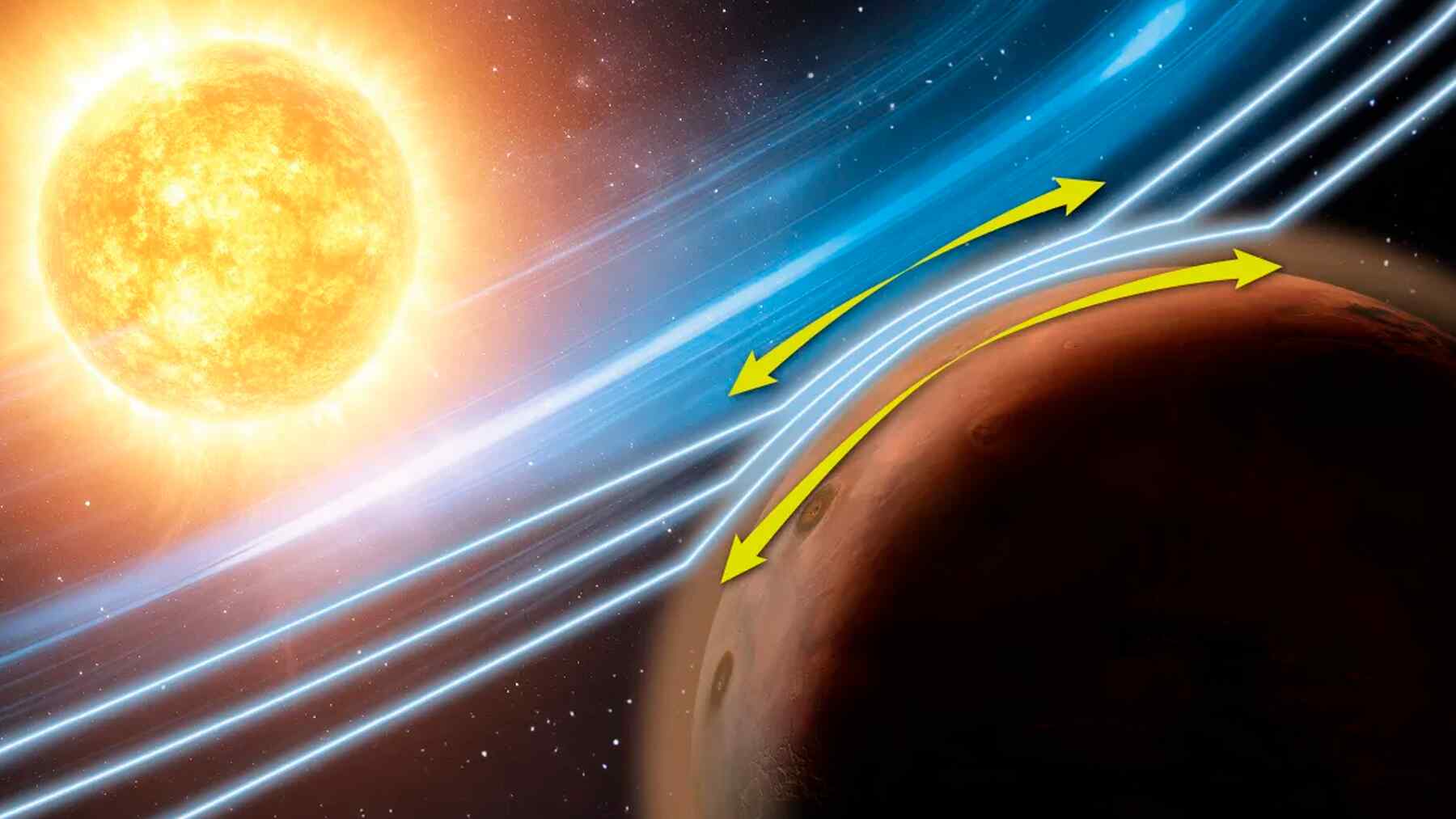
First described in 1976, the Zwan-Wolf effect involves charged particles being squeezed along magnetic structures called flux tubes. Researchers compare it to toothpaste being pushed out of a tube. The effect deflects solar wind and has been observed in Earth’s magnetosphere for decades.
The key word there is magnetosphere. Until MAVEN’s finding, the Zwan-Wolf effect had only ever been detected in the magnetospheres of planets — the protective magnetic bubbles generated by a planet’s internal magnetic field. Nobody had observed it operating inside a planetary atmosphere itself.
Mars makes this discovery particularly notable. Unlike Earth, Mars has no global magnetic field, and that fundamental difference shapes everything about how the planet interacts with solar wind and space weather. It also meant the Martian atmosphere wasn’t considered a likely place to find a phenomenon tied to magnetic structures. That assumption, it turns out, was wrong.
A solar storm that made the invisible visible
The Zwan-Wolf effect was detected deep in the Martian ionosphere — below 200 kilometers in altitude — during a large solar storm. The ionosphere contains significant numbers of electrically charged particles, and MAVEN’s instruments captured those particles being squeezed and redistributed around Mars during the event.
Mars does have what’s called an induced magnetosphere: a magnetic field generated not by the planet’s interior, but by the interaction between solar wind and the Martian ionosphere. Unlike Earth’s magnetosphere, this induced version can shift dramatically in size and shape during intense space weather events — and that variability appears central to what MAVEN detected.
According to the research team, the Zwan-Wolf effect may actually be occurring in the Martian ionosphere continuously, but at intensities too low for MAVEN’s instruments to register under normal conditions. The solar storm appears to have amplified it to detectable levels, making something that had always been there suddenly measurable. The findings were published in Nature Communications and represent the first comprehensive observational record of the Zwan-Wolf effect in any planetary atmosphere.
What this means for Mars — and beyond
The discovery raises immediate questions about how space weather dynamically reshapes the Martian atmosphere over time. MAVEN’s primary mission has always centered on understanding atmospheric loss — how Mars shed the thick atmosphere it likely once had, and with it the conditions that may have supported liquid water and, potentially, habitability. A previously unknown mechanism influencing how solar wind interacts with the ionosphere is directly relevant to that picture.
“It introduces interesting physics that we haven’t yet explored and a new way the Sun and space weather can change the dynamics in the Martian atmosphere,” Fowler said.
The implications may reach well beyond Mars. Similar unmagnetized bodies — Venus and Saturn’s moon Titan are two candidates — could experience the same effect, each representing a new target for researchers now that scientists know what to look for.
MAVEN principal investigator Shannon Curry underscored the broader stakes. “Knowing how space weather interacts with Mars is essential,” she said, noting the importance of understanding large space weather events for any assets operating on or near the planet — a concern that’ll only grow as human exploration missions move closer to reality.
Whether MAVEN itself will continue contributing to that picture remains uncertain. The spacecraft lost contact with ground stations in December 2025, and as of early 2026, NASA had convened an anomaly review board to assess its status. But the data it’s already collected — including Fowler’s unexpected wiggles — will keep yielding answers for years to come.
Read the whole thing?
Get the week's signal, not the noise
Our sharpest reporting on energy, climate and nature — free, once a week.