
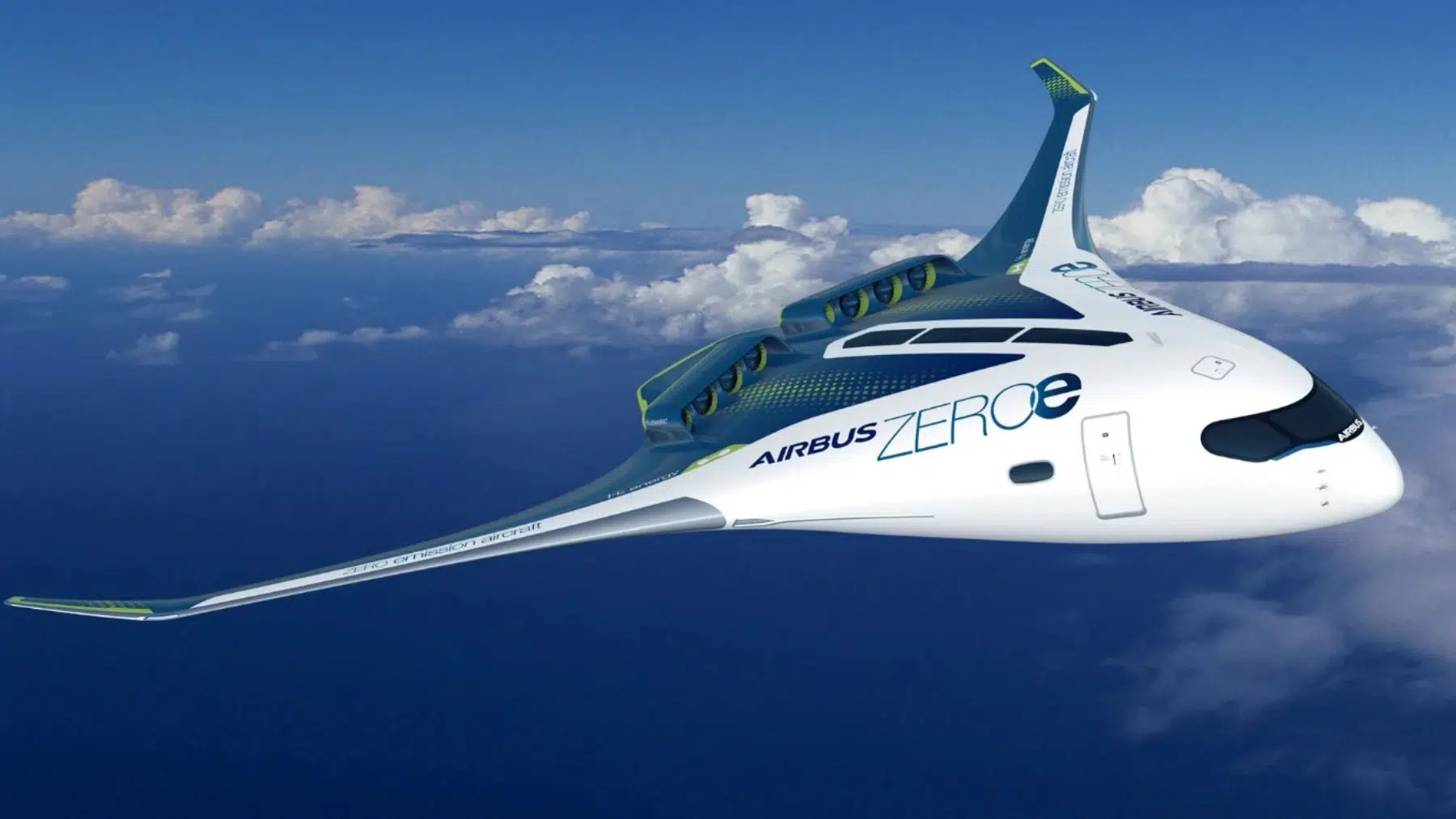
The aircraft industry is one of the sectors that have long contributed to carbon emissions; however, that might change soon as they are working on joining with other sectors to promote a cleaner and greener environment. Airbus, a leading European aerospace corporation, has introduced ZeroE, an aircraft developed to function on hydrogen. It was during the Airbus 2025 Summit that the company formally unveiled the ZeroE aircraft that strictly operates on hydrogen. When we talk about hydrogen, we are talking about a hydrogen-powered aircraft because hydrogen emits only water vapour when burnt.
AeroContact states that Airbus’ ZeroE could enter the market in 2030. Prior to this announcement, Airbus spoke about committing to a fully electric engine aircraft; however, that seems to have changed as they probably saw that the process of extracting lithium for batteries and electric engines will take time and harm the environment to a certain extent, while hydrogen combustion emits only clean water vapour.
The clean revolution in aviation: ZeroE’s hydrogen-powered propulsion system
An aircraft that utilises a hydrogen-powered engine might sound unrealistic, and because the term “hydrogen” is mostly common in the automotive industry, therefore, in aviation it could seem like something unfeasible. However, Airbus has done its research and is sure about this groundbreaking invention. ZeroE’s system is made to burn pure and clean hydrogen that only emits water vapour.
Bruno Fichefeux, Head of Future Programmes at Airbus, said in a statement, in a research report by AeroContact, that Airbus’ objective to get rid of carbon emissions is to fully focus on hydrogen. Though there are changes in their development plan, the aircraft will be flown into the skies using hydrogen, a hydrogen-powered engine. Just as electric engines have an impact on cars, so will hydrogen on their aircraft.
The ZeroE hydrogen-powered aircraft: More information about it
According to Airbus, ZeroE was first announced in 2020, and they have seen the importance of utilising two primary hydrogen propulsion technologies: hydrogen combustion and hydrogen fuel cells. After exploring, partnering, and researching, at the 2025 Airbus Summit the company confirmed that the future of their aircraft is hydrogen. Airbus stated that hydrogen is not a new concept; however, it is the best alternative to ensure decarbonisation.
The future of aviation is hydrogen. The difficulties and innovations
Airbus’ groundbreaking and revolutionary development also comes with hurdles. Hydrogen for years now still has infrastructure issues, and not only has it affected the automotive and energy sectors, but the aviation sector will be affected too. Although it emits water vapour, which is the perfect emission for a green environment, storing it will be more complicated and will probably cause this development to be costly.
Additionally, production is quite expensive, which might either make Airbus’ service expensive for end-users, or they could pull out or pause for a while. Experts state that solar or wind-powered electrolysis are natural resources; therefore, production from them will be carbon-free. If, however, production comes from natural gas, it will not be green but grey hydrogen, which is not clean at all.
Sabine Ortega, a journalist at AeroContact, explained that the liquid hydrogen (LH2) test mock-up was created in Grenoble, France, by Airbus and Air Liquide Advanced Technologies to solve the difficulties associated with handling and dispersing liquid hydrogen while in flight. The Electric Aircraft System Test Centre in Munich is scheduled to conduct integrated ground tests in 2027.
When will ZeroE take off into the skies?
Airbus is set to have its aircraft fully operational by 2030. Currently, the company is running tests and they have been using liquid hydrogen combustion to test on the ground and in the air. Developers and aircraft engineers have expressed that so far the results are good and positive; the aircraft works exactly like that which operates on fossil fuels, except this time around it runs on hydrogen and does not pollute the atmosphere. The aviation industry could be redefined once Airbus succeeds in making this a fully operational system. In the next few years, the hydrogen-powered ZeroE aircraft could make history.
Read the whole thing?
Get the week's signal, not the noise
Our sharpest reporting on energy, climate and nature — free, once a week.


