
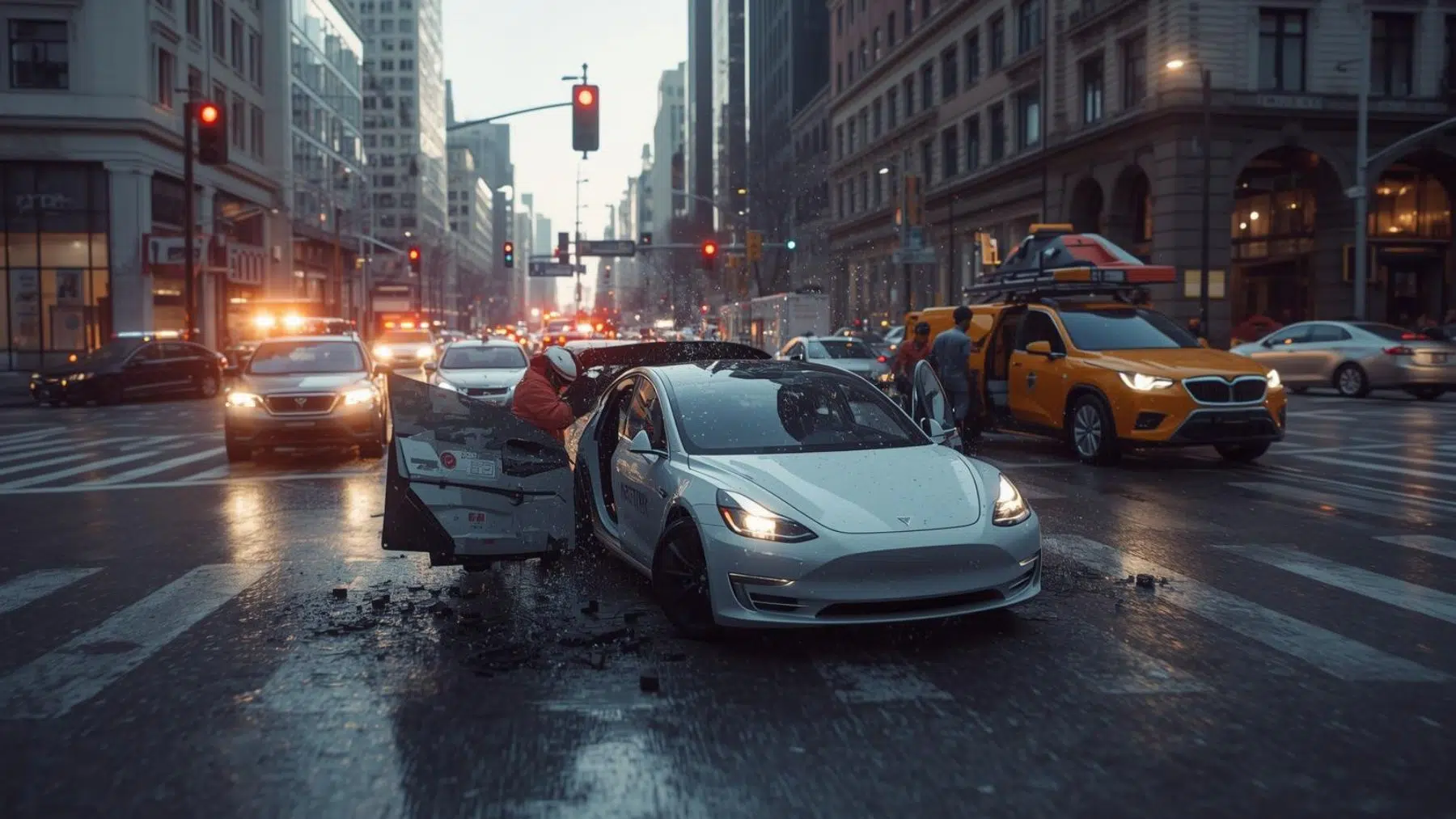
Tesla’s February NHTSA filing carries what looks like good news: one new robotaxi crash, down from five the month before. A Model Y clipped a fixed object at 9 mph in Austin, no injuries, autonomous system engaged. On paper, it reads like progress.
But that single number can’t tell you much without one crucial piece of context — how many miles the fleet actually drove. Fewer crashes could mean a safer system. Or it could simply mean fewer cars on the road during a month that included an Austin ice storm. Without mileage data, there’s no way to tell the difference.
One crash versus five: why the raw count is misleading
Tesla’s February NHTSA submission covers the second half of January and the first half of February — a window that included an ice storm that shut the Austin fleet down for several days. Fewer operational days mean fewer miles driven, which means fewer opportunities for a crash to occur. A drop from five incidents to one looks like a trend. It may simply be a calendar effect.
The five incidents in the previous submission spanned collisions with a bus, a heavy truck, a pole, and two fixed objects. February’s single report involves a Model Y striking a fixed object at 9 mph. Both periods show low-speed impacts with the autonomous system engaged — the character of the crashes hasn’t obviously changed. Just the count.
Without monthly mileage figures, there is no denominator. A rate requires two numbers, and Tesla is only providing one.
The numbers we do have — and what they reveal
Tesla disclosed approximately 500,000 cumulative miles through November 2025 in a one-time filing. Extrapolating from that figure, the fleet had logged roughly 800,000 miles by mid-January 2026. Across 15 total incidents, that works out to approximately one crash every 57,000 miles.
The average American driver, according to NHTSA data, experiences one crash per 500,000 miles — putting Tesla’s current rate roughly nine times worse. Even narrowing the comparison to minor fender-benders, which most of these incidents appear to be, the fleet’s rate still runs around four times the human average.
That comparison carries an important caveat: every Tesla robotaxi has a trained safety supervisor inside, presumably catching situations that never reach the incident log. The reported crash rate may actually understate how often the autonomous system encounters problems it can’t resolve on its own.
35 cars, one city, and a single unsupervised vehicle
Nine months after launch, Tesla is running approximately 35 robotaxis in Austin. Independent trackers who reverse-engineered the ride-hailing app report availability below 20 percent, and every vehicle carries an in-car safety supervisor with a kill switch.
Tesla did announce in January that unsupervised rides had begun. In practice, that means one vehicle, operating in a restricted section of Austin’s service area, at a time. One car, one zone, one city.
Waymo operates over 2,500 fully driverless vehicles across multiple US cities with no safety monitor in any of them. The company has logged more than 127 million autonomous miles, and peer-reviewed research puts Waymo’s crash rate for injury-causing incidents at 85 percent lower than human drivers. The gap between the two programs isn’t a matter of months — it’s a matter of scale, data, and demonstrated unsupervised performance.
Redacted narratives and the transparency gap
Every crash report Tesla files with NHTSA has its narrative section marked as confidential business information. No other major autonomous vehicle operator does this. Waymo, Zoox, and Aurora all provide full incident descriptions — what the system did, what it failed to do, and what the circumstances were.
Narratives are where the meaningful information lives. Knowing a Model Y hit a fixed object at 9 mph explains almost nothing. Whether the vehicle misidentified a bollard, failed to respond to a sensor return, or hit a software edge case — that would give regulators and researchers something to actually work with. Right now, none of that is available.
Tesla also doesn’t disclose how often safety supervisors intervene. Intervention rates are a standard proxy for how frequently an autonomous system reaches the edge of its competence, and without them there’s no way to assess whether the system is approaching unsupervised readiness or still leaning heavily on human correction.
What it would take to judge the program fairly
The information needed to evaluate Tesla’s robotaxi program isn’t exotic. Monthly mileage figures, intervention counts, and unredacted crash narratives would provide a foundation for genuine safety assessment — and other operators already provide most of this.
Without those disclosures, the public and regulators are left working with crash counts stripped of context. That context-free picture currently shows a small supervised fleet in a single city, a crash rate several times worse than the human average, and one unsupervised vehicle confined to a corner of Austin.
That may not be the full story. Tesla may have internal data showing meaningful system improvement over the past nine months. If so, releasing mileage and intervention figures would make that case far more effectively than any press announcement.
The next few months will be worth watching. If Tesla moves toward broader unsupervised deployment, regulators will face increasing pressure to require the disclosures that currently don’t exist. And if the crash rate — properly calculated against actual miles driven — continues to sit well above human baselines, the question of whether supervised expansion counts as progress will become harder to avoid.
Read the whole thing?
Get the week's signal, not the noise
Our sharpest reporting on energy, climate and nature — free, once a week.


