

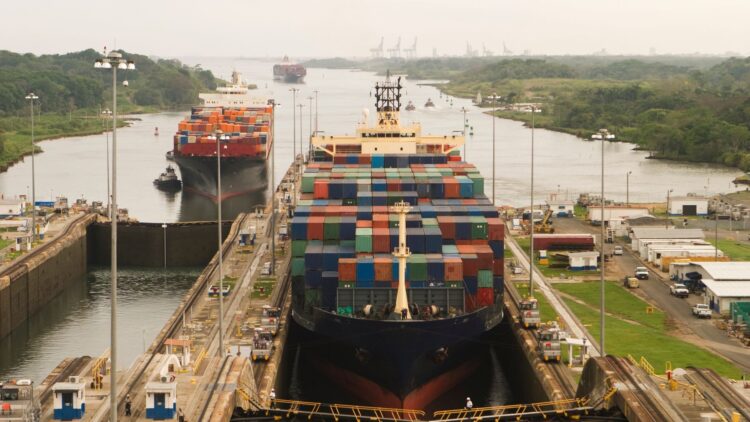
For more than a hundred years, one narrow waterway has quietly held the world’s trade together.
Ships from every ocean line up to squeeze through it, lifted over a mountain and lowered again, carrying everything from cars to cereal. It is one of the busiest shortcuts on Earth, and almost no one thinks about it until something goes wrong.
Lately, something has. And while the world watched that famous canal struggle, a very different kind of crossing was quietly taking shape a few hundred miles away.
The shortcut the whole world leans on
The Panama Canal does something close to magic. It lifts enormous ships up and over the land using a staircase of locks, then sets them back down on the far ocean.
But that magic runs entirely on fresh water. Every single ship that crosses spills tens of millions of gallons of lake water out to sea, water that comes from rain.
So when drought struck and the canal’s great lake dropped low, the canal had to do the unthinkable and slow itself down, cutting the number of ships allowed through each day. Vessels queued for weeks or took the long way around the bottom of a continent. The whole planet’s supply chain felt the squeeze. A canal that had always seemed permanent suddenly looked fragile, a hostage to the weather.
A canal with no water at all
Now look a little to the north, across Mexico’s narrowest waist.
There, between the Pacific port of Salina Cruz and the Gulf port of Coatzacoalcos, runs a 303 kilometer rail corridor that planners proudly call a dry canal. Instead of floating ships across, it lifts their containers off, stacks them onto heavy freight trains, races them coast to coast, and loads them back onto a waiting ship on the other ocean. What takes a vessel a slow, careful day of climbing through locks, the train does in an afternoon of rolling across solid ground.
No locks. No lake. No drop of water required. The whole crossing is designed to take under six hours, and the route could eventually move well over a million containers a year, much like other vast pieces of infrastructure quietly reshaping the land.
An old dream, finished at last
The strangest part is that this is not a new idea at all.
A railway across this exact strip of land was first finished in 1907, only to be abandoned years later when the Panama Canal opened and stole all the traffic. For a century the tracks sat half forgotten.
Then Mexico poured billions of dollars into rebuilding the whole thing, and in a quiet sign of what it could become, a recent test run carried 900 new cars shipped from South Korea, across the Pacific, over the land bridge by rail, and back onto a ship bound for the coast of Georgia in the United States. It was only a small shipment, but it proved the whole chain could actually work end to end.
Why a slower route could still win
On paper, the dry canal should not be able to compete.
Hauling cargo off a ship, onto a train and back onto another ship is slower and clumsier than simply floating straight through. It cannot hope to match the sheer volume the Panama Canal moves on a normal day.
But its whole appeal is to be the plan B. When the famous canal is choked by drought, and ships are stacking up for weeks, suddenly a route that always works, rain or no rain, starts to look very attractive indeed. In a warming world, the crossing that needs no water may be the one with the future. Slow and steady, in other words, may finally beat fast and thirsty.
The cost the map does not show
There is a harder side to this story, and it deserves to be told plainly.
The land the corridor cuts through is one of Mexico’s most biodiverse regions, and the plan is not only rails. It includes a string of industrial parks, pipelines and refineries that could turn a green isthmus into a long industrial belt if the safeguards fail. Local and Indigenous communities have raised alarms about land being taken and promises about consultation going unkept.
And progress has already come at a human cost, after a passenger train on the new line derailed in late 2025, killing more than a dozen people.
The dry canal is a genuinely clever answer to a warming, thirsty world. But like the famous waterway it hopes to rival, it is quietly asking the land, and the people on it, to pay for the shortcut.