A 289-million-year-old reptile found in Oklahoma is revealing the secrets behind breathing.
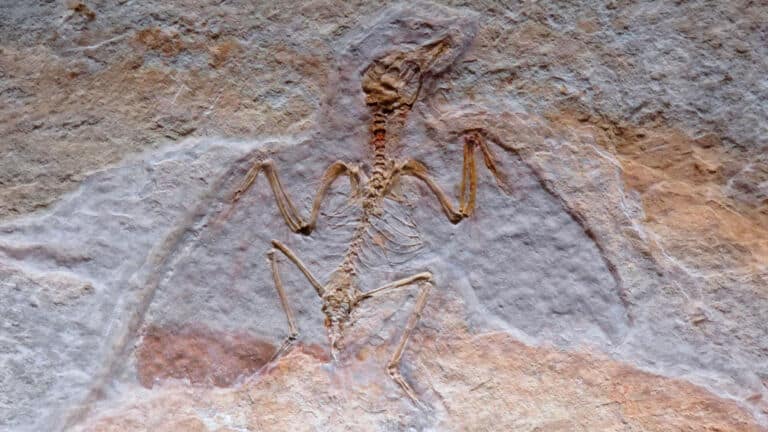
The fossil preserved soft tissue, including a ribcage similar to our own.
Its remains are not just bones, they are evidence of how early lungs functioned.
Including skin, cartilage, and even a few preserved traces of proteins.
This sort of preservation is almost unheard of for researchers in the know.
And it may be about to force a rethink about something we take for granted.
How can every breath we take trace back to this mystery?
How one ancient creature has preserved the very mechanics of breathing
This finding came from a cave system, unlike most other fossil sites.
Conditions prevented decay that is common in the sector. This cave preserved soft tissue rarely seen by science.
In this Oklahoma cave, several factors slowed the decomposition.
Factors like oil seeps, mineral-rich water, and low oxygen levels.
Instead of being flattened into the rock, this body remained three-dimensional.
Meaning soft tissue survived alongside the skeleton and bones.
The ribcage and surrounding tissue remained intact enough to study. And that’s where the real clue appeared.
Researchers aimed to understand this oddly familiar system that enables breathing.
It is still being used by modern reptiles, birds, and some mammals. Can it explain human breathing?
How the researchers were able to decode this centuries-long mystery
The team of researchers used modern imaging tools to understand the creature.
Experts reconstructed the creature’s motion of its ribcage expanding and contracting. That would prove to be vital.
Cave systems can provide evidence that rewrites what we know about life.
Some have estimated that around 90% of the world’s caves are yet to be explored.
In this Oklahoma cave, they saw something remarkably familiar.
Scans showed the ribs moved outward and inward.
A pattern leading to a human connection. That similarity was not expected.
In other words, the animal wasn’t just breathing.
It was breathing as most do nowadays.
That one realization shifted the entire direction of the study.
Into one far closer to home for humans.
Humans and animals often share many biological traits.
A shared biology between different species.
The realization of this truth led researchers in a different direction than intended.
And it could answer a century-long mystery.
How did early land animals breathe?
And what could it tell us about ourselves?
Thankfully, the iconic Harvard University has finally solved this mystery.
And the answers may not be what you were expecting.
How a mummified reptile could rewrite a centuries-old mystery….finally
Researchers regularly find unexpected fossils and remains in caves.
These time capsules answer questions that have puzzled science for a long time.
For centuries, a debate has split the scientific community.
Scientists debated whether rib-based breathing evolved early or later on.
Or did the key to breathing just appear at random?
This mummified reptile has given the clearest answer to date.
And it does so with evidence, not speculation or theories.
The mummified reptile in question is the Captorhinus aguti.
A small, lizard-like creature that lived approximately 289 million years ago.
Its perfectly preserved body revealed a breathing system known as costal aspiration.
The same rib-driven system humans still use to this very day. That link solved a long-standing mystery.
What is the human-reptile connection revealed by this “mummified reptile”
The process is the same basic mechanism we humans use today.
Among a multitude of other modern animals.
What makes this discovery so important is its age.
It pushes the breathing system we use back around 100 million years or so.
Which answers one of the most profound evolutionary questions ever.
How did vertebrates transition from water to land? How were they able to eventually breathe on land?
This rib-driven system became the blueprint for life as we know it.
Proving in just one discovery something revolutionary. The foundation of human breathing is far older than expected.
Humans and animals share a lot more in common than we ever knew.
Read the whole thing?
Get the week's signal, not the noise
Our sharpest reporting on energy, climate and nature — free, once a week.