

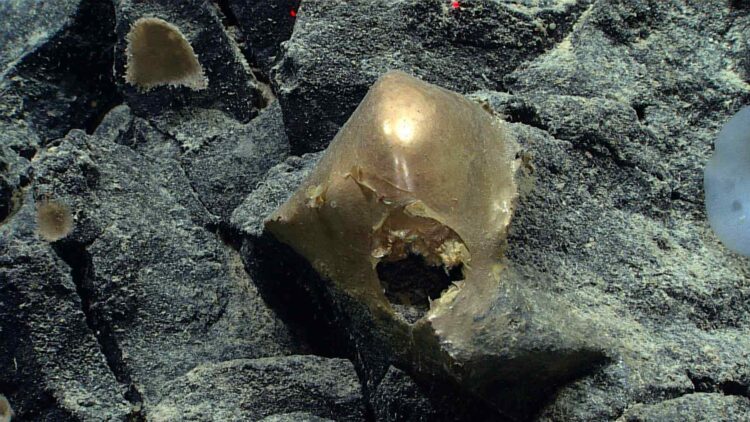
Two miles beneath the Alaskan surf, a metallic glint pierced the inky abyss.
It looked artificial—a smooth, golden sphere adhered to jagged rock like a misplaced treasure.
When a robotic arm reached out, the surface felt fleshy, not cold like steel. This wasn’t debris; it was biological.
The discovery sparked a global frenzy of alien theories and deep-sea dread.
If it wasn’t man-made, what exactly was that “golden sphere”?
How a discovery led to what can only be described as deep-sea déjà vu
The Seascape Alaska 5 expedition targeted the crushing depths of the North Pacific.
NOAA’s Deep Discoverer ROV navigated through the silent, midnight zone.
Suddenly, high-definition cameras locked onto a bizarre, mound-shaped specimen.
It sat solitary on a rocky outcropping, over two miles down.
The object shimmered with an eerie, polished luster.
Its surface appeared fibrous, yet structured in delicate layers. A jagged hole near the base suggested a violent exit or a mysterious entry.
The scientific team stared at their monitors in stunned silence.
Could this be a strange new species of egg casing? Was it a biological vessel for something that had already escaped?
It defied every known category of deep-sea sponge or coral.
The suction sampler carefully lifted the specimen from its ancient perch.
On deck, the “golden orb” felt soft and skin-like.
The mystery was no longer a blip on a screen; it was a physical enigma. Had they just stumbled upon a relic of a silent, predatory giant?
A golden sphere that was hiding its origin in plain sight
Expeditions can often unearth secrets hiding in plain sight underwater.
On this mission, the researchers began analyzing the odd golden sphere.
Its texture pointed to biological material, not metal.
Its shape was unexpectedly precise. That one detail would prove to be profoundly important.
It was far too symmetrical for natural formations.
They ran initial tests. No answers emerged.
The next step was to conduct DNA tests. That’s where this story started to get even more interesting.
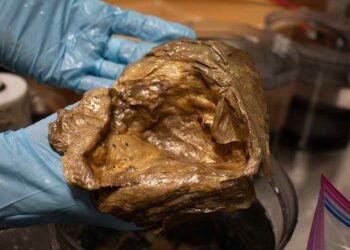
Genetic testing revealed a marine organism of some kind.
One that is not easily identified.
The tests revealed something large. Much larger than the sphere itself. Was it part of a bigger lifeform?
Or maybe something it produced?
The small opening on its base became critical to the study.
It suggested an entry and exit point. Interaction of some kind.
Was it a strange creature hidden for eons in the darkness of the sea?
The evidence pointed to scale. Something big enough to leave this sphere behind.
Large yet elusive enough to keep the mystery hidden. So what was this?
Details have been provided by the NOAA. This led the expedition in Alaska.
The deep truth revealed: The golden sphere held something larger
The golden orb finally reached the labs at the Smithsonian National Museum of Natural History.
Initial DNA barcoding tests failed, yielding only a messy soup of microbial filler.
Scientists pivoted to whole-genome sequencing to crack the genetic code. The results shattered the “egg casing” and “alien” theories entirely.
The specimen was a mass of dead cells and fibrous tissue packed with spirocysts.
These unique, coiled stinging cells are the signature of the Hexacorallia group.
The “orb” was officially identified as the biological anchor of Relicanthus daphneae.
This giant, predatory sea anemone brandishes tentacles stretching over seven feet long.
Usually, the animal sits directly atop this sticky, golden pedestal. The orb was simply the “glue” left behind when the giant moved or perished.
Hidden beneath the anemone’s pinkish body, this anatomy is almost never seen by human eyes.
What exactly was that “golden sphere”?
It was a discarded footprint of a massive, deep-sea titan.
A long-lived inhabitant of hydrothermal vents, surviving where the sun never reaches.
This discovery proves that thousands of unidentified specimens in museum vaults are waiting for their own DNA breakthroughs.
Our blue planet still guards its most mesmerizing secrets behind two miles of water.
What else is lurking in the dark, waiting to be found?