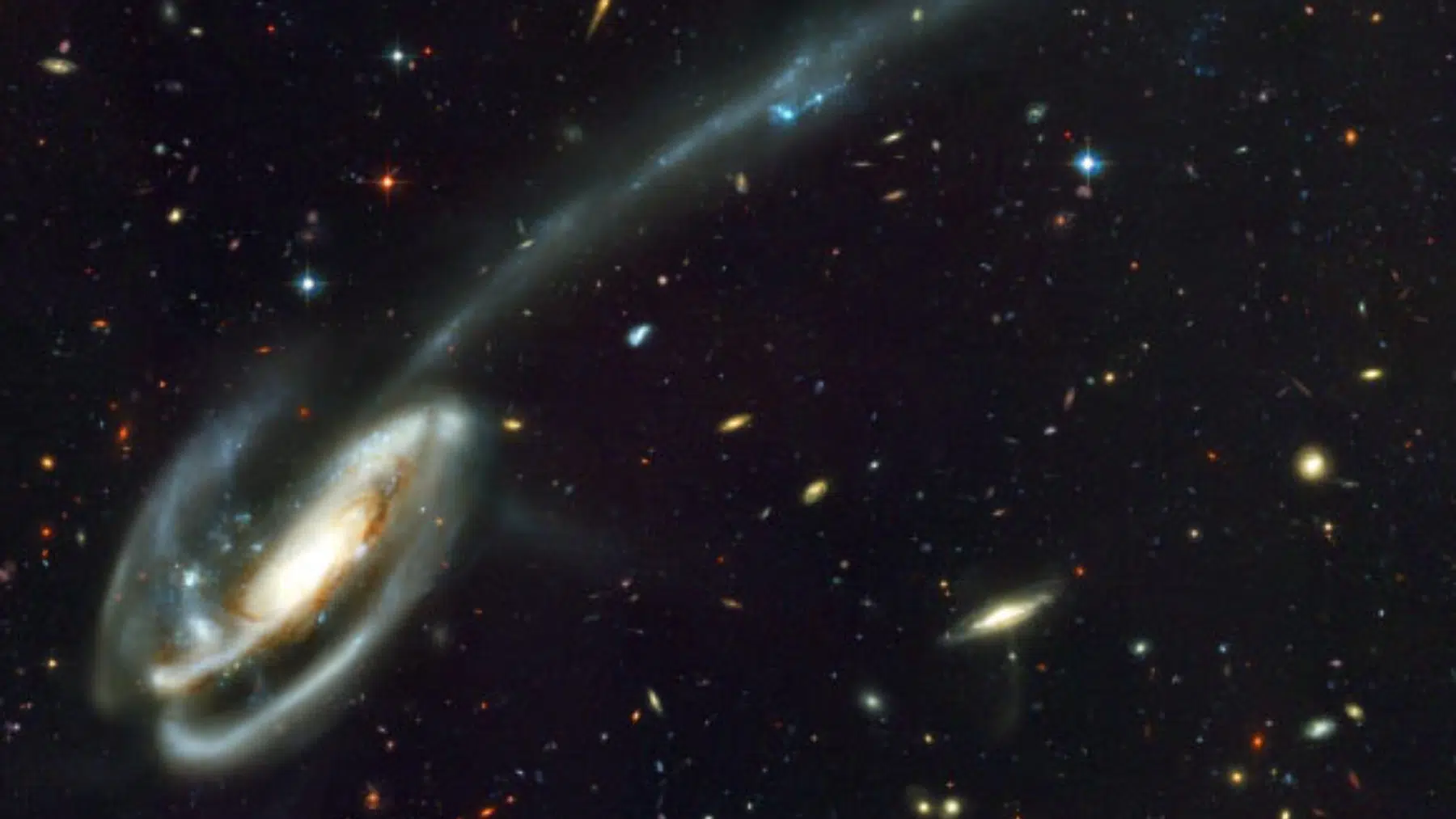
Astronomers and scientists partnering with NASA have discovered a strange trend within the deep parts of space. More than 30 galaxies are spinning in unison, and the one thing that is even more intriguing is that they are all pointing directly at Earth. As much as it sounds absurd and not scientifically meaningful, it is real and true. An article by Futurism states that the Andromeda galaxy (M31), our closest galactic neighbour, is encircled by several small satellite galaxies, just like the Earth holds the Moon in place with gravity.
Galaxies orbiting an unknown object at the centre are spinning in unison
NASA detected more than 30. If you know ballroom dancers, how they are always together, that is what is transpiring with these galaxies, and that is not how they behave in such a unison setup. They are always scattered across space and the universe, but this time around, it is the opposite. Researchers have expressed that the galaxies appear to be spinning or circling a common centre, but oddly, nothing observable or quantifiable seems to be located there.
According to our present knowledge of cosmology, tiny galaxies gradually merge to produce larger galaxies. This is being orchestrated from the shadows by “haloes”—basically clusters—of dark matter, the invisible material that is believed to make up 85% of the universe’s mass and whose gravitational attraction holds galaxies together.
What concerns scientists is that the Earth-pointing pattern is not random
Whatever seems “unnatural” in the universe or new to the scientific eye is never random; there is always a root cause or something stimulating that reaction or activity, and that is exactly what is transpiring with galaxies orbiting in a group and pointing to Earth. For science enthusiasts, this is not a coincidence. Natural explanations, like the effect of gravitational lensing or data processing faults, are being investigated.
The part where we are pointed at here on Earth could be because of how we are viewing and where we are positioned. Although scientific tools and instruments have developed over time and provided some accurate information over the past years, it does not take away from the fact that the universe is vast and complex, and can confuse us at times. Science research also claims that perhaps we are looking at a new cosmic structure.
Lead author Kosuke Jamie Kanehisa at the Leibniz Institute for Astrophysics Potsdam in Germany told Space.com and said,
“The fact that we see M31’s satellites in this unstable configuration today — which is strange, to say the least — may point towards many having fallen in recently, possibly related to the major merger thought to have been experienced by Andromeda around two to three billion years ago.”
Is it the first sign of something greater or just a galactic anomaly?
It looks like the information provided by NASA indicates that we are not in danger and there is no need to panic. The universe and the galaxy are mysterious and there will always be something that researchers discover. In this case, it is a matter of experts delving deeper into what the galactic world is doing and comprehending it fully, to either detect if something is forming or if it is just another universal activity that will pass over time.
Beyond simple curiosity, the observation that several galaxies seem to be facing Earth and spinning in unison raises important issues regarding dark matter, gravity, and perhaps our place in the cosmos. Is it a huge, unseen thing? A dark matter trait? Or something nobody has thought of yet? Although it’s too early to make any firm judgments, one thing is certain: we require additional data and observations on satellites of much more distant galaxies in addition to Andromeda’s.
Read the whole thing?
Get the week's signal, not the noise
Our sharpest reporting on energy, climate and nature — free, once a week.