Fossils on Earth represent a piece of the history of the world. During massive extinctions, like the dinosaurs, which did not happen all at once with a big explosion from an asteroid, it’s normal for the bones and other rigid structures to remain intact for millions of years. Scientists can trace the estimated age of organic remains using carbon dating. Recently, NASA was able to find a galactic fossil and trace it back millions of years, and they did not use carbon to measure the lifespan.
NASA found a ‘fossil’ in another galaxy
Carbon is abundant in the universe, and it can be found in stars in nuclear fusion or in other forms such as atoms, molecules, and solid structures. Finding the element in outer space can mean the presence of other complex molecules, and it plays a big part in the evolution process. In 2024, carbon was detected in a galaxy observed 350 million years after the Big Bang, which may hint that life emerged earlier than previously thought.
On the other hand, there are no records of animals or other organic life forms that leave behind carbon-14. However, carbon is still very abundant in the universe, but other elements are even more common, such as hydrogen and helium, both present in the process of creation and nuclear fusion of a star, like the Sun. But scientists were still able to find a fossil even without carbon.
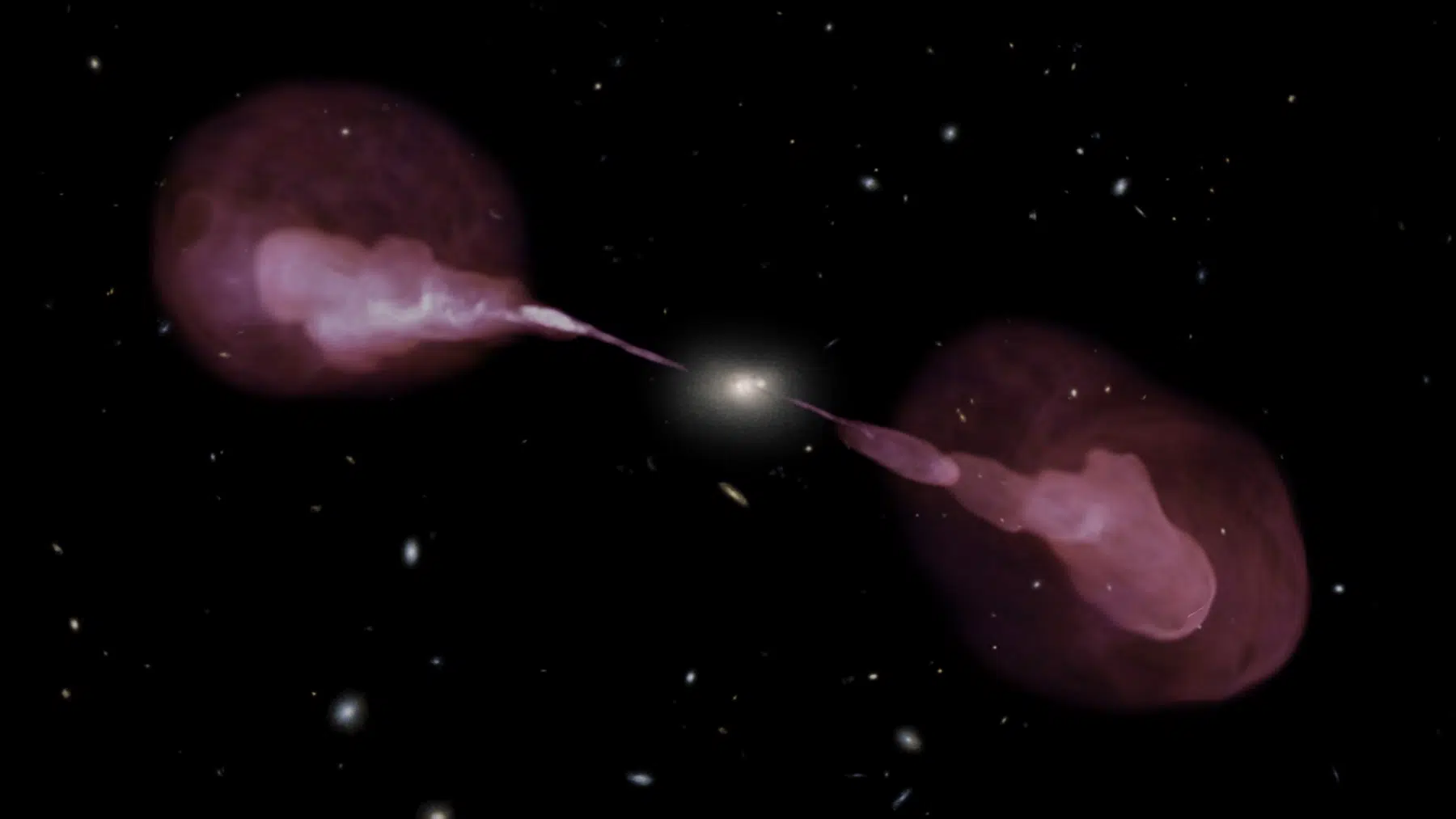
In a galaxy called NGC4945, about 13 million light-years away from the Milky Way, a supermassive black hole erupted in a massive outburst five million years ago. The huge outburst created a massive cloud of gas, detectable to this day. The ESA XMM-Newton space telescope was used to take a look at the phenomenon using X-ray readings coming from the area around the black hole.
The impact of the gas cloud in space
The cloud is full of cold gas, which means that it is not hot enough to glow, and scientists found this fossil by detecting a signal called the Iron K-Alpha Line – it only appears when X-rays bounce off cold gas. The distance in which the gas expanded is surprising, spreading across 32,000 light-years in the plane and 16,000 light-years above it.
When supermassive black holes undergo powerful outbursts, they can reshape the galaxy, acting like the trigger for a burst of nearby star formation. When this happens, matter nearby is ejected at relativistic speeds, traveling through vast regions of space until it dissipates.
The cloud was hidden in plain sight
The outburst happened 5 million years ago, and only now are scientists able to see the fossil gas cloud left behind by the supermassive black hole’s activity. This happens because when scientists look at something in the telescope, they are not seeing it as it is now, but as it was when light left it. So, if someone 65 million light-years away from Earth had a telescope and could sneak into the planet’s atmosphere, they would see dinosaurs still inhabiting the planet before the mass extinction event happened.
The universe is full of dead life that NASA can’t see
There are fossils all around, and not necessarily from animals or organisms that completed their life cycle and died. Other objects in outer space can be traced back millions of years ago without using carbon, and only by looking at the size of the gas cloud left in an outburst from a supernova, a supermassive black hole, or a star that did not have time to grow and suddenly erupted – and this is just what scientists can observe given the time it takes for light to travel through the universe and make things visible for us.
Read the whole thing?
Get the week's signal, not the noise
Our sharpest reporting on energy, climate and nature — free, once a week.