Superluminous supernovae are among the most violent events the universe produces — explosions that can outshine ordinary stellar deaths by a factor of 100. For nearly two decades, astronomers suspected something extraordinary was driving that excess energy, but the physics remained stubbornly out of reach.
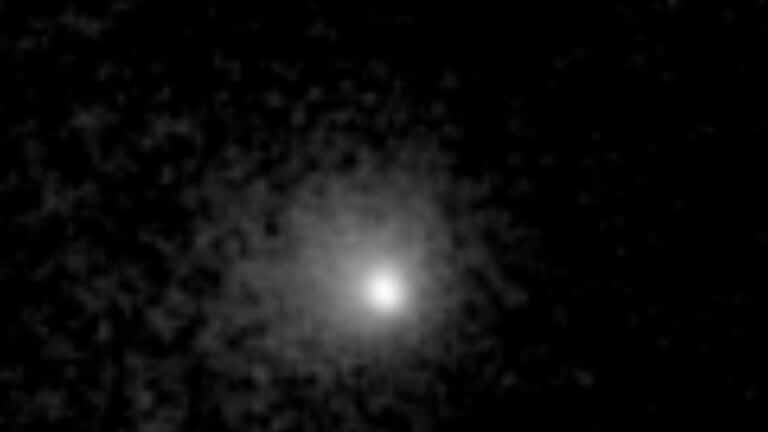
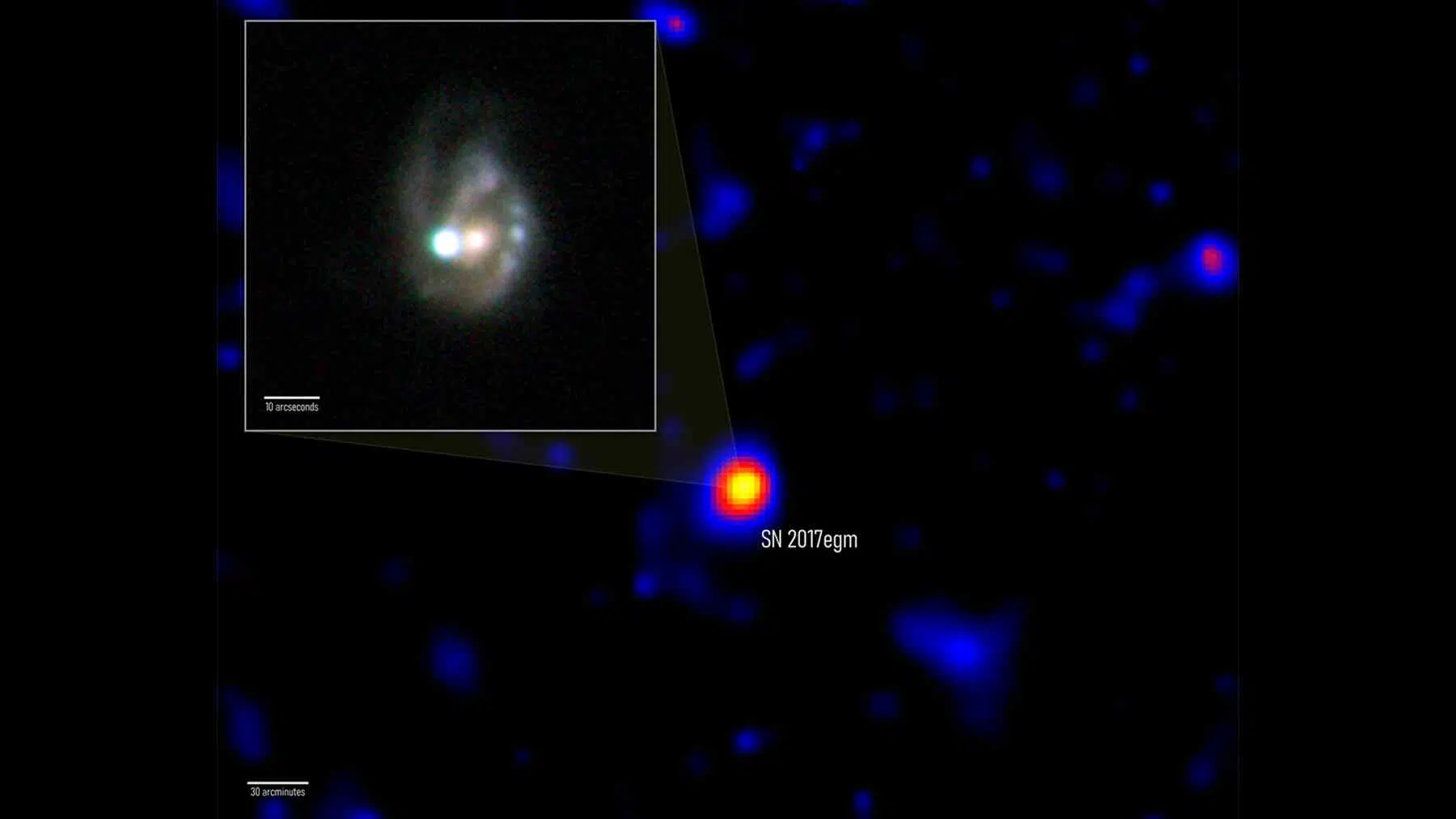
Then one particular explosion, SN 2017egm, did something no superluminous supernova had done before: it showed up in gamma rays.
The most powerful explosions in the universe — and what drives them
Superluminous supernovae can be 100 times brighter than ordinary core-collapse supernovae — events that already outshine every star in their host galaxy combined. That staggering energy surplus has to originate somewhere, and for decades astronomers have debated two competing explanations.
The first is the magnetar central engine model. The second is the circumstellar material (CSM) interaction model, where gas shells shed by the star before it dies illuminate as the explosion plows through them. Both models can reproduce a supernova’s optical brightness. Neither can reproduce the same gamma-ray signal.
Gamma rays are the decisive diagnostic. Their presence, timing, and energy profile carry a fingerprint that belongs to one model and not the other — yet nearly 20 years of searching Fermi data produced only hints. Intriguing ones, but never definitive. Until now.
How a magnetar can light up a dying star from the inside
When a massive star collapses under the magnetar model, it leaves behind a neutron star with a magnetic field up to 1,000 times stronger than a typical one. That object spins hundreds of times per second, flinging out a powerful wind of electrons and positrons.
This wind inflates an enormous cloud of energetic particles called a magnetar wind nebula. Inside it, gamma rays are produced continuously — but they can’t escape right away. They collide with supernova debris, shed energy, and convert into visible light, providing the extra luminosity that sets superluminous supernovae apart from ordinary stellar deaths. Only after roughly three months, as the expanding debris thins out, do gamma rays begin leaking into space.
That delay is a precise, testable prediction. It turns out to match exactly what astronomers observed from SN 2017egm.

SN 2017egm: the supernova that finally answered back
Researchers led by Fabio Acero of CNRS and the University of Paris-Saclay searched through all six superluminous supernovae present in Fermi’s 16-year dataset. Five came up empty. Only SN 2017egm — the brightest of the group — produced a detectable gamma-ray signal.
The signal appeared roughly two months after the explosion and persisted for several months. Its timing and luminosity both matched what the magnetar model predicts; neither matched the CSM interaction model nearly as well. “Both the peak time and the luminosity of the GeV emission are consistent with the magnetar model prediction,” the team wrote. The result, published in Astronomy & Astrophysics, marks the first definitive gamma-ray detection from a superluminous supernova.
An almost-clean answer — and the wrinkles that remain
The magnetar model fits the gamma-ray data well. The optical data, though, tells a more complicated story. At late times, SN 2017egm’s visible-light curve shows irregular bumps that the straightforward magnetar model doesn’t fully account for.
Two plausible explanations emerge. One is a hybrid magnetar-plus-CSM model, where gas shell interactions contribute at later stages. The other is a pure magnetar model incorporating an infalling accretion disk — which could drive the irregular optical behavior without invoking external shells at all. The CSM model isn’t eliminated. What shifts is the weight of evidence, suggesting the underlying physics may be more layered than either model alone has assumed.
What comes next: new telescopes and millions of supernovae
The next significant advance may come from the Cherenkov Telescope Array Observatory (CTAO). With 64 telescopes, it’ll be the most powerful ground-based gamma-ray observatory ever built. Because the CSM model strongly suppresses high-energy gamma-ray emission, any CTAO detection of a superluminous supernova would heavily favor the magnetar scenario — and researchers estimate it could detect a few such events per decade within roughly 140 megaparsecs.
The Vera Rubin Observatory’s Legacy Survey of Space and Time adds another dimension entirely. Scientists expect it to discover between 3 and 4 million supernovae over the next decade, vastly expanding the statistical sample available for this kind of analysis.
As Judy Racusin, Fermi’s deputy project scientist at NASA’s Goddard Space Flight Center, put it: “Observing gamma rays from supernovae will give us a new way to explore their inner workings.” SN 2017egm opened that window. What astronomers see through it next may finally settle the question of what makes the universe’s grandest explosions burn so impossibly bright.
Read the whole thing?
Get the week's signal, not the noise
Our sharpest reporting on energy, climate and nature — free, once a week.