NASA has launched over 90 telescopes in space since 1970, but the most notable are the James Webb, Hubble, and Chandra X-Ray Observatory. Each one has its particularity and can make its own discoveries, but sometimes they collaborate to take readings from the same location. The James Webb Telescope is the most powerful, and it has to study the farthest points in the universe, where its expansion is still ongoing. We might not be able to travel at light speed to make discoveries ourselves, but the telescopes have been doing their job with excellence.
Telescopes do the work, so humans can stay on Earth
Scientists from NASA and other space agencies are able to see new planets, dying stars, black holes, and other galaxies, millions of light years away, without ever leaving Earth. Humanity might never be able to explore space if spaceships cannot travel at the speed of light, and even if an engine can make the job, it would still take years to travel to the nearest point outside our solar system, such as the nearest exoplanet, which is around 4 light years away.
For this reason, the telescopes do the job for us, and recently, the James Webb found a galactic fossil that had never been seen before. It took us hundreds of millions of years to spot it, not because of the technological barrier, but because we are always late for the news in the universe.
We only see things because light travels to us
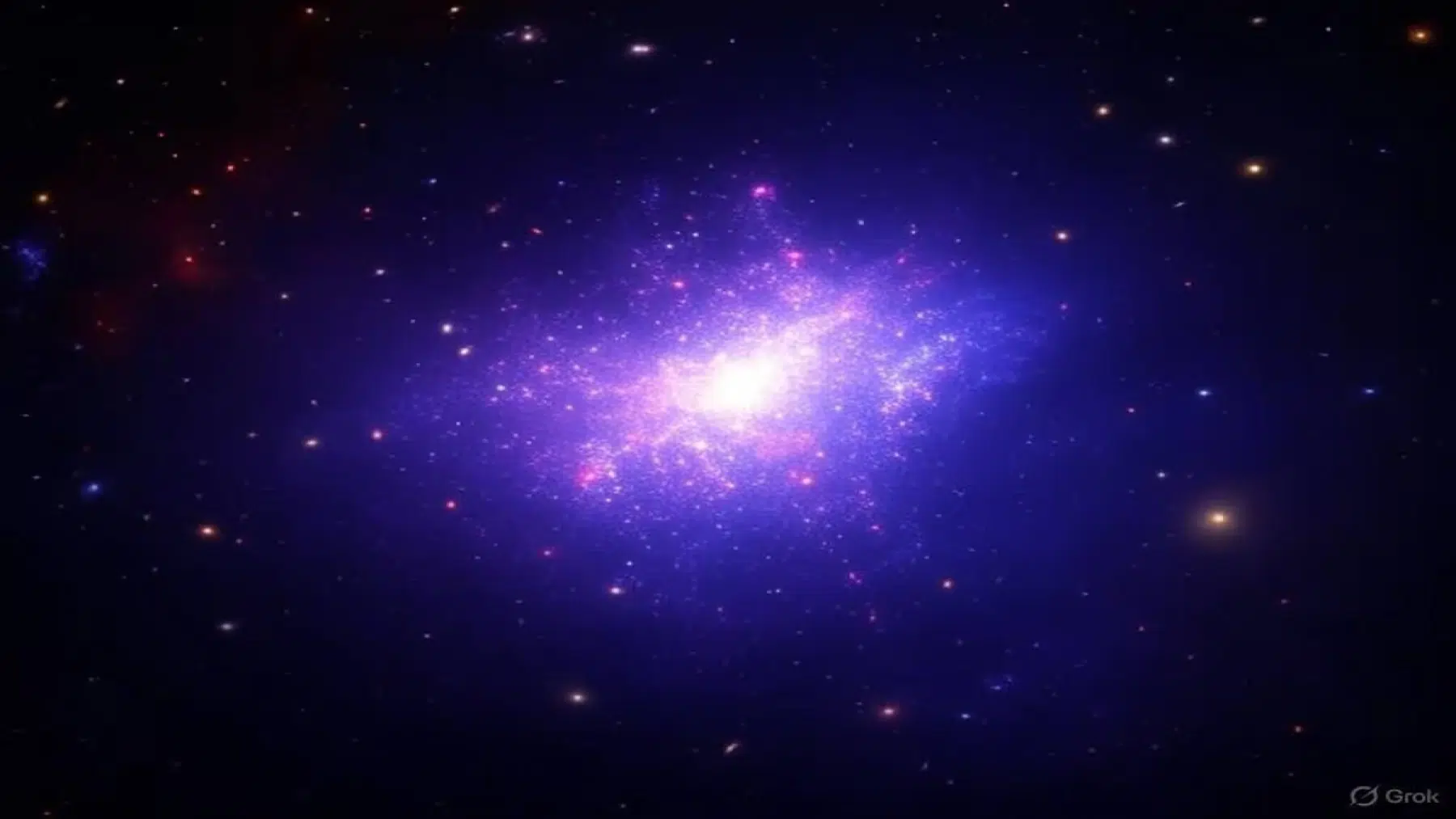
NASA’s James Webb Space Telescope found the most distant, and one of the youngest, dead galaxies. The cosmic fossil stopped growing 50 to 100 million years before the JWST discovery, as the star formation inside slowed down, which classifies the galaxy RUBIES-UDS-QG-z7 as dead. ‘Red and dead’ galaxies identified by NASA lack massive hot young blue stars and there an abundance of old small red stars
Everything NASA observes in the cosmos is due to light traveling far enough for us to see, but that does not mean that we are seeing it as it is. The further the object, the longer it takes for light to travel from one point to another.
NASA found a cosmic fossil from the very beginning of the universe
Not necessarily a ‘dead galaxy’ means that no life or cosmic objects is glowing inside; it just means that the star formation is no longer happening, and the RUBIES-UDS-QG-z7 stopped its star formation just 700 million years after the Big Bang—which means light has been traveling to Earth for 13 billion years, from the very beginning of the universe.
One point highlighted by Andrea Weibel, a member of the study, is that RUBIES-UDS-QG-z7 has 15 billion times the mass of the sun in stars, and it completely stopped forming stars 50 to 100 million years before scientists observed it.
Humanity might never get close to another galaxy
Quiescent galaxies – those that had their star formation slowed down or completely stopped – are common around the Milky Way. However, even with these small stellar groups around us, we are still millions of light years away, and every time humanity can see something through a telescope, it has already happened. The name of the phenomenon is look-back time, and it also involves other concepts such as the observable universe, cosmological redshift, and time dilation (in relativity).
The universe continues to expand by the minute, and there are many challenges for humanity before it even gets the chance to make a trip to another planet. NASA estimates that by 2030, astronauts will go to Mars, and traveling to the Red Planet takes about 10 months.
Read the whole thing?
Get the week's signal, not the noise
Our sharpest reporting on energy, climate and nature — free, once a week.