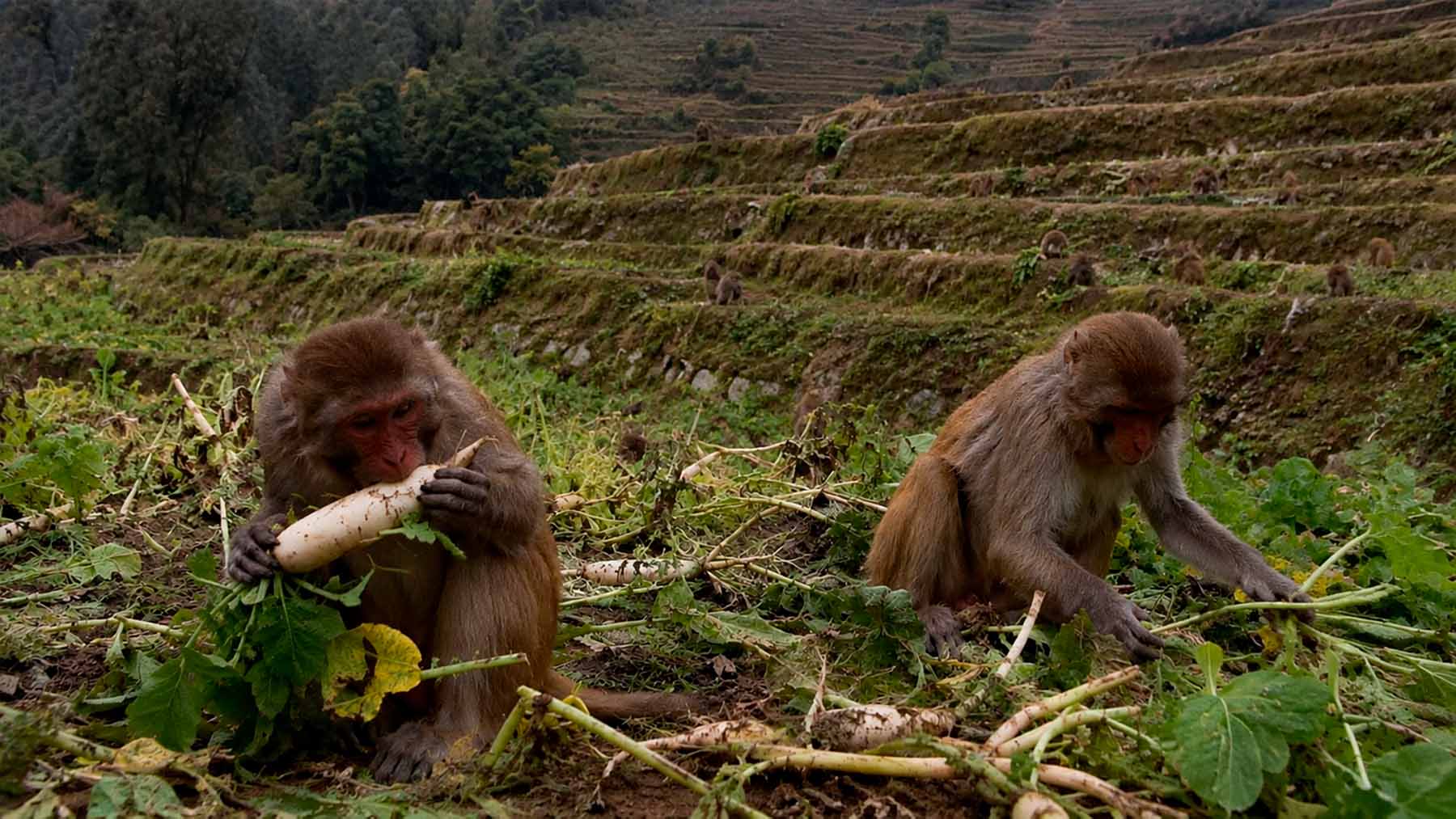
For thousands of years, farmers in Nepal’s mid-hill region have carved terraces into Himalayan slopes to grow the maize, millet, and rice their families depend on. Today, that ancient way of life is under siege.
Troops of up to 200 rhesus macaques descend on fields in broad daylight, stripping crops while farmers scramble to drive them off with slings and homemade noise cannons. When darkness falls, porcupines move in — and farmers say there’s simply nothing they can do. One survey found that the average household loses roughly half its maize harvest to wildlife raids each year.
A crisis written into the hillsides
Nepal’s mid-hill region isn’t easy farming country. The terraced slopes that staircase down from the Himalayas were carved by hand over centuries, shaped to hold soil against the monsoon rains. Farmers here rotate legumes, maize, millet, and rice through the seasons, working within a subtropical highland climate that swings between drenching wet spells and punishing dry ones. The land demands everything — and for generations, families gave it.
Now that commitment is being tested by three persistent raiders. Rhesus macaques strike during daylight hours, moving in troops of up to 200 animals. After dark, Indian crested porcupines take over, tunneling through maize and potato crops while farmers sleep. Wild boars complete the assault — trampling standing crops, rooting for tubers, leaving fields wrecked behind them.
Ram Prasad Paudel of Maramche village put it plainly to Mongabay: “During the day, it’s the monkeys that raid the field, at night it’s the turn of the porcupines. Villagers guard their crops during the day to drive away monkeys. But when it’s dark, the porcupines come and eat the crops and we can’t do anything about it.” For these communities, farming isn’t a side income. It’s identity, inheritance, and survival.
What the numbers reveal about macaque raids
The scale of the macaque problem is larger than most people realize. A direct count by the National Trust for Nature Conservation (NTNC) tallied 20,395 rhesus macaques across 44 highly affected areas — and across Nepal’s broader mid-hill region, the NTNC projected a minimum population exceeding 104,000.
Those animals are increasingly dependent on what farmers grow. A 2026 study found that cultivated crops make up 49% of wild macaques’ annual diet in central Nepal — farmland has become a primary food source, not a fallback. The NTNC estimated annual crop losses of roughly $327,000 across 1,846 surveyed households, with each household losing about half its maize production every year to monkey raids. Of 73 randomly selected farmers surveyed in Palpa district, 85% said wildlife damage had increased over the previous five years.
The vicious cycle: fewer farmers, bolder wildlife
Younger generations in Nepal’s mid-hills are leaving, according to media such as Mongabay. Researchers at the Southasia Institute of Advanced Studies found that people cite better education, employment opportunities, and access to healthcare as their main reasons for migrating. The terraced fields their parents farmed are increasingly left unattended.
As fields go unworked, the boundary between agricultural and wildlife habitat softens. Animals move in more freely, and the human presence that once deterred them disappears. A study of Mangalsen Municipality in Achham District connected this directly: monkey and wild boar conflict was linked to declining agricultural productivity and accelerating out-migration.
The loop is self-reinforcing. Wildlife raids reduce farming viability, which pushes people to leave. Fewer people means fewer guardians watching the fields — and with fewer guardians, the raids intensify.
How farmers are fighting back — and what they don’t know
The farmers who stay aren’t passive. Each day, many arm themselves with slings, sticks, and homemade noise cannons and head to the treeline to watch for incoming troops. It’s exhausting — hours spent guarding rather than growing. The NTNC report also documented darker responses: mass drownings and high-voltage traps, reflecting how desperate some communities have become.
A government compensation program exists for wildlife crop losses. Yet 80% of affected farmers were unaware they could make a claim, according to the NTNC — and policy without awareness rarely reaches the people who need it most.
Reforestation’s unintended legacy — and the search for solutions
One striking hypothesis about why conflict has escalated comes from Sabina Koirala, a PhD researcher in human-monkey conflict. She told Mongabay that Nepal’s 1970s reforestation push — which favored fast-growing Australian pine — may have inadvertently pushed macaques toward human settlements. Pine forests offer little food for monkeys, so as those trees spread, animals likely turned to farmland to fill the gap.
Koirala proposes habitat enrichment as a partial remedy: planting native fruit-bearing trees to give macaques alternative food sources before they reach the fields. A government task force is also exploring less-palatable crops, community patrol systems, and improved compensation access. What’s missing is large-scale evidence — most existing research consists of small case studies. Until broader research confirms which interventions actually work, farmers and policymakers alike will be navigating a problem that’s still being fully understood.
The complete study Socio-Economic Impacts and Control Mechanisms of Problematic Wildlife Species in Mid-hill Regions of Nepal (Monkey, Wild boar, and Porcupine) is available from the National Trust for Nature Conservation.
Read the whole thing?
Get the week's signal, not the noise
Our sharpest reporting on energy, climate and nature — free, once a week.