Neptune’s moon system is a study in chaos. Of the planet’s 16 known moons, most trace wildly irregular orbits, and a single moon — Triton — accounts for 99% of the entire system’s mass. For decades, scientists assumed that Nereid, with its strangely elongated orbit, was simply another stray body captured from the Kuiper Belt.
New data from the James Webb Space Telescope suggests that assumption was wrong. Nereid’s composition tells a different story — one that could rewrite what we know about how ice giant planets like Neptune build their families of moons.
A moon that doesn’t fit the mold
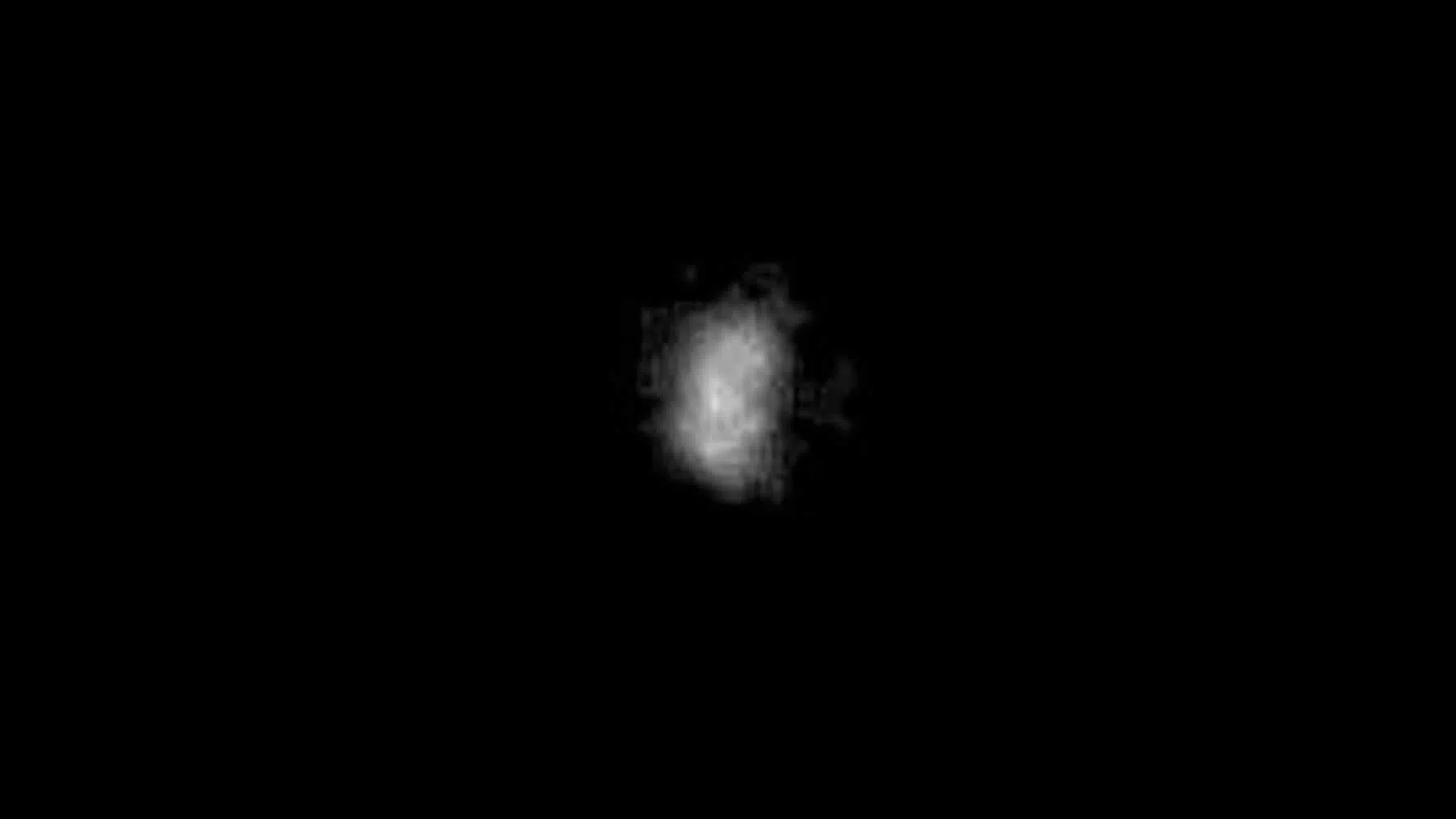
Nereid has puzzled astronomers since its discovery in 1949. At roughly 220 miles wide, it’s Neptune’s third-largest moon — but its most striking feature isn’t its size. It’s the orbit. Nereid traces one of the most elongated paths of any moon in the solar system, swinging dramatically close to Neptune before arcing back out to enormous distances. That extreme ellipse looked like a telltale sign of a captured body, pulled from a stable Kuiper Belt trajectory by Neptune’s gravity.
The assumption held for decades. Neptune has 16 known moons, most of them small and tumbling in irregular orbits, with no tidy, circular “regular” satellites to serve as a baseline. As first study author Matthew Belyakov, a graduate student in planetary science at Caltech, put it: “The trouble at Neptune is that we don’t have any regular satellites really, whatsoever.”
Triton dominates the picture entirely. Neptune’s largest moon accounts for 99% of the Neptunian moon system’s total mass and orbits in retrograde — moving backward relative to Neptune’s rotation, which alone flags it as an outsider. Nereid, lost in Triton’s shadow, was folded into the same captured-object narrative without the data to prove or disprove it.

What JWST saw in Nereid’s light
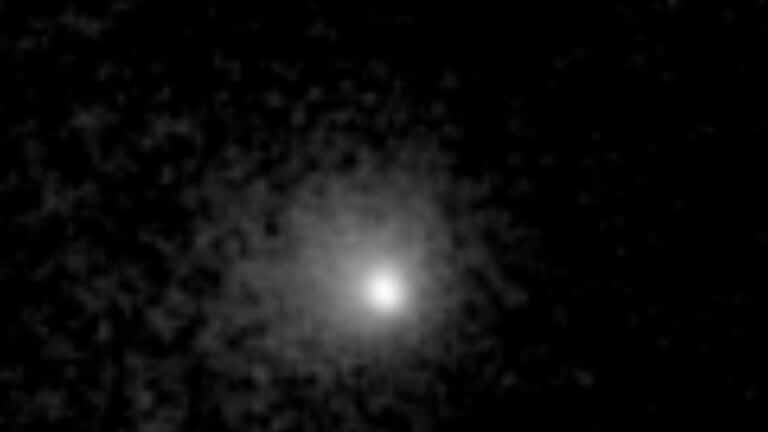
That’s where the James Webb Space Telescope changed the equation. JWST’s Near-Infrared Spectrograph (NIRSpec) captured spectral data from Nereid, revealing the overall shape of the light the moon reflects — a surface with high water-ice content and a composition that looks meaningfully different from known Kuiper Belt objects.
That comparison is now possible in a way it wasn’t before, because JWST has observed a meaningful sample of Kuiper Belt objects directly, enabling consistent cross-referencing. “We’re able to compare apples to apples,” Belyakov told Live Science. Previous attempts relied on observations made by different instruments under different conditions, introducing noise into any comparison. With consistent data from the same telescope, the spectral mismatch between Nereid and Kuiper Belt objects becomes hard to dismiss. If Nereid had originated there, its surface chemistry should broadly resemble those objects. It doesn’t.
Triton’s violent arrival rewrote the neighborhood
If Nereid wasn’t captured, how did it end up in such a chaotic orbit? The answer, the researchers suggest, lies with Triton. Unlike Nereid, Triton almost certainly was captured — its retrograde orbit and a composition more similar to Pluto’s than to Neptune’s make that clear. But Triton’s arrival wasn’t quiet.
The research team ran simulations of what Triton’s capture would have done to moons already orbiting Neptune, and the results were striking. Triton’s gravitational influence scattered moons and triggered widespread disruption. Neptune’s innermost moons today are thought to be fragments that recoalesced after that chaotic event — not survivors of it.
The simulations also produced something unexpected: a Nereid-like object. “Triton gets captured and alters the original system, and creates a Nereid-like object,” Belyakov explained. Nereid’s strange orbit may not be evidence of capture at all. It may be a scar left by Triton’s arrival, impressed upon a moon that was already there.
A lone window into the solar system’s origins
This finding takes on added weight when you consider how rare intact first-generation moons may be. Uranus offers a stark example of what’s typically lost — the planet’s extreme axial tilt, likely the result of a massive ancient collision, almost certainly destroyed its original generation of satellites. Neptune’s story runs similarly: its innermost moons were reforged from debris after Triton’s disruptive capture.
Nereid, if the new findings hold up, may be the single exception — the only intact remnant of satellites that originally formed around an ice giant anywhere in the solar system. Belyakov framed the stakes plainly: “Perhaps Nereid is the only original, sort of intact, remnant of satellites that originally formed around these planets. That would be a very exciting result, because it means that we have this one window to explore and understand satellites.”
Why it matters beyond Neptune
The implications reach well past Neptune’s orbit. Planets roughly the size of Uranus and Neptune are the most common type found around other stars — the default planet, in a meaningful sense — yet how their moon systems form and evolve remains one of the more significant open questions in planetary science. “If we don’t understand how moons around these objects form, that’s a really big problem,” Belyakov said.
The results were published May 20 in the journal Science Advances. The team, which includes Caltech professor and moon dynamicist Konstantin Batygin, used NIRSpec in its lowest-resolution mode — just a few minutes of telescope time. Higher-resolution NIRSpec observations are planned for a future proposal, with the goal of sharpening the spectral picture and putting the hypothesis on firmer ground. What JWST has already returned is suggestive; what it might yet reveal could be definitive.
Read the whole thing?
Get the week's signal, not the noise
Our sharpest reporting on energy, climate and nature — free, once a week.