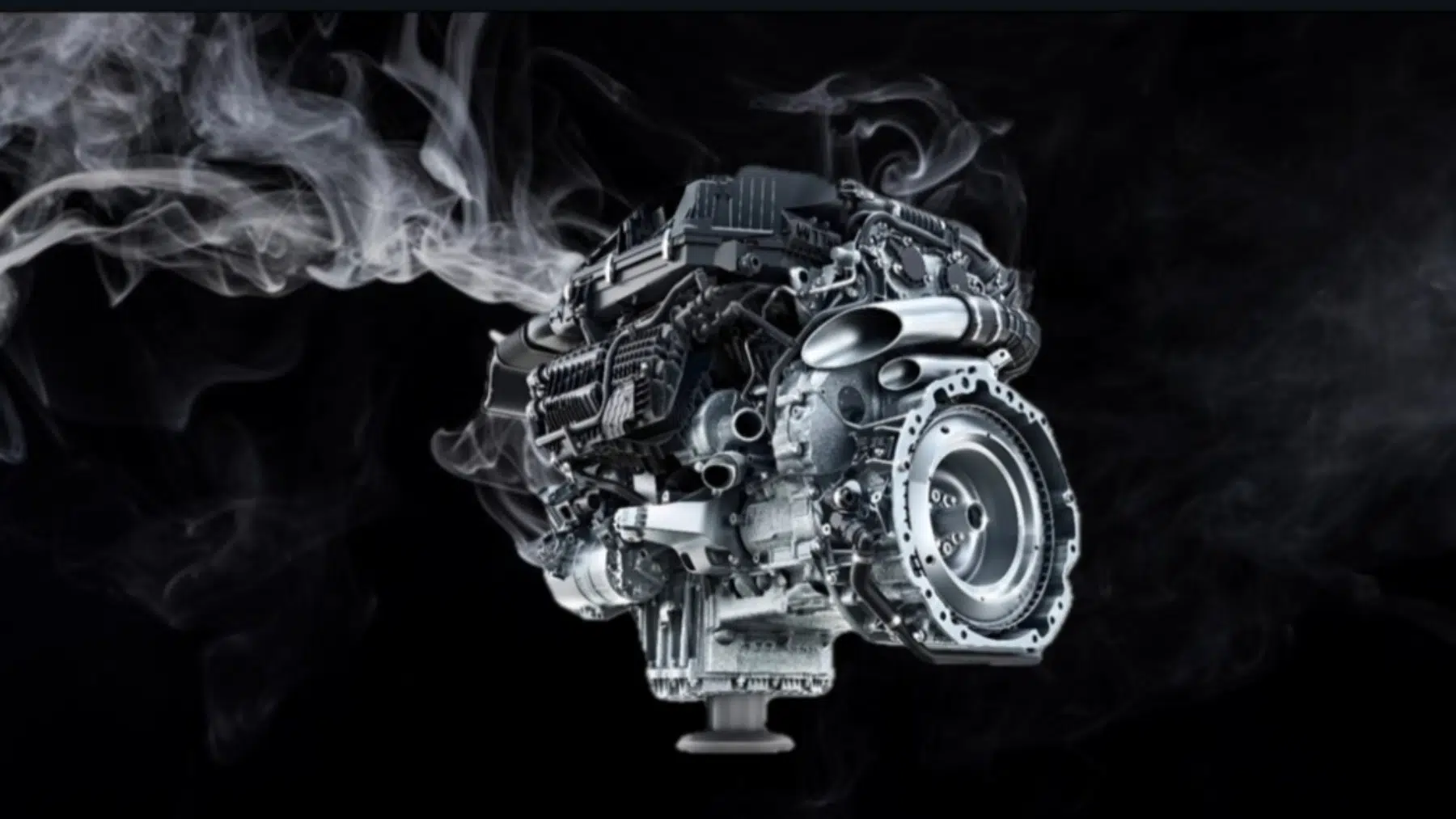
Mercedes-Benz built the world’s first petrol-powered car in 1886, and since then, the brand has become synonymous with luxury and performance. The automaker has always been ambitious, as indicated by its three-pointed star logo symbolizing the company’s early ambition to power vehicles on land, sea, and air. The latest 408 HP engine showcases the company’s ambition yet again, however, it is not appreciated by everyone as it has caused some controversy.
Mercedes is ambitious about its new engine
The world is competing to supply more efficient engines and aims to do so by downsizing and turbocharging everything. Mercedes seems to be the exception to the rule, as the company is still pushing the classic inline six and V8. Mercedes announced its new range of engines, which support electric turbocharging. One of the engines in the range has been the talk of the town, namely the new inline-six M256 engine, the first inline-six in eight years.
The Mercedes-Benz M256 will include a 48-volt battery and utilize a twin-scroll turbocharger and an auxiliary electrical compressor. The auxiliary unit boasts extremely fast spin-up power, charging the engine before the exhaust-driven system has a chance to gain momentum, resulting in instant peak power. The other technology that makes this package special is a combination starter/alternator that saves weight.
The new M256 has some interesting figures
Mercedes’ new inline-6 M256 motor will reportedly generate more than 300 kW (408 HP) and 500 Nm (369 lb-ft) of torque, which is impressive in comparison to the current M276, a V6 that has been in service for nearly 15 years. M256 will also be one of the first motors to use an electric turbo, which will spin up to 70,000 rpm in just 300 milliseconds, offering a big shove in the back with almost no discernible linger. The new 48V electrical architecture will drive the turbo and serve as an alternator, feeding high-draw elements like air conditioning and the starter motor.
Mercedes also showcased its commitment to the V8 engine with the twin-turbo M178. The new 4.0-liter motor was developed by AMG for use in regular Mercedes and develops more than 350 kW (476 hp) of power, which is 15 kW (20 hp) more than the current M278 V8 can handle. It’s reportedly also around 10 percent more efficient than the one it replaces.
Why the M256 is so controversial
Besides the extra power, the M256 should also be around 15 percent more power efficient than the current M276 V6, and a combined coherent filter makes it much cleaner as well. The M256 boasts 20% lower carbon dioxide (CO2) emissions than the M276 V6. According to Automotive Tech Info, the M276 V6, particularly in the S 350, has a CO2 emission of 177 g/km. This means that the new M256 would still have a CO2 emission of 141.6 g/km.
What makes the Mercedes M256 so controversial, or any mild-hybrid engine for that matter, is the fact that automakers are still opting for various options besides an electric or zero-emission engine, especially considering that the European Union has set a target to ban any new petrol and diesel cars from being sold by 2035.
Yes, the new M256 has a smaller carbon footprint, but through the eyes of the European Union, that will not be good enough. Is this perhaps automakers such as Mercedes’ last hope to enjoy the magnificent roar of an engine under the hood before it will be gone for good? We guess we’ll never know their true motives, but at least it is a small consolation for car enthusiasts who also enjoy the skin-tingling roar of a magnificent engine. We wonder what else could have been up for offer in the last ten years before the big ban.
Read the whole thing?
Get the week's signal, not the noise
Our sharpest reporting on energy, climate and nature — free, once a week.