

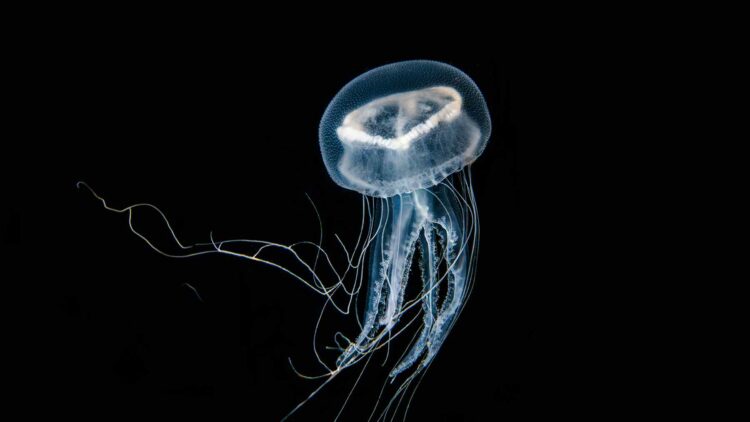
Sentosa — Singapore’s glittering resort island — means “peace and tranquility” in Malay. But its original name tells a different story: Pulau Blakang Mati, “Island of Death Behind.”
It turns out the old name may still apply. Scientists have formally identified a new species of highly venomous box jellyfish lurking in the waters just off that same shore — one that had gone unrecognized for years, hiding in plain sight.
A new species hiding in plain sight
The formal description of Chironex blakangmati is based on specimens collected near Sentosa island in 2020 and 2021. For years, those animals had been misidentified as C. yamaguchii, a box jellyfish first described in Okinawa. The two species look strikingly similar — similar enough that the error persisted until researchers examined the anatomy more closely and ran genetic comparisons. The study was published May 15 in the Raffles Bulletin of Zoology.
The species name is a deliberate nod to the island’s original Malay identity. “Blakang mati” translates to “death behind,” and the name carries real weight: this ranks among the most venomous animals on the planet, found just off a beach that draws millions of tourists every year.
What makes Chironex box jellyfish so dangerous
All four known Chironex species are considered among the most venomous animals on Earth. Their stings are delivered through nematocysts — specialized cells packed into their tentacles — and carry enough potency to kill humans. Box jellyfish stings are estimated to cause around 40 deaths per year globally, though experts believe the true figure is considerably higher, given how many cases go unreported or get attributed to other causes entirely.
What sets Chironex apart from most jellyfish is behavior. Rather than drifting passively with ocean currents, these animals actively hunt. They possess strong musculature and complex eyes capable of detecting and tracking prey — and that combination of mobility, sensory capability, and potent venom places them in a category that very few other marine creatures occupy.
The anatomical clue that set it apart
The key distinction between C. blakangmati and its closest relatives comes down to a structural feature inside the bell. The other three Chironex species — C. yamaguchii, C. fleckeri, and C. indrasaksajiae — all have branched canal structures within their perradial lappets, the flaps that reinforce the musculature used for swimming. C. blakangmati lacks these canals entirely.
That absence is a clear morphological signal, but the researchers didn’t stop at anatomy. Genetic analysis confirmed what the structure suggested, establishing C. blakangmati as a fully distinct species rather than a regional variant of something already known.
The comparison required deliberate effort. Study co-author Cheryl Ames, a professor of applied marine biology at Tohoku University and a research associate at the Smithsonian National Museum of Natural History, retrieved a preserved C. yamaguchii specimen she’d kept in storage in Okinawa — originally collected during her master’s research — specifically to support the side-by-side analysis. “C. blakangmati looks remarkably like Chironex yamaguchii,” Ames said in a statement. “But we realized they were completely distinct.”
A surprise second finding: another deadly species far from home
The new species wasn’t the only significant result to emerge from the study. The researchers also confirmed, for the first time, that C. indrasaksajiae — commonly called the Thai sea wasp — is present in Singaporean waters. Typically associated with the Thai coastline, its presence near Singapore represents an unexpected range extension.
“We were surprised to find C. indrasaksajiae so far away from Thailand,” Ames noted. The finding points to how incomplete the current understanding of box jellyfish distribution really is. These are dangerous animals, yet basic questions about where they live remain unanswered. Documenting range extensions like this one, the researchers argue, is essential to building a more accurate picture of where human encounters are likely to occur.
Why this discovery matters beyond taxonomy
Identifying a new species is scientifically significant on its own, but the implications here reach well beyond classification. Accurate species identification is foundational to developing effective treatments for envenomation — venom composition can vary considerably between species, which means a treatment calibrated for one Chironex may not perform equally well against another.
There’s also a direct public health dimension. Knowing which species inhabit which waters allows authorities to issue more targeted warnings and develop better safety protocols for swimmers and beachgoers. The waters around Sentosa are heavily used, and the gap between the island’s serene reputation and what lives offshore is a practical concern, not just a geographic irony.
The discovery is ultimately a reminder that significant marine biodiversity remains undocumented even in well-studied, heavily trafficked coastal zones. If a deadly jellyfish species can go unrecognized in the waters off one of Southeast Asia’s busiest tourist destinations, the gaps elsewhere are likely far larger. With the global death toll from box jellyfish stings already considered a probable undercount, researchers are calling for expanded surveys and much closer attention to the animals that have, until now, been hiding in plain sight.