Floating wind turbines off the coast of California have to be anchored in thousands of feet of water with heavy mooring lines. The environment is restless, with ocean waves constantly putting the cables under pressure.
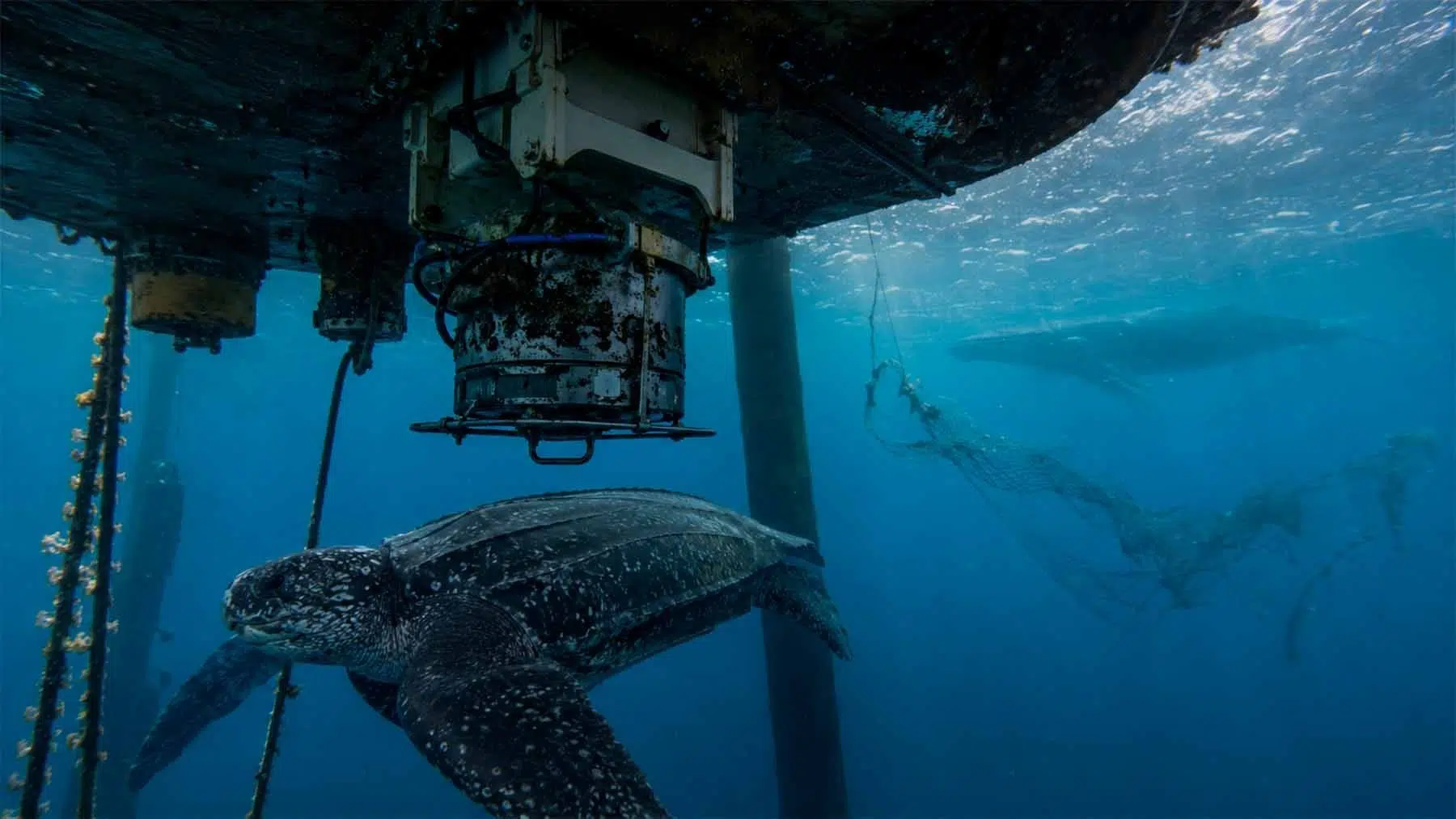
Spotting debris snagged on the anchor cables is not easy. Researchers got busy with a smart solution, incorporating the mathematical profiles of blue whales and leatherback turtles into sensor algorithms.
Now, the underwater sensors can distinguish between living marine animals and ghost nets, allowing opportunities for rescue.
How ocean wildlife has to navigate mooring lines in the Pacific
There are serious engineering challenges involved in installing wind energy projects in the federal areas off Humboldt and Morro Bay in California. This part of the Pacific features a steep continental shelf drop-off, so fixing turbine towers to the seafloor is not viable.
The alternative is planting turbines on floating platforms anchored to the seabed with steel cables. In some locations, the lines run 3,000 feet deep.
These lines do not only snag the abandoned fishing nets drifting through the water. The hazards are significant to sea life, especially migrating species like leatherback turtles and blue whales.
The hanging debris on the lines becomes a deathtrap if they get caught, and freeing themselves is unlikely.
It is possible to do physical inspections from specialized vessels, but this relies on clear weather, and the process is slow and expensive. Engineers have been working on automated monitoring tools that are attached directly to the cables to track the conditions continuously.
Isolating animal distress signals in changeable ocean conditions
One of the complexities of building sensors for underwater cables is filtering out the water motion in the background. Tides, wind, and swells are constantly pulling at the turbine platforms, causing the mooring lines to stretch and vibrate.
Sensors on the cables work by measuring the tension changes in real time. A sudden tug does not explain what caused it. It could be a winter storm surge, which registers a tension pulse that looks almost identical to contact from an object.
Site sensor operators needed better data filtering to be able to tell if a spike was due to rough waves, a passing whale, or a net caught on the cable.
One of the main objectives of upgraded sensing technology was eliminating the financial and time costs of sending remotely operated vehicles down to inspect every sensor spike.
Separating natural ocean motion from actual wildlife contact before dispatching inspection crews was the biggest technical complexity to work around.
Mathematical modeling for targeted threat identification
Researchers at the Schatz Energy Research Center addressed this signal confusion by feeding species-specific physical measurements straight into detection software algorithms. The mathematical models use specific data on body mass, swimming kinematics, water drag, and tissue flexibility for both blue whales and leatherback sea turtles.
When an object strikes a tethering cable, the system compares the incoming strain pattern against these distinct biological profiles.
A swimming whale creates a short force spike that resets quickly as the animal moves past. A snagged ghost net causes steady drag that holds the cable under constant physical load.
Filtering background wave noise against these dynamic profiles lets the software flag potential entanglements in real time, calling for remote vehicle checks only when necessary, according to the Pacific Northwest National Laboratory.
Real-world testing is still needed, but the early results are encouraging
This setup is currently a modeled diagnostic tool designed for future offshore deployment. Commercial floating wind farms still need to test the software in open ocean conditions across multiple seasons before confirming its real-world reliability.
Using physics models to monitor deep ocean structures reflects a broader effort across marine conservation research. Similar tracking systems are being tested along busy coastal shipping channels, where automated seafloor sensors track deep-water animal movement to help commercial vessels avoid collisions.
Read the whole thing?
Get the week's signal, not the noise
Our sharpest reporting on energy, climate and nature — free, once a week.