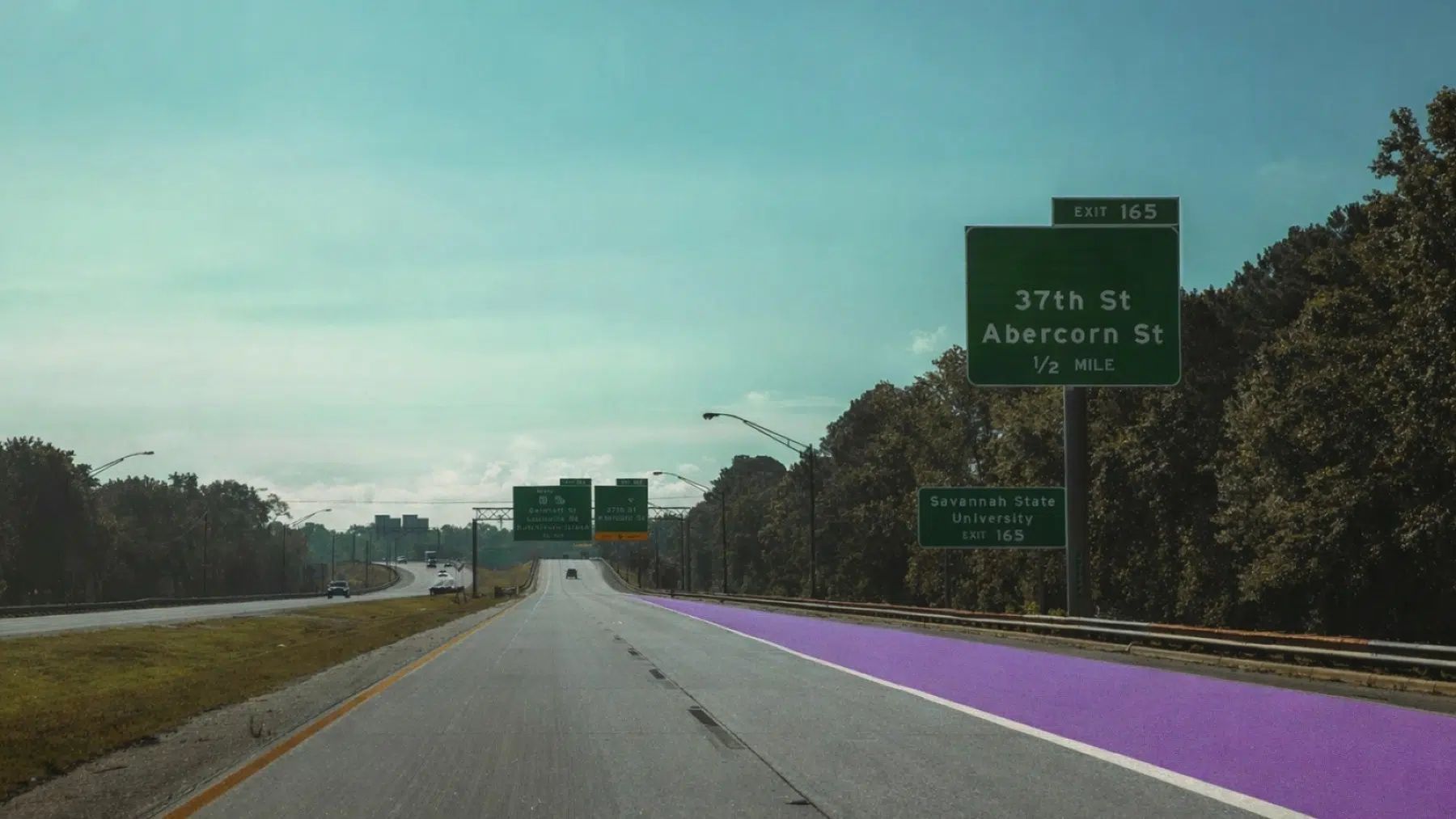
You’re about to see something new on the road in 2026, but it’s not a new car or speed limit.
Under updated federal traffic standards now rolling out across the United States, states are repainting certain lanes, and the change already has some drivers confused.
If you’ve spotted a purple lane on the road surface, it’s not decorative. It signals something specific.
And if you ignore it, the consequence may show up in your mailbox.
Yes, 2026 will be different. Even on the roads
2026 will be a year of change behind the wheel.
The long-anticipated 11th edition of the Manual on Uniform Traffic Control Devices (MUTCD) has been finalized and states have started applying the guidelines. The federal rulebook is the resource that engineers rely on for instructions about signs, lane markings, signals, and colors..
These updates go beyond simply tweaking a full rules. It is expected to expand national standards for a range of traffic control devices, street markings, and signals.
States are now obligated to implement these changes, meaning drivers will begin seeing new cues, markings and controls in places they’ve never seen before.
So buckle up, because the road signs and markings you’ve taken for granted are about to evolve, and even AI is going to feature in future.
A purple lane has appeared on the roads, and driver’s don’t like it
Have you ever driven a stretch of road and suddenly seen something totally new and thought, “What is that?”
A handful of states will be rolling out purple pavement markings on certain roads in 2026. Drivers are far from thrilled. These purple markings aren’t random, they’re part of the updated standards that now allow purple among the official roadmap of highway marking colors under the newest traffic control guidelines.
Drivers in Maryland, Virginia and California are already seeing purple on the roads. While people are reportedly confused and frustrated about new traffic signals.
It’s worth noting that purple pavement isn’t entirely new to the U.S. It was used in parts of New York and Pennsylvania in the 1990s and 2000s for E-ZPass express lanes. What’s different this time is that the color will be used even more widely under modern traffic standards, and drivers haven’t adjusted.
Why this purple lane is going to cost you dearly
This simple color change may end up costing real money.
That sudden purple paint or pavement you’re seeing on highways isn’t decorative — it’s going to be used to mark toll lanes or toll zones across the U.S. Purple has been adopted in many states to visually indicate lanes where electronic tolling applies and fees will be collected if you drive through them without a proper payment device.
In Maryland, controversial toll projects like Maryland Route 200 — the Intercounty Connector — charge drivers through all-electronic tolling systems. If you don’t have a transponder, cameras snap your license plate and a bill with an extra surcharge follows in the mail.
In Virginia, express toll lanes on State Route 267 and I-66 use similar systems. You can avoid congestion, but only if you’re willing to pay for the privilege.
And on the West Coast in California, purple markings are tied to toll facilities on bridges and highways where you’ll face charges — sometimes steep ones — especially during peak hours if you don’t have the right toll account.
Drivers are furious because these purple lane don’t just designate lanes — they signal consistent money out of your wallet every time you use them, with little advance warning and potentially large toll bills.
2026 isn’t just bringing new paint. It’s bringing new expectations. That purple lane isn’t a design experiment — it’s a financial signal. Cross into the wrong lane without realizing it, and the bill may arrive later with surcharges attached.
The broader shift is simple: road markings are becoming more complex, and more tied to automated systems. Before you merge, it may be worth paying closer attention to the color beneath your tires.
Because on today’s highways, confusion can get expensive.
Read the whole thing?
Get the week's signal, not the noise
Our sharpest reporting on energy, climate and nature — free, once a week.