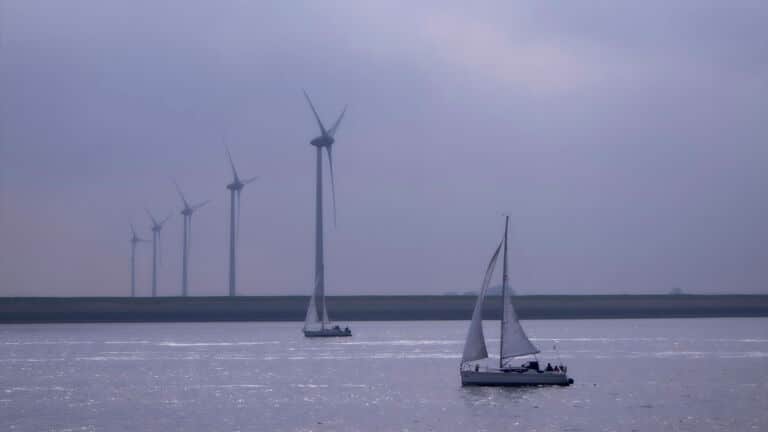
Federal agencies have installed hydrophones tethered to the seabed in the Pacific Ocean, miles offshore in deep waters.
The mission is to evaluate deepwater regions for floating wind farm sites. Scientists deployed 90 drifting acoustic recorders to capture sound underwater.
Instead of finding uniform marine life, researchers logged shifts in whale and dolphin calls across different months and changing locations. What was behind the changing sounds of the whales and dolphins?
Why acoustic monitoring is operating in the Pacific
Most floating wind turbines are installed at depths beyond 1,000 feet. These regions are not suitable for traditional fixed turbines because of the great depths. Off the West Coast of the United States, these ocean zones overlap with migration corridors that have been established for generations. These are also feeding grounds for several species of cetaceans.
An environmental baseline has to be set before construction begins. Oceanographers placed unfixed acoustic sensors into the currents below the surface. Each instrument logged low-frequency baleen whale calls and high-frequency dolphin clicks across hundreds of square miles of ocean.
Early data showed that the presence of mammals changed rapidly. Recorders separated by only 20 miles logged completely different species. Areas that were completely silent during the months of spring were filled with vocalizations by the time late autumn arrived.
Tracking these patterns has implications for future development of the clean energy sector. Construction noise and vessel movement could disrupt communication channels for vulnerable species if industrial work takes place during activity surges that were not planned for.

Marine mammal activity is based on seasonal shifts and spatial variations
The scale of the variation has created a problem for environmental planners to work around. Standard aerial and boat surveys give only brief snapshots of surface behavior. This means some animals are missed while they are diving to forage.
Whale, dolphin, and porpoise activity fluctuated based on latitude and features on the seafloor around proposed sites for wind farms. In the sectors in the north, blue whales and fin whales were loudest and most active in the autumn. Sperm whales and harbor porpoises were recorded most in the offshore acoustic tracks during winter months.
Planners attempting to set low-impact construction schedules realized a single blanket strategy would fail, according to EDP. Operating heavy piling equipment during a quiet month in one sector could coincide directly with a peak migratory surge just a few miles away. That spatial reality turns seasonal construction planning into a delicate regulatory balancing act across ocean sectors.
Vocalization shifts tied to prey concentrations
These dramatic acoustic shifts stem from seasonal oceanographic upwelling. Strong wind-driven currents push surface waters offshore, forcing cold, nutrient-dense water up from deep submarine canyons. These upwellings cause plankton blooms that concentrate swarms of krill and small forage fish over specific features on the seabed.
Whales and dolphins follow these food hotspots, changing their vocal behavior in response to local shifts rather than according to fixed calendar schedules.
There are no fixed geographical boundaries
There are operational limits involved in acoustic monitoring. Hydrophones only detect animals nearby when they vocalize. Whales that are silent or resting go uncounted, says the Singapore Economic Development Board. The sensors move with water surface currents, so their locations change.
The extensive acoustic survey of the Pacific using hydrophones demonstrates that the distribution of marine mammals in prospective zones for wind farms is tied to feeding concentrations in the ocean, not boundaries in the geography.
The window to capture the sounds of whales and dolphins while drifting is short. The way that migration corridors adapt once floating platforms and cables have been installed in full-scale energy production areas has still not been measured yet. How oceanographers decide to deploy satellite telemetry and tag data to model plankton concentrations offers another perspective on changes in marine ecosystems.
As the world pursues new green power endeavors, planners are increasingly coming up with clever ways to bond conservation with clean energy infrastructure.
Read the whole thing?
Get the week's signal, not the noise
Our sharpest reporting on energy, climate and nature — free, once a week.