Something is playing tug-of-war with a whole planet, and it’s winning.
Gravity is a violent space force. It can warp space and time in ways we are yet to understand fully.
Gas giants normally form in the icy cold outer reaches of deep space. This one has a mighty reach and strength to match even the Earth.
What could possibly pull a massive gas structure out of orbit?
Planets on the march: How the cosmos great space migration unfolds
Massive gas structures like TOI-6692 b define the cosmos.
Ice and space dust provide the foundation for this massive cosmic infrastructure from deep space.
While most giants dwell in the freezing dark, this “warm Jupiter” huddles dangerously close to its star. This suggests that there is a hidden inward migration taking place in space.
Planets can be pulled out of their established orbit, leaving astronomers to wonder: why is this taking place?
This world, with a mass 0.62 times that of Jupiter, is being dragged into a volatile, eccentric dance.
As it passes its parent star every 131 days, the pulling gets stronger.
We often think of planetary paths as permanent, but this is not “set in stone.”
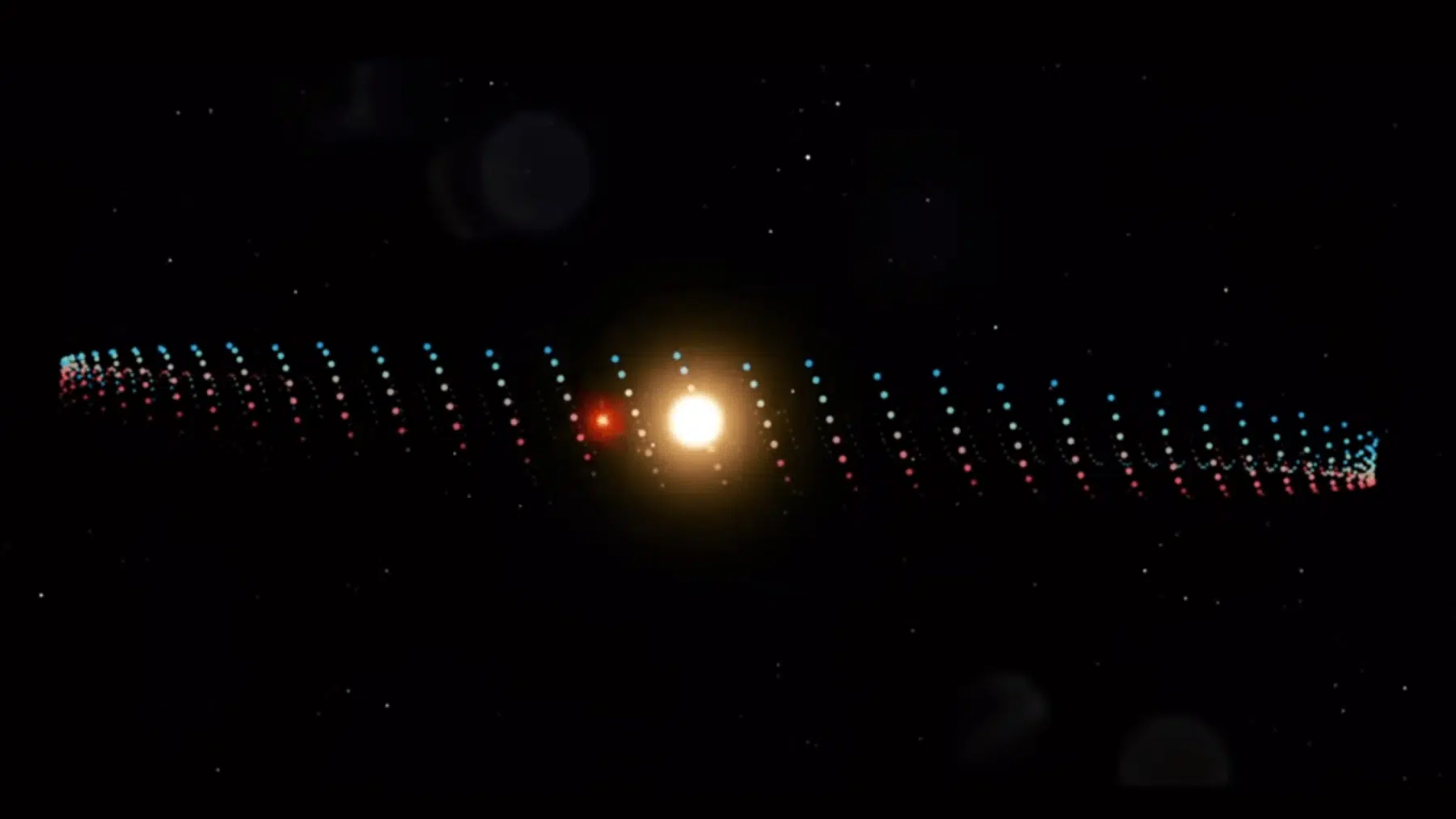
Another force is pulling this planet out of its orbit, creating a massive 0.54 eccentricity.
If gravity is the anchor, what is acting as the chain? Something is lurking in the shadows.
A subtle yet relentless grip on planets exists in deep space
The grand planetary migration can take centuries to unfold.
We can now study these movements in space in great detail. Using NASA’s TESS satellite, astronomers have cataloged over 7,800 potential worlds.
Yet, despite this technology, we struggle to explain certain oddities.
Space and time can be pulled in one direction or another. As TOI-6692 b approaches its star, gravity plays its role.

This 7.8-billion-year-old star creates a force that affects the planet’s atmosphere. This effectively pumps the brakes on the orbit.
With every 131-day rotation, energy is slowly lost.
Stars also send out massive solar winds, adding to the friction.
Kinetic energy loss remains a mystery, but this “warm Jupiter” is trapped in a volatile, 0.54 eccentric path.
Why is this one planet being pulled so dramatically?
This slow-motion spiral captures bits of energy, affecting everything about the world. Is the star the only thing pulling the strings?
NASA has found out why this is taking place in deep space with one particular example.
NASA has detected a spiral sentinal in deep space
A new and striking example of this space development has been discovered.
Located approximately 1,320 light-years away from Earth, NASA found TOI-6692 b. NASA and others have found several space events through new technology recently.
Some come perilously close to us on Earth.
However, exoplanet TOI-6692 b is not your normal planet. It is a massive gas giant with no solid atmosphere to speak of. It has a similar radius to Jupiter as well as a similar mass.
The TESS mission undertaken by NASA detected TOI-6692 b during its extremely rapid 3.9-day orbit.
The star is hungry for planet, decayed or not
The gas planet is so close to its star that one year passes by in a week.
Even a massive planet can be vaporized by a star. And TOI-6692 b is slowly being pulled towards its F-type host star.
This celestial event may enable us to study planetary decay in great detail.
Our Sun regularly receives cosmic visitors.
The space rocks are vaporized in an instant by our star. Is this the same fate that TOI-6692 b is destined for? At least we can study how this takes place over the coming decades.
Read the whole thing?
Get the week's signal, not the noise
Our sharpest reporting on energy, climate and nature — free, once a week.