
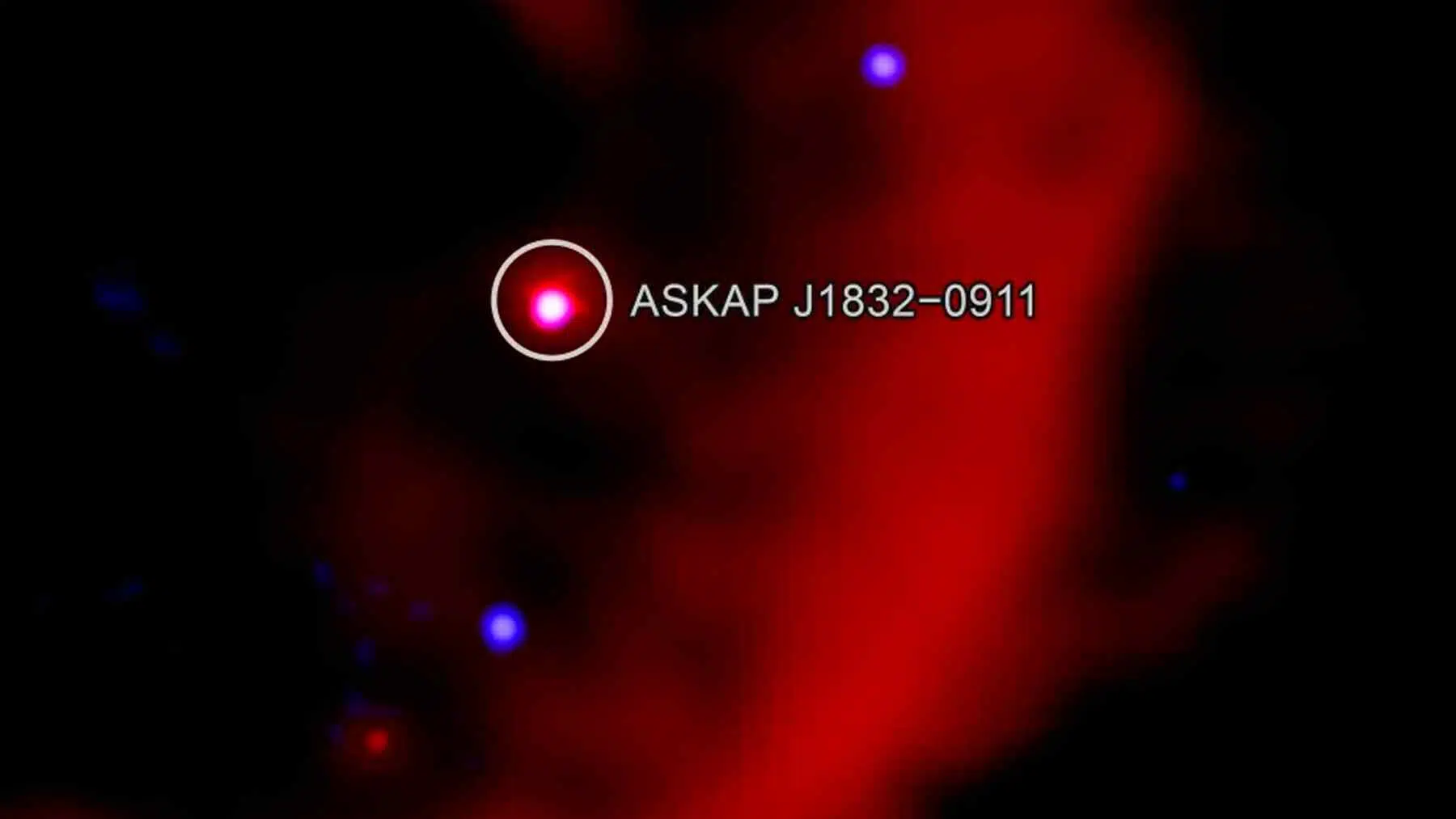
A strange object is reaching out from the darkness of the Milky Way.
A powerful signal is blinking at the Earth every 44 minutes with perfect precision. It lasts for two minutes, and then vanishes again.
Like a ghostly heartbeat, the mechanical rhythm has scientists baffled by its persistence. It’s thousands of times slower than any known star, defying current laws of physics.
How will understanding this strange object change astrological science?
An impossible rhythm: How a mechanical signal is blinking at Earth from space
Something is reaching out from the depths of secretive space. An incredible 15,000 light-years away.
An eerie signal is being picked up by telescopes on Earth.
Its origin and purpose are mysteries, but we know it comes from our own Milky Way.
The phenomenon’s mechanical nature and unchanging pattern are odd enough. But it’s the sluggish rhythm that makes the 120-second-long pulse “impossible.”
Most pulsing stars in our universe—called pulsars—flicker multiple times per second.
This schedule is way off, and current scientific models actually “forbid” it, because the cycle is thousands of times slower than expected.
Fast Radio Bursts (FRBs) are the closest thing we know of. They are millisecond-long flashes from distant galaxies.
That’s a major difference: none of the FRBs ever stayed active for two minutes. Not even close.
And none of them maintained such a long-period looping schedule.
We aren’t talking about a flicker. Rather, a high-energy, sustained broadcast that makes it clear we are missing an integral piece of the puzzle.
The “forbidden signal” has a class, and astronomers are getting closer to understanding it
The signal is being called a “Long-Period Transient” (LPT). For years, the slow pulses got lost among more powerful and obvious “noises.”
It was a stroke of astronomical fortune that changed everything.
Using the Australian Square Kilometre Array Pathfinder (ASKAP) and NASA’s Chandra X-ray Observatory, the object was caught in a rare “loud” phase.

We discovered that the object emits two forms of radiation.
It comes through in radio waves and X-rays, which pulse in perfect synchronization. This points to a massive, high-energy “engine.”
The “X-ray fingerprint” narrows the options.
All we know is that it’s a magnetic powerhouse capable of launching radiation across space from the constellation Scutum.
Some researchers at NASA considered that the “blinks” are stars being blocked by planets. But the intensity of the X-ray blasts rules that out.
It’s deliberate, it’s high-energy, and it emerges from the center of the object itself.
The signal is growing an identity: There’s a theory about ASKAP J1832-0911
What if the signal, which has been designated ASKAP J1832-0911, has to do with the “corpses” of dead stars?
This theory is based on the dual-wave data, and there are two options being put forward.
The first is that it’s a Magnetar—an ultra-dense neutron star with a magnetic field trillions of times stronger than Earth’s.
A Magnetar could technically produce long bursts if it’s spinning slowly enough. We haven’t seen anything similar before, though
The second theory is more intriguing: a white dwarf, but a super-magnetized one.
Picture a star like our Sun that has died and collapsed. But its magnetic field is so strong that it behaves like a pulsar.
The signal could be beyond categorization
There’s a hybrid theory being floated as well, that it’s a “Strange Dwarf Pulsar” that hasn’t been categorized yet.
Be it a lonely dead star or magnetic remnants in binary form, the rulebooks are being rewritten.
How many other “forbidden” rhythms are currently beating in the dark, just waiting for us to develop the technology to hear them?
Read the whole thing?
Get the week's signal, not the noise
Our sharpest reporting on energy, climate and nature — free, once a week.


