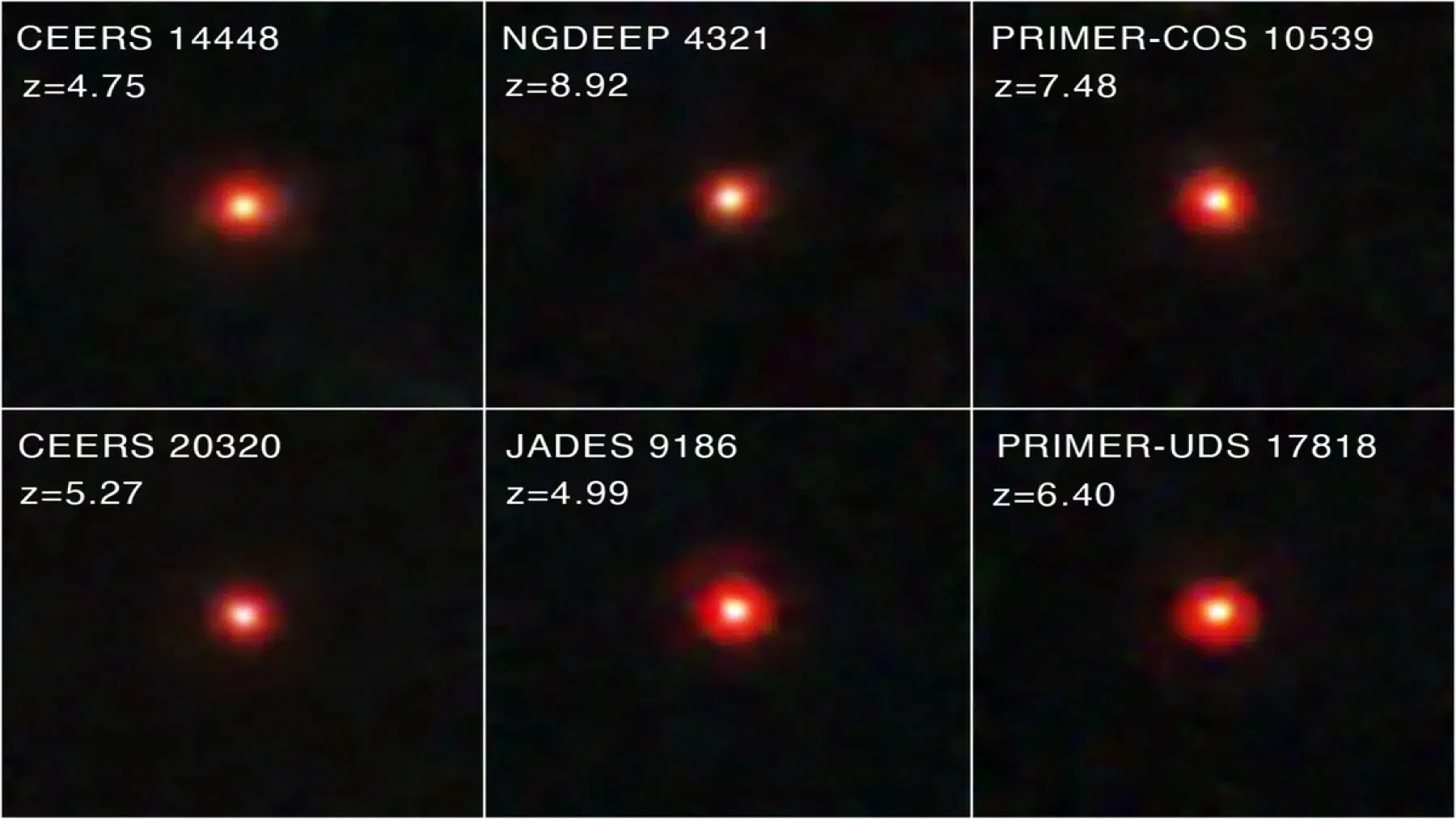
The James Webb Space Telescope has captured something that could rewrite parts of physics: little red dots behaving in surprising ways. Built to be one of humanity’s sharpest eyes in space, the JWST keeps going beyond the limits of what we thought was possible. Right now, it is stationed over 1.5 million kilometers from Earth, far beyond the reach of our atmosphere. From that distant orbit, NASA’s most advanced observatory is delivering discoveries that continue to surprise even the scientists who designed it.
The search for cosmic structures in the infancy of the universe
Among the Webb Telescope’s most curious early findings are faint objects that scientists have started calling ‘little red dots.’
These distant points live up to the nickname – they are much smaller than our Milky Way galaxy and shine with a distinct reddish glow. What makes them so puzzling is the strange way their light behaves, unlike anything seen or explained previously. For astronomers, this means that one thing is clear: this is something new, and the hunt is on to find more of them.
New theory about the red dots: They’re more complex than we thought
Fresh research is shaking up what we thought we knew about the ‘little red dots’ from the early universe. Instead of being baby galaxies, some scientists now argue that they could be ‘black hole stars’ – a type of object that we have never seen before. If that’s correct, it may explain how black holes grew to staggering sizes before the universe even reached its first billion years.
The James Webb Space Telescope detected these tiny red dots more than 13 billion light-years away. At first, they looked like galaxies that had formed within just 600 million years of the Big Bang. The problem was that they seemed too advanced for that era, packed with stars that shouldn’t have existed yet. This led researchers to nickname them ‘universe breakers’, and their end could happen this way.
They shine brighter than they should: Scientists do not know why
One reason the ‘little red dots’ puzzle astronomers is their brightness. To shine that strongly, a galaxy would have to pack in stars at an unreal density. Princeton’s Bingjie Wang put it simply: in such a galaxy, the night sky would glow so brightly it would feel unnatural – the kind of star formation that no one has ever recorded. Penn State’s Joel Leja and his colleagues broke the problem down by examining the dots’ light across different wavelengths. One object in particular, ‘The Cliff’, about 12 billion light-years away, stood out.
Its black hole seems to be growing at a breakneck speed, fueling the idea that black hole stars could be the missing link in explaining the rise of the universe’s earliest giants. The Cliff’s light comes from a single source, not a dense star cluster. Researchers believe it is a supermassive black hole that is consuming material so quickly that it’s wrapped in a glowing sphere of gas.
This black hole is different: It grew independently
Supermassive black holes are common at the centers of large galaxies, and many are actively feeding. However, it is hard to explain how the red dots grew to millions or billions of suns so early in the universe’s history – when it was less than a billion years old. The standard growth model involves black holes merging over time and pulling in surrounding matter, but that process usually takes longer than a billion years, and some could end up shooting some matter out of the disk.
Read the whole thing?
Get the week's signal, not the noise
Our sharpest reporting on energy, climate and nature — free, once a week.