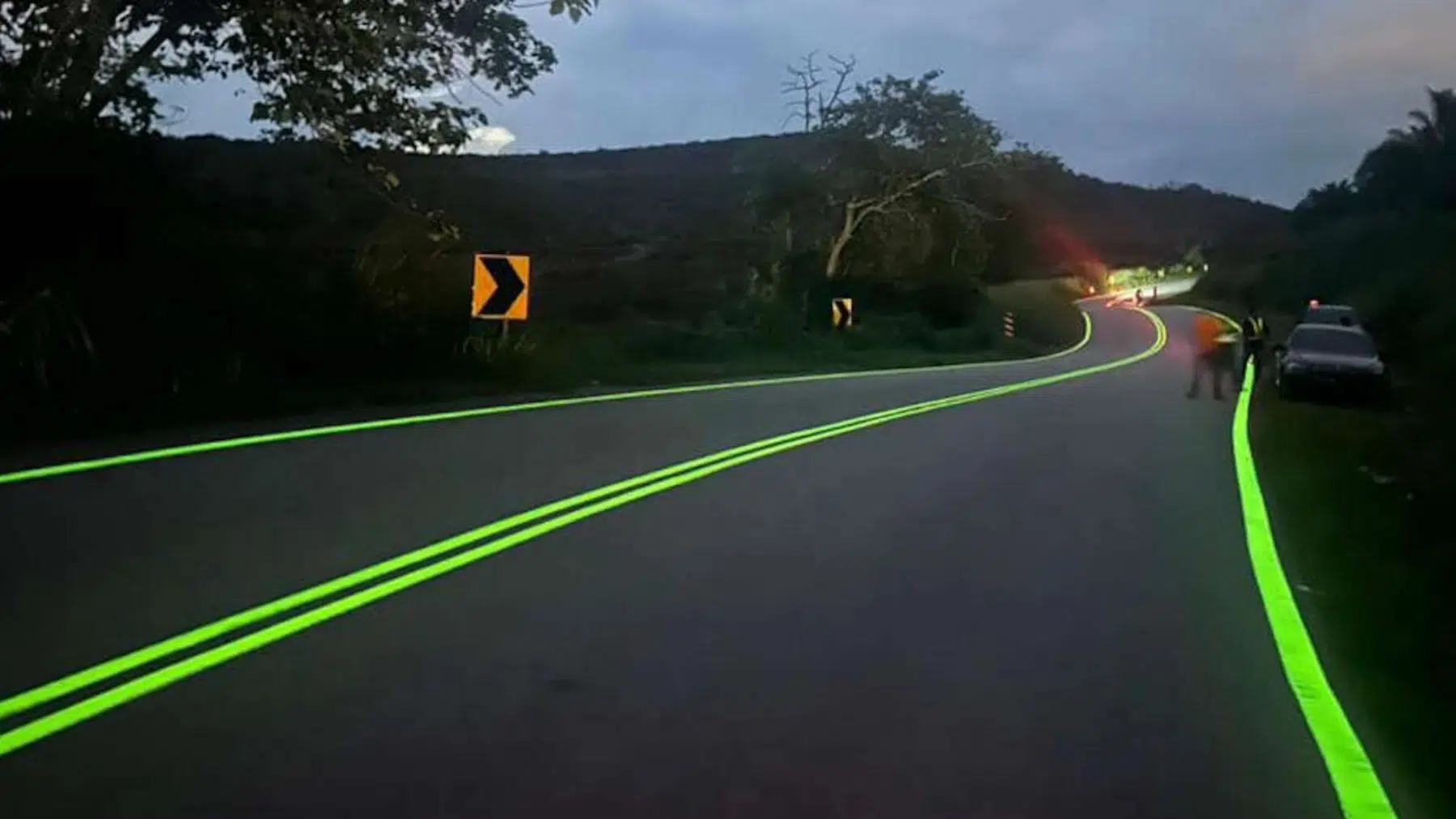
New night driving technology has been surprising for the drivers around the world, after pictures of “glow-in-the-dark” road paint went viral on the internet. The images, captured on a road at the Hulu Langat district in Malaysia, amazed engineers in many countries, and it did not take long for the idea to be implemented elsewhere. Recently, a North American university deployed its shining path with the same technology used by Malaysia. Besides having another intention, both structures have the same goal: to keep the road safe for users.
A successful project inspired this North American university to create its own shining path
Malaysia was among the first countries to deploy glow-in-the-dark road markings. The 245-metre stretch was installed along the intersection of Jalan Sungai Lalang and Jalan Sungai Tekali in Semenyih, Selangor, and was known for being an extremely dark path. With no street lights and a dark surrounding area, the safety of drivers traveling through the area at night or in bad weather conditions was compromised before the new painting was implemented.
After the changes, Malaysians shared pictures of the road online and celebrated the new technology that improves their safety. On social media, drivers shared their opinions, and in a short period, other locations started to adopt the same technology on their roads. The same happened in other countries, which took the Malaysian road as inspiration for their shining streets.
Recently, pedestrians, cyclists, and visitors to Texas A&M University were surprised by the new line painting on campus. The first place to receive the photoluminescent technology was the intersection on the Texas A&M campus, which now has its self-lighting path for cyclists. In the daylight, the path has a bright green color, but at night it starts to glow, lighting the path. Besides this campus installation, other locations are implementing changes to increase safety on their roads.
The university sees its campus as a living lab
Besides being the first luminescent intersection in the United States, the bike path on the Texas A&M campus is part of a living lab for the university. By using the photoluminescent technology, they tried to solve a traffic problem for the students who ride bikes on campus.
According to Robert Brydia, senior research scientist at the Texas A&M Transportation Institute, the initiative helped to solve a major issue:
“Part of the issue is there is a lot of turning traffic at that intersection, so vehicles were turning a lot in front of and across bikes and pedestrians. There was a lot of conflict and interaction at that point.”
A design made to protect bikes and pedestrians
The university was the first to receive permission from the Federal Highway Administration to implement the photoluminescent technology at the intersection. With the changes, they expected to protect cyclists and pedestrians. But the fluorescent path was not the only change made to the path.
Along with the pigment, four islands were implemented near the corners of each intersection. The concrete structure prevents cars from turning into the path of a cyclist. The bike path also has a curb to separate it from traffic and the crosswalk. Thanks to the green color, bikers know exactly where to go.
The same technology might be applied to other streets
While the effects of these changes are being analyzed by scientists from the campus, other streets and intersections are waiting to be renewed. If the results were as positive as they seem, other streets may be painted with the same photoluminescent technology. For the students involved in this project, the tendency is that the same technology will become widely adopted in other locations. In fact, other changes are being implemented to roads and streets in Texas, but there is one in particular that caused some commotion among the population.
Read the whole thing?
Get the week's signal, not the noise
Our sharpest reporting on energy, climate and nature — free, once a week.