

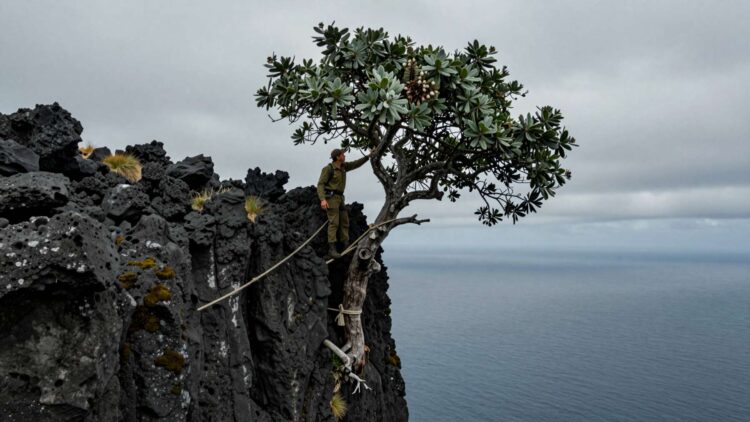
On a steep volcanic cliff on Robinson Crusoe Island — 420 miles off the coast of Chile — a single tree clings to the rock face, held in place by ropes. It is the last known wild individual of Dendroseris neriifolia, a species that was still relatively common in the late 19th century.
Until recently, no seeds from this entire genus had ever been stored in a seed bank. That gap in conservation history left one of the world’s rarest trees with almost no safety net.
The last tree standing
Dendroseris neriifolia is native to the Juan Fernández Islands, a remote volcanic archipelago off the Chilean coast. It once grew across the lowland areas of Robinson Crusoe Island, where early botanists documented it as relatively widespread in the late 19th century. By the time a field expedition arrived in 1980, only seven trees remained, each standing up to 16 feet tall. Today, just one survives — monitored closely by rangers from CONAF, Chile’s national forest agency.
The causes of its decline are familiar and compounding: habitat loss, invasive species, grazing animals, fires, historic forest clearing. The species did not disappear in a single dramatic event. It faded slowly, tree by tree, over more than a century.
D. neriifolia is not alone in this. All 11 species in the Dendroseris genus are struggling — the problem runs across the entire group, not just this one outlier on a cliff.
A dangerous climb for a handful of seeds
Getting to the last wild tree is itself a significant undertaking. Robinson Crusoe Island has no car-accessible roads, and reaching the site requires a four-hour boat journey followed by a two-hour climb over rocky volcanic terrain. There is no easy route.
The tree grows on a steep cliff face. Ropes now support its trunk to prevent it from falling — a small intervention that may be all that stands between the species and total wild extinction.
Each March, when seeds mature, Chilean park rangers climb along the trunk to reach the flowering branches, catching seeds in nets as they naturally release. It is painstaking, physical work performed in an exposed and unforgiving location. New technologies, including drones, may eventually assist with collection in terrain like this. For now, the rangers do it by hand, one careful step at a time.
Seeds reach the Millennium Seed Bank for the first time
The seeds collected from that cliff have now traveled from a remote Pacific island to West Sussex, England. They arrived at the Millennium Seed Bank at Kew Wakehurst — and with them, a quiet but significant milestone. For the first time in history, seeds from any Dendroseris species entered a seed bank.
Scientists ran X-ray analysis on 29 seeds. Twenty-five appeared potentially viable, and seven seedlings are now actively growing within the gardens at Kew Wakehurst, putting down roots in a controlled environment far from the volcanic island where their parent tree still stands. Germination trials are underway, alongside the development of long-term storage protocols to ensure the material remains useful for decades to come.
Genetic bottlenecks and biological hurdles
Storing seeds does not eliminate every risk. When a species is reduced to a single individual, genetic bottlenecks, low fertility, and inbreeding become real threats — and they do not disappear simply because seeds are now in a bank.
D. neriifolia can self-fertilize, which offers some flexibility. But if the tree’s flowering branches are sparse in a given season, seed production may still fall short regardless of that biological capability.
Seed banks address a different set of problems. They allow scientists to study germination requirements in a controlled setting, away from the unpredictability of the wild — and many plant species have complex dormancy needs that remain poorly understood. Working with seeds in a laboratory helps researchers determine what conditions a species actually needs to grow. As Alice Hudson of the Millennium Seed Bank explained, understanding germination opens the door to reintroduction, scientific research, and the potential discovery of future foods or medicines.
A path back to Chile
The seedlings growing at Kew Wakehurst are not the end goal. They are a step toward one. Scientists hope the young plants will eventually reach flowering age and produce more seeds, expanding the bank’s holdings and reducing pressure on the single wild tree.
The protocols developed at Kew are intended to travel back to Chile, where the knowledge gained from cultivating D. neriifolia could support restoration efforts led by Chilean conservationists working on the ground. Seeds and plants could eventually contribute to ex-situ living collections within Chile itself, creating a domestic safety net alongside the international one. The species would no longer depend entirely on one roped tree on a cliff.
What scientists learn from this case may reach further still — offering a working model for emergency conservation of critically endangered plant species that other teams, facing other species on the edge of extinction, could adapt and apply.