Picture the flattest, most featureless place on Earth: a plain of white ice in West Antarctica, so vast it swallows the horizon in every direction.
Nothing moves on it.
Nothing seems to live in it or under it.
What a team of scientists just pulled out of the ground there has turned that picture completely inside out, and the thing they found has been waiting to be read for what initial dating suggests is up to 23 million years.
A place so remote the flights were delayed for weeks
Getting there was its own kind of ordeal.
The drilling site sat more than 700 kilometers from the nearest Antarctic stations, at a deep-field camp at Crary Ice Rise on the edge of the West Antarctic Ice Sheet.
Weather presented a significant challenge, with the drillers’ and scientists’ flights into camp delayed by weeks due to freezing fog at the site.
When the team finally landed, they stepped onto a featureless white plain where the wind cut through every layer of clothing and the sun circled the sky without ever setting.
A team of 29 scientists, drillers, engineers and polar specialists lived in tents on the snow, knowing that success was far from guaranteed.
Two earlier attempts at this same mission had already been thwarted by technical challenges.
The third try, people kept telling each other, had to count.
What it takes to reach mud that no one has ever touched
You cannot just drive a drill into Antarctica’s ice and hope for the best.
To access the sediment below, the team first used a hot-water drill to melt a hole through 523 meters of ice.
They then lowered more than 1,300 meters of riser and drill string pipe down through that hole and into the seafloor below.
Working in shifts around the clock, the crew pressed deeper.
The cold was relentless and the machinery had to be coaxed through every shift.
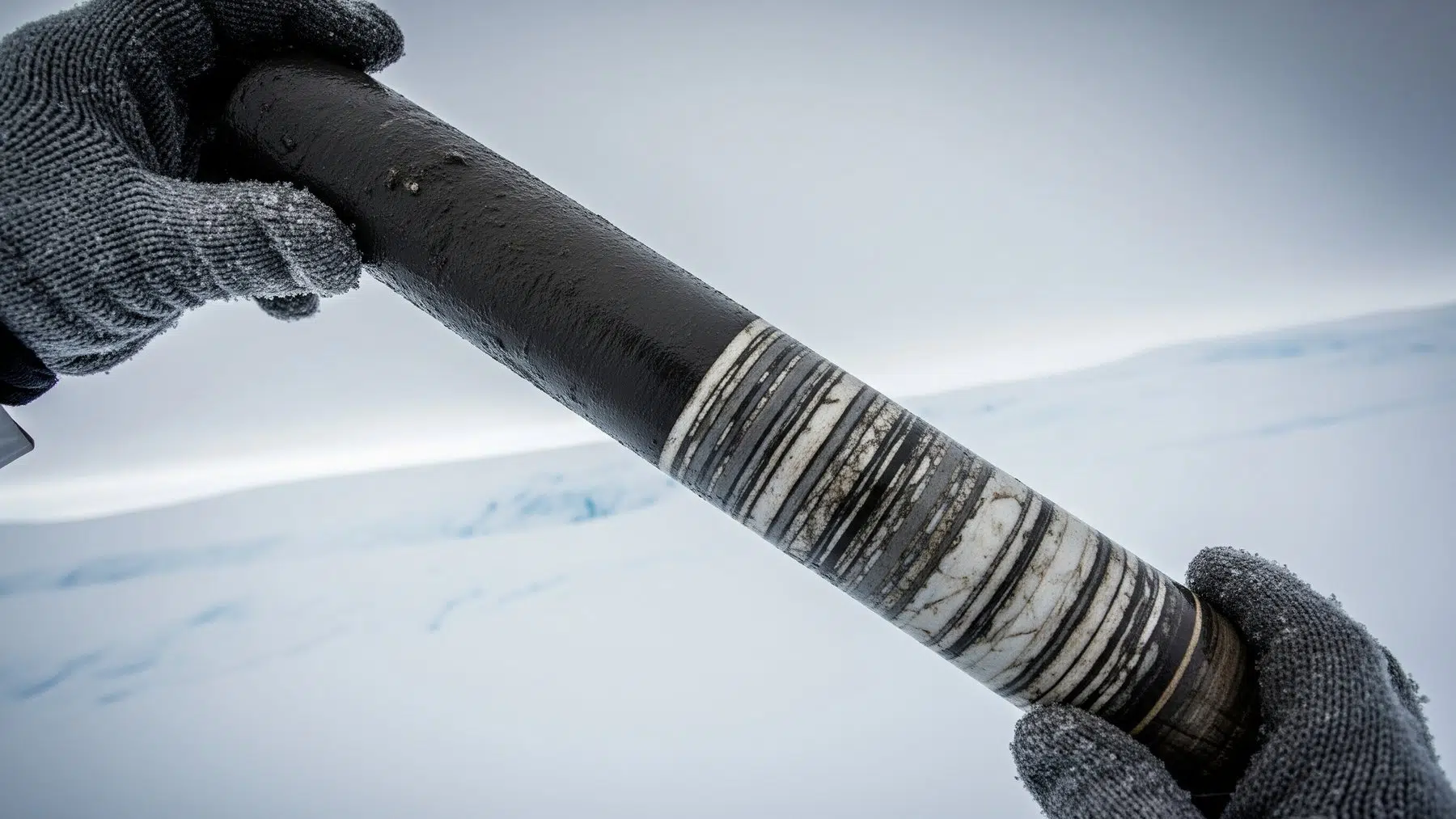
The 228-meter-long core they ultimately recovered contains geological evidence and fossils of marine organisms that indicate a previously open, ice-free ocean.
Think about that for a moment.
Where solid ice sits today, creatures once drifted through a living sea.
Reading mud like a book with millions of pages
Each layer of sediment in the core is a sentence in a very long story about the planet’s past.
Reading the core is like reconstructing past environments layer by layer: when the ice is in contact with the seabed, it bulldozes everything, leaving coarse, mixed debris behind.
Finer, undisturbed layers mean the ice had pulled back and the sea had returned.
Based on preliminary dating of fossils within the core, the record appears to reach back up to 23 million years, containing a climate archive from earlier warm periods.
Those periods include phases when global average temperatures were significantly above 2°C above pre-industrial levels, exactly the temperatures scientists are worried about reaching again this century.
The fossils in those layers are not abstract data points.
They are the shells of real organisms that lived, fed and died in an ocean that no longer exists above that spot.
The mud is, in a real sense, a forecast.
The number hiding in the ice that changes everything
Here is where the story turns from remarkable to urgent.
The vast West Antarctic Ice Sheet holds enough ice to raise global sea level by 4 to 5 meters if it melts completely.
That is enough to swallow the ground floors of cities from Miami to Mumbai.
Until now, scientists lacked direct physical evidence from beneath the ice sheet itself to show exactly how sensitive it is to warming beyond 2°C, because the longest sediment cores previously drilled under an ice sheet were less than 10 meters long.
This new core, at 228 meters, changed that overnight.
The fossils locked inside it are the direct testimony of an ocean that once moved freely where immovable ice now stands, proof that the ice sheet has retreated before and a clue to how fast it could do so again.
What ancient shells mean for the coast where you live
The mud will take years to fully decode.
Determining the exact timing of when the ice advanced and retreated requires detailed geochemical analyses, and the most important numbers are still being confirmed rather than settled.
But the direction of travel is already clear.
Scientists say this sediment core will provide the most comprehensive picture yet of how the West Antarctic Ice Sheet responded to past warming, information that is crucial for estimating how quickly sea levels could rise in a warmer future.
Every shell in that column was once a living creature, floating above a seafloor now locked under half a kilometer of ice.
Animals, as they always do, leave a trail that tells the whole story if you know how to read it.
The scientists camped on the snow in tents, drilling by shifts through an Antarctic summer of endless daylight, specifically so that we can read it before the ending writes itself.
Something extraordinary came up from the dark, wrapped in mud, and it has been waiting there since long before the first human ever looked at a coastline and wondered how permanent it was.
Read the whole thing?
Get the week's signal, not the noise
Our sharpest reporting on energy, climate and nature — free, once a week.