
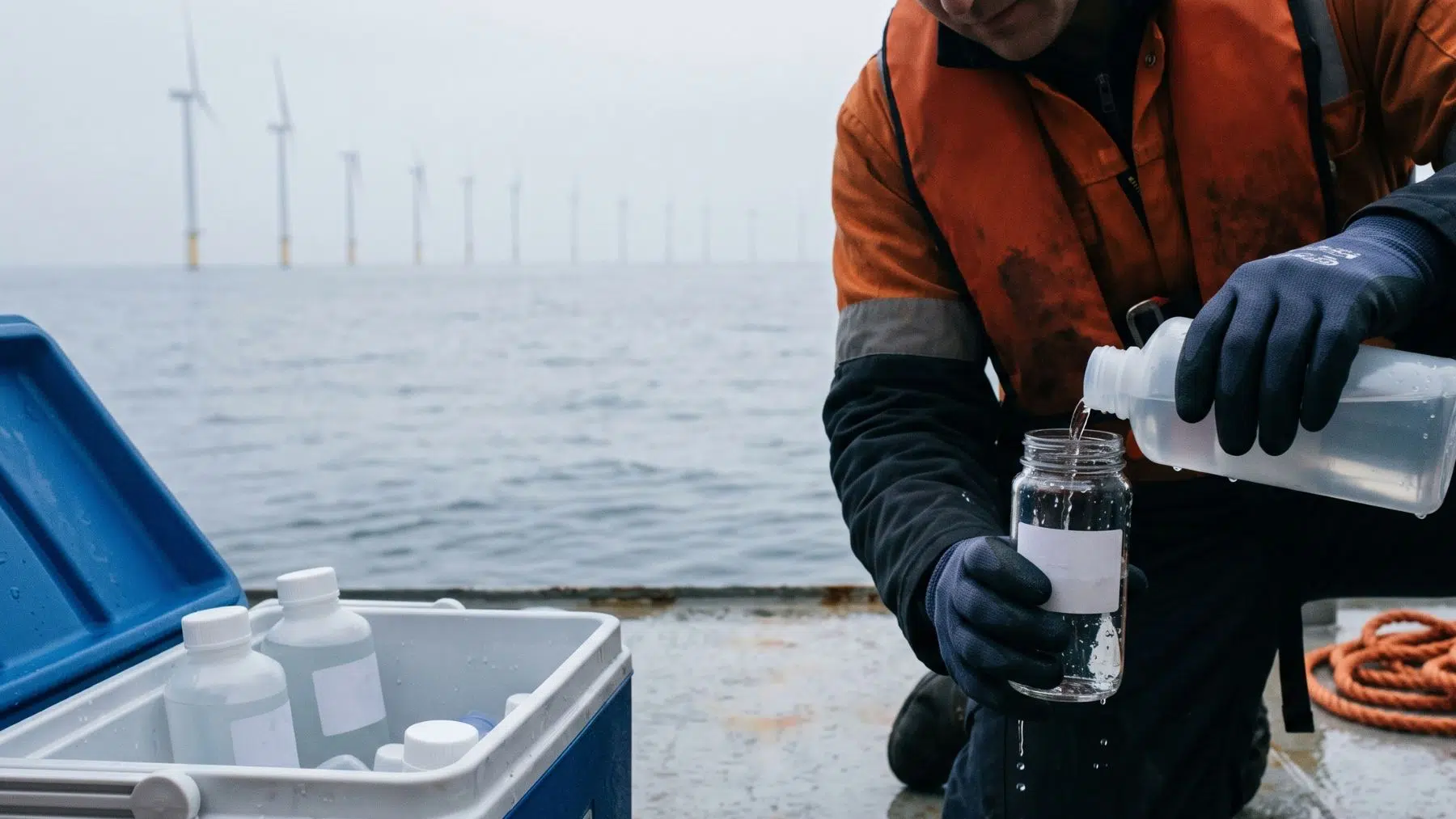
Picture a small boat on the gray North Sea, a gloved hand dipping an empty bottle over the side.
Inside is nothing but plain seawater.
No shark breaks the surface, and none ever will.
Yet the water holds a secret written in traces of DNA.
Something large and toothy passed this way and left it behind.
So how do you find a shark you never see?
The DNA hidden in the water
The answer floats in the water itself. Every fish sheds a faint trail of skin, slime and waste, and each scrap carries its own genetic code. A Dutch research team scooped up 436 seawater samples from in and around four working wind farms, then read the code hiding inside.
What came back surprised them. The water carried the DNA of five shark and ray species, among them the thornback ray, the blonde ray and a small hound shark. One sample even held the mark of a basking shark, the gentle giant that ranks as the second largest fish in the sea.
So the water was hiding far more than anyone expected.
The lead researcher likens the trick to detective work. It is like finding a fingerprint in the water, she said, because even if you never see the shark, the DNA tells you it has been there. This was the first time such traces had been logged inside these farms.
How a steel leg becomes a reef
Each turbine stands on a foundation driven deep into the seabed. Above the sand, that bare steel leg quickly stops being bare. Within a season it furs over with mussels and anemones, and before long it is a living tower from the waterline down.
That crust then feeds a whole chain. Small fish and crabs graze the mussels, bigger fish chase the small ones, and the hunters follow the crowd. A single foundation can shelter hundreds of species stacked from top to bottom.
So the tower works like a reef. It pulls in life where the open sand offered little, and it does so entirely by accident. Someone built a power plant, and the sea built a habitat on it.
A hunter that needs the seabed
Rays and skates are not tower dwellers, though. They are flat bodied bottom feeders that glide along the sand, hunting buried worms, crabs and shellfish. For them the prize is not the steel, it is the open floor around it.
That floor is exactly what heavy fishing tears up. Boats that drag heavy gear across the bottom scrape the seabed bare, flattening the burrows and ridges the rays feed over. Across the crowded southern North Sea, that pressure reaches almost everywhere.
But a trawler cannot fish here. Its nets and cables cannot work between turbines set close together, so inside the farm the bottom is left undisturbed. The one place the machines guard is the exact place the rays need.
Why the fishing free zone matters
This is where a wind farm turns into something more. Bottom trawling is banned inside the farms, not by any grand decree but simply because the boats cannot squeeze between the towers. So each site becomes a fishing free zone by default.
And nobody set out to plan it that way.
That accidental shelter is turning up at an offshore wind farm after farm across the region, where the shark DNA keeps surfacing in the water. Left off the trawlers’ maps, these patches begin to act as de facto refuges for animals that struggle nearly everywhere else.
Still, one caution matters. These farms are young, most built within the last decade, so this is no 40 year old sanctuary. Whether the rays truly moved back in, or simply were never fully gone, is still an open question.
What the DNA cannot yet say
A fingerprint in the water proves a shark passed by, but not much more. It cannot say whether the animal lives there, hunts there, or was merely drifting through. Those 436 samples are a single snapshot, rich but thin, and far from proof of a lasting comeback.
The researcher stays careful about it. We must tread carefully, she said, because if trawling is ever allowed back in, the protection these zones might offer could slip away. So the next step is more sampling, across more seasons, to see who truly stays.
For now the picture is hopeful all the same. A structure built for clean power, like a fox that settles in around some solar panels, can double as an accidental reserve, and the same DNA test can watch it happen without touching a single fish.
It turns out a forest of steel can grow its own kind of wild.
Read the whole thing?
Get the week's signal, not the noise
Our sharpest reporting on energy, climate and nature — free, once a week.


