
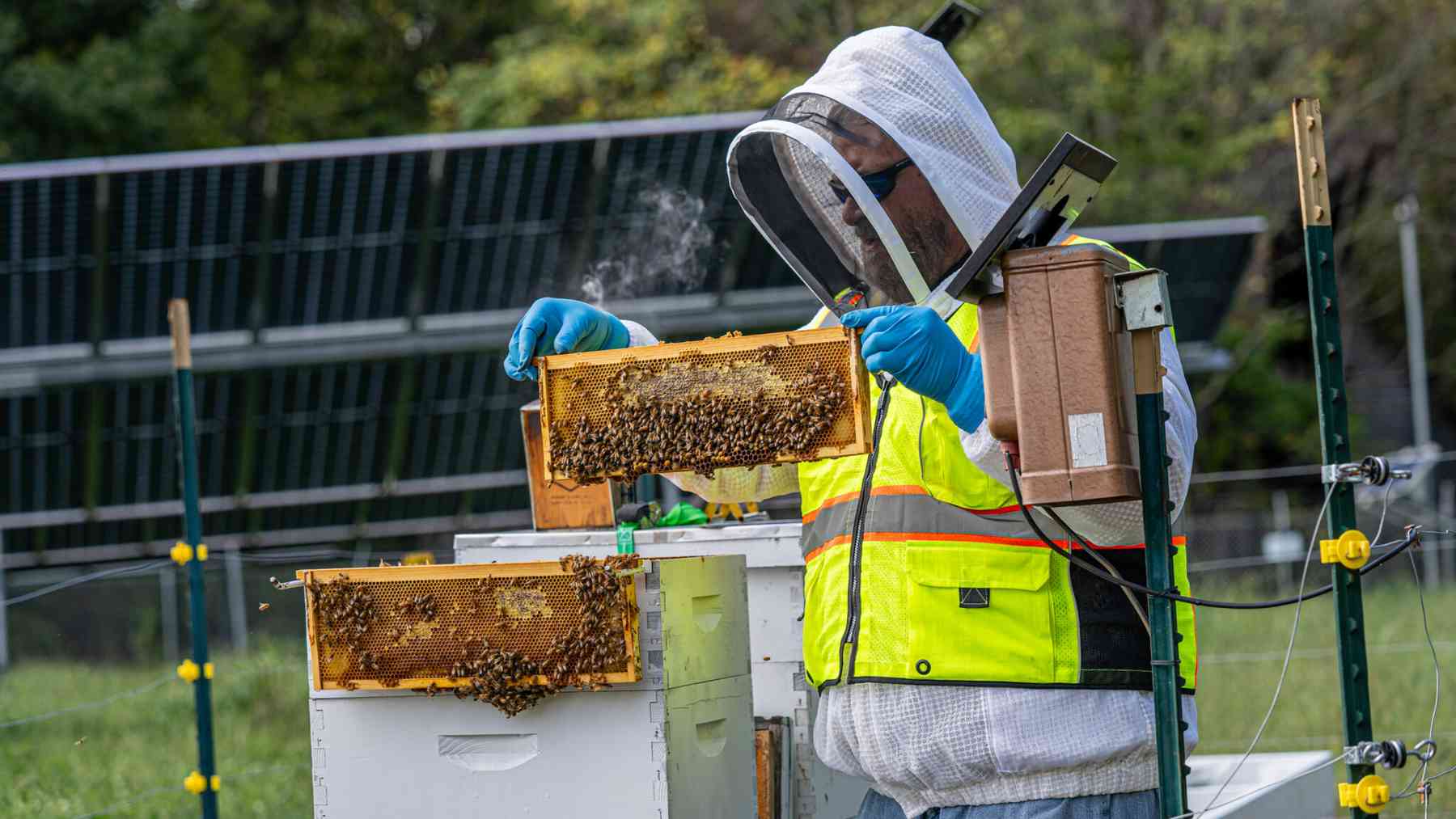
A white box hums at the edge of a Virginia solar field, tucked between rows of dark panels.
Lift the lid and the air turns thick and loud.
Thousands of honeybees crawl over wax combs in the afternoon light.
Nobody put them there to make electricity move any faster.
They are doing something the panels were never built for.
So what exactly are all those bees up to out here among the wiring and steel racks?
What the bees are actually doing between the panel rows
The site is Dominion Energy’s Black Bear Solar in Dillwyn, a 13 acre array with a peak capacity of 1.6 megawatts, enough to power about 400 homes when the sun is out. Beekeeper Chuck Burden of Mountain House Apiaries put four hives inside the fence, an approach called agrivoltaics that pairs power generation with farming or habitat on the same ground. He installed and monitors the hives, which house about 180,000 bees that pollinate wildflowers and crops in a 5-mile radius, according to VPM News.
So the panels generate watts, but the real daily output leaving the fence is pollen. Worker bees fan out in overlapping loops, each one holding the sun’s position in memory alongside an internal clock that corrects for how far it has moved since she left the hive.
That dead reckoning is what gets her home after a foraging trip that can run miles from the box. None of it would work if the ground below the panels were the mowed turf a solar site usually becomes. Burden said Dominion’s solar farms have all a bee could need: native wildflowers, water retention ponds in most cases, fences that keep protein hungry animals like bears and raccoons away, and no pesticides used on the property.
The hive as a small, fenced wilderness
Picture the scene at dusk, panels tilted to catch the last light while bees stream back toward four boxes inside the perimeter fence. The barrier that keeps the public and predators out doubles as protection nobody designed it for.
“A solar farm is an oasis, it’s kind of like a safe place for honeybees,” Burden said. He has also told reporters that ground inside a solar fence, spared herbicide and insecticide, is allowed to recover whatever was grown on it before, and that the surrounding trees and security fencing help keep bears off the hives. That is not a safe place by accident so much as by omission.
Burden determined the site could accommodate up to 24 beehives, and started small with just four, watching how the first colonies handle a full season. The hives are monitored with an array of sensors tracking weight, temperature, noise levels and more. Each small fluctuation in hum or mass can flag a colony in trouble before anyone opens a lid.
What a watched hive actually reveals
The instrumentation lets Burden catch problems early rather than guessing at colony health from the outside, and he has said he plans to double the hive count if the bees do well. Separate research backs the broader pattern well beyond this one Virginia field.
At Iowa State University’s agrivoltaics site, researchers added native perennial flowering plants near the hives. They found that doing so led to a 412 percent rise in honey production for a collection of honeybee colonies, without interfering with energy generation or farming efforts, a jump that points to the flowers, not the hardware, as the driver.
At two Minnesota solar sites seeded with native grasses and wildflowers, Argonne National Laboratory scientists logged the same direction of change. In less than five years the team observed rapid increases in habitat and biodiversity metrics, and by the end total insect abundance had tripled while native bees showed a 20-fold increase in numbers. Pollinators from the solar sites also visited soybean flowers in adjacent crop fields, providing additional pollination services. None of this means every solar field becomes a meadow, since the gain shows up only where someone plants the right flowers and skips the herbicide, a deliberate choice rather than a byproduct of the panels.
Where the sky itself does some of the work
A forager does not simply wander until she finds flowers and then wander home. She reads the sun’s position, runs an internal clock to correct for its drift across the sky, and when cloud hides it she falls back on a pattern of polarized light invisible to human eyes. That light is caught by a narrow band of specialized cells along the top edge of each compound eye.
Back in the dark hive, she repeats that bearing as a dance on the vertical face of the comb, translating the angle between hive, sun and flower patch into a straight waggling run her sisters then follow out the door.
It is a celestial navigation system packed into an insect smaller than a thumbnail, and the foragers among those 180,000 bees are reading the sky the whole way out and back.
What still has to go right for this to hold
None of this guarantees a solar farm becomes pollinator habitat on its own. The flowers, the skipped pesticides and the beekeeper reading sensors are choices layered onto the hardware, not something the racks do by themselves. A site that keeps mowed turf under its rows gets none of the benefit, however much electricity it sends to the grid.
Even so, Dillwyn offers a small working answer to a question utilities are only beginning to ask, which is what else fenced, protected acreage can do while the panels work. Four hives on 13 acres, on a site judged able to hold about two dozen, is a modest test, and the sensor data will decide whether it grows.
That same instinct, wringing a second job out of land and hardware built for one task, shows up elsewhere too, from floating panels on a water reservoir to fish tracked past a dam, each one finding something extra where nobody planned for it.
Read the whole thing?
Get the week's signal, not the noise
Our sharpest reporting on energy, climate and nature — free, once a week.


