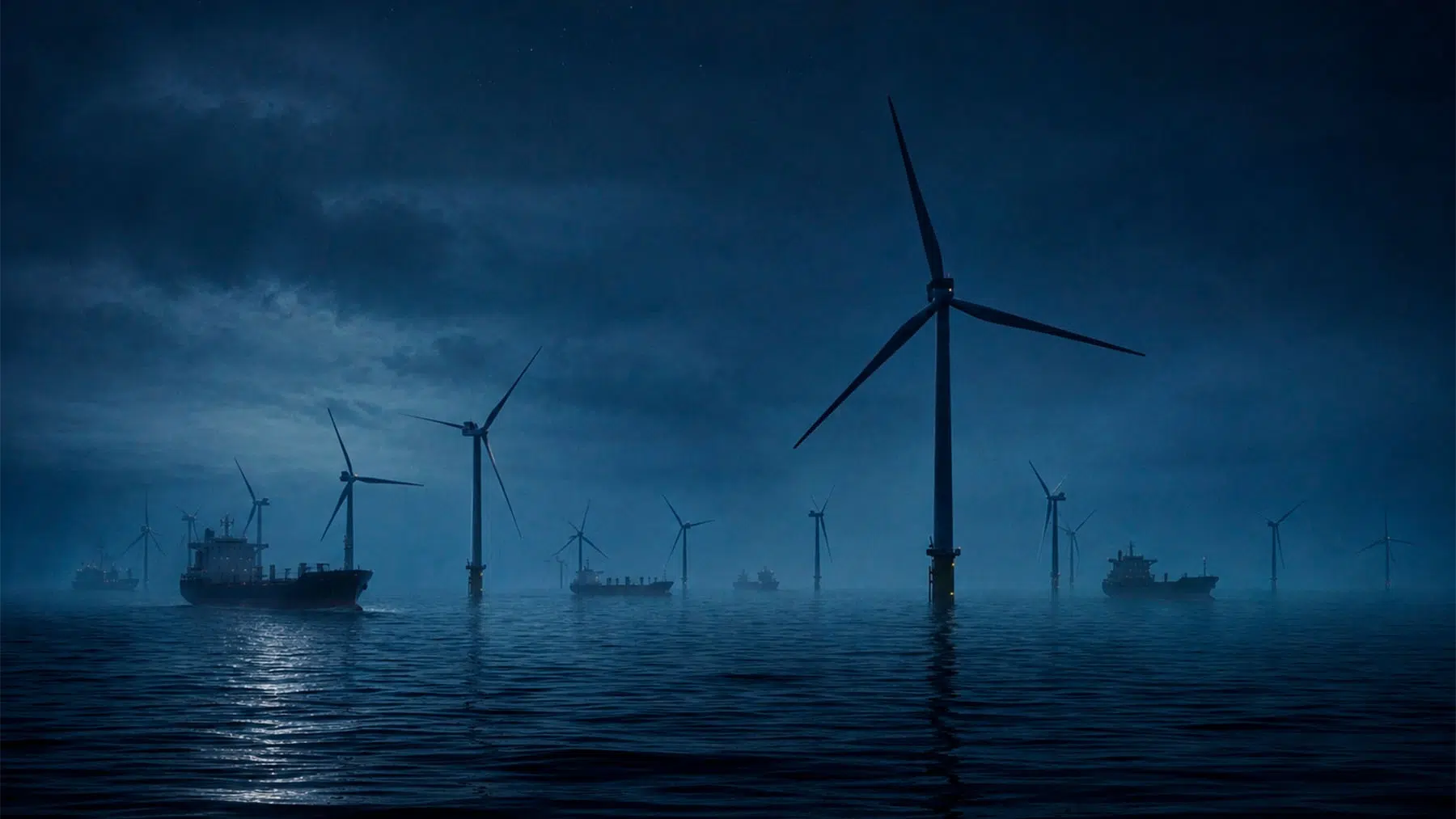
Captains navigating near offshore wind farms have been reporting worrying situations for years.
Ships are vanishing, but not into the sea. Into a digital radar blind spot that lasts just long enough to trigger panic in crowded shipping lanes.
The reality is that navigation systems can’t keep up at the rate that massive steel turbines are multiplying.
Researchers were driven to launch an unusual experiment in the middle of turbine fields and track what happened.
What they discovered explains why ships with the latest tech are suddenly going dark.
What do offshore wind farms have to do with marine radar systems?
Ship radar is normally reliable. It works by sending out radio waves and measuring the signals that bounce back.
On screens, vessels are expected to stand out clearly against the open water.
But offshore wind farms changed that environment completely.
Instead of seeing clean vessel targets, operators often see overlapping reflections from turbines and nearby ships.
In some situations, smaller vessels partially disappear inside the interference.
Researchers have become especially worried about crowded coastal shipping lanes.
Fishing boats, cargo ships, and coastal monitoring crews can’t go about navigating blindly indefinitely. Something catastrophic is bound to happen.
Experts carried out controlled navigation tests around operating turbine arrays to study the problem properly.
An experiment placed 53 separate vessels inside offshore wind farm environments while radar systems monitored their movement.
The goal was simple: find out exactly how turbine structures distorted radar tracking at sea.
Why navigating the new ocean grid is getting dangerous
Researchers observed several repeating problems once vessels moved deeper between turbine rows.
Radar targets became unstable.
Some ships appeared stretched or fragmented on navigation screens. Others faded briefly before reappearing moments later.
The effect became more severe in rough weather and at certain viewing angles.
Add rotating blades to the mix and there’s another layer of interference.
These factors increase the difficulty of separating ships from background clutter. And smaller boats face the biggest visibility problems.
Vessels are becoming difficult to track consistently while operating near dense turbine groupings.
Researchers also discovered that spacing between turbines matters a lot.
Certain layouts create cleaner radar conditions than others.
The tests eventually revealed patterns that help operators improve vessel detection inside offshore wind farms.
Instead of treating the turbines as isolated obstacles, radar systems need to process the entire wind farm environment differently.
US Wind realized that this is one of the most important findings in the experiment.
The new reality of floating wind turbines changing maritime environments is now the norm.
Radar needs to be advanced at the same time that wind farming expands
Obviously, ships are not disappearing.
Radar interference created by towers and blades is, according to the University of Texas at Austin.
Large metal structures catch radar signals and send them straight back toward ships and coastal monitoring systems.
Weaker returns from nearby vessels get overwhelmed.
Rotating blades complicate things further by producing constantly shifting echoes. As the blades move, they create shifting radar echoes that constantly change shape and intensity.
Their movement produces fluctuating radar returns that look similar to moving vessels.
Even as new wind energy systems emerge, the issue persists in the open sea.
A 53-ship experiment is rewriting the rules of maritime radar
Researchers found that ship detection improved when radar systems filtered turbine reflections differently.
It’s also essential to track vessel movement over longer periods and considered layout.
Some turbine grid formations created relatively stable tracking conditions. Others produced severe blind spots and fragmented vessel signatures.
New problems are cropping up even as solutions are being engineered in other areas of weakness.
How will we use this discovery to foster maritime safety as the world’s turbine fields expand?
Read the whole thing?
Get the week's signal, not the noise
Our sharpest reporting on energy, climate and nature — free, once a week.