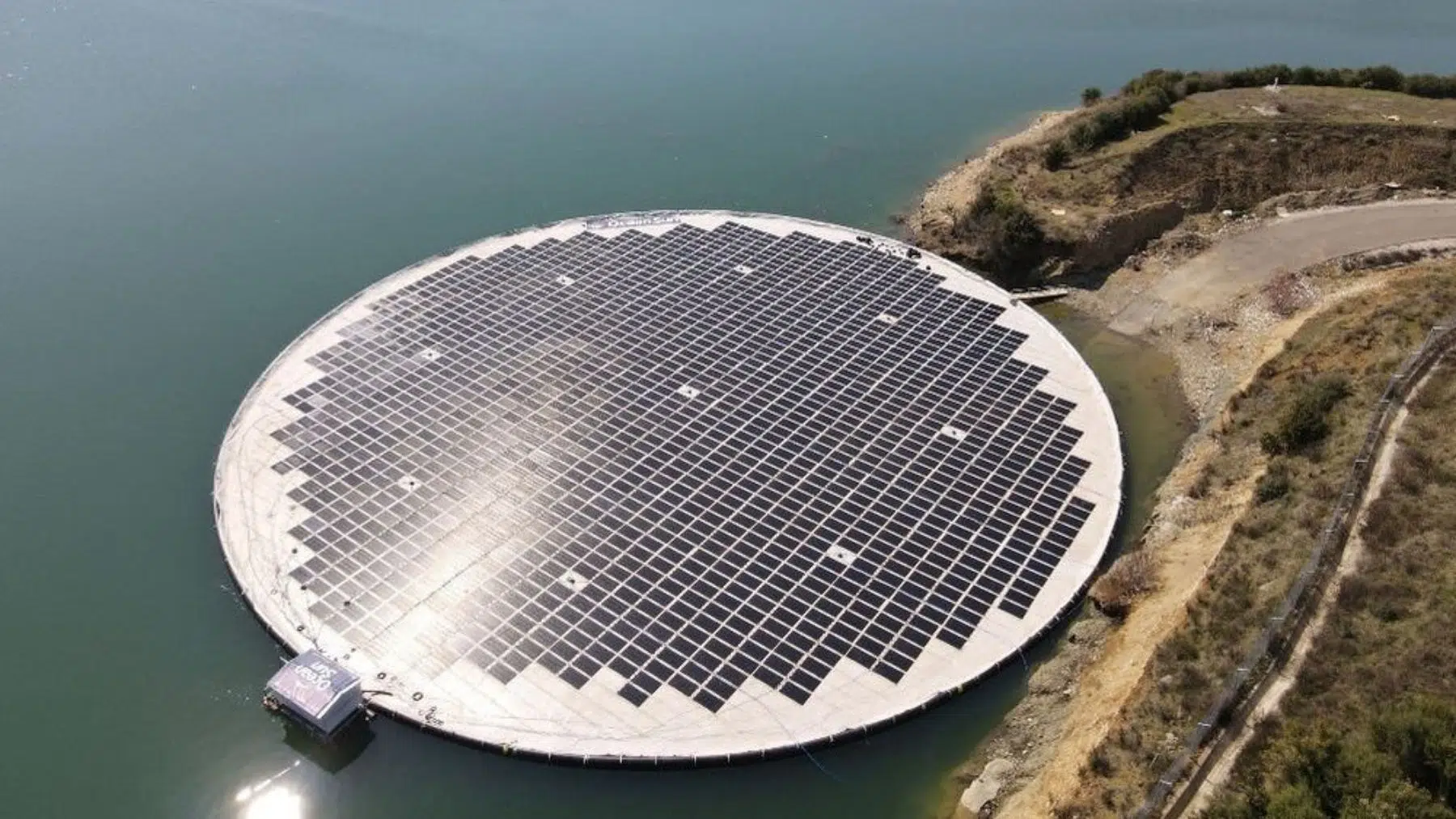
A floating solar plant quietly snuck up on a reservoir in Albania last year.
Its panels rested on an odd platform that used water itself as a cooling surface.
Engineers hoped the design would improve efficiency during hot summer conditions.
But suddenly, twisted sections littered the reservoir only days after installation crews downed tools.
The collapse confused observers. Nothing suggested an explosion or major equipment failure.
But weather records pointed toward something far stranger.
What took out the floating solar plant?
Why engineers thought floating solar panels on a reservoir was a good idea
Banja hydropower reservoir in Albania is the home of what was meant to be a smart solar solution.
Developers wanted a floating array that could work alongside existing hydroelectric infrastructure.
The plan came across as a good one—on paper, that is.
It may seem contradictory, but solar panels lose efficiency when they become too hot.
So cooling them with water naturally located underneath is smart, right? In theory, the cooling effect will improve electricity production.
The floating installation also avoided farmland or forested terrain.
So Statkraft engineers anchored the platform directly onto the reservoir surface.
Crews from one of Europe’s largest renewable energy producers finished assembling the solar arrays. All seemed calm as the water.
Then conditions shifted unexpectedly.
Wind speeds rose quickly over the reservoir basin.
Within hours, parts of the floating structure began breaking loose.
Disturbing photographs showed damaged sections folded into the water like paper.
Drifting everywhere except where they should have been.
Investigators looked to an anchoring system failure first.
The culprit turned out to be beyond the usual suspects.
Sayanara, solar: The weather event nobody expected
Early inspections found no evidence of electrical malfunction.
The platform itself had been designed for rough outdoor conditions.
Attention soon moved toward the atmosphere above the lake.
Meteorologists reviewing local conditions discovered signs of a powerful rotating wind event crossing the reservoir.
Witnesses described violent gusts striking the floating structure without warning.
Engineers later concluded the solar plant had likely been hit by a small tornado or waterspout.
That mattered because floating platforms behave differently from ground-mounted systems.
The panels sat on connected pontoons that shifted with wave motion.
Once strong rotational winds pushed against one section, stress spread rapidly across the structure.
Anchoring cables tightened unevenly.
Parts of the floating array twisted sideways.
Several sections detached completely.
The reservoir itself may have intensified the instability.
Warm air moving across cooler water can sometimes create localized atmospheric rotation under the right conditions.
Statkraft believes the unusual wind event overwhelmed the floating system before operators could react.
The evidence says it was all out of man’s hands
Investigators concluded the plant collapsed after a sudden tornado-like wind vortex crossed the Banja reservoir.
The rotating gusts tore through the floating structure only days after installation work had finished.
Panels shifted out of alignment first. Then, sections of the platform separated as anchoring forces became uneven across the reservoir surface.
A renewable energy project that was changing the environment around it, dramatically at that.
Why did the disintegration catch engineers by surprise?
Floating solar systems are normally designed to handle heavy rain and changing water conditions.
But violent rotating winds create different stresses entirely.
Unlike ground-mounted panels, floating arrays move constantly with the water beneath them.
That flexibility becomes dangerous during abrupt crosswinds.
The Banja incident quickly drew attention because floating solar projects are expanding worldwide.
Reservoir-based systems are now appearing across Europe, Asia, and South America.
The collapse highlighted how little data engineers still have about extreme weather impacts on large floating platforms.
For now, the damaged Albanian project remains a warning.
A solar plant designed to stay cool on water ended up destroyed by the same environment supporting it.
Read the whole thing?
Get the week's signal, not the noise
Our sharpest reporting on energy, climate and nature — free, once a week.