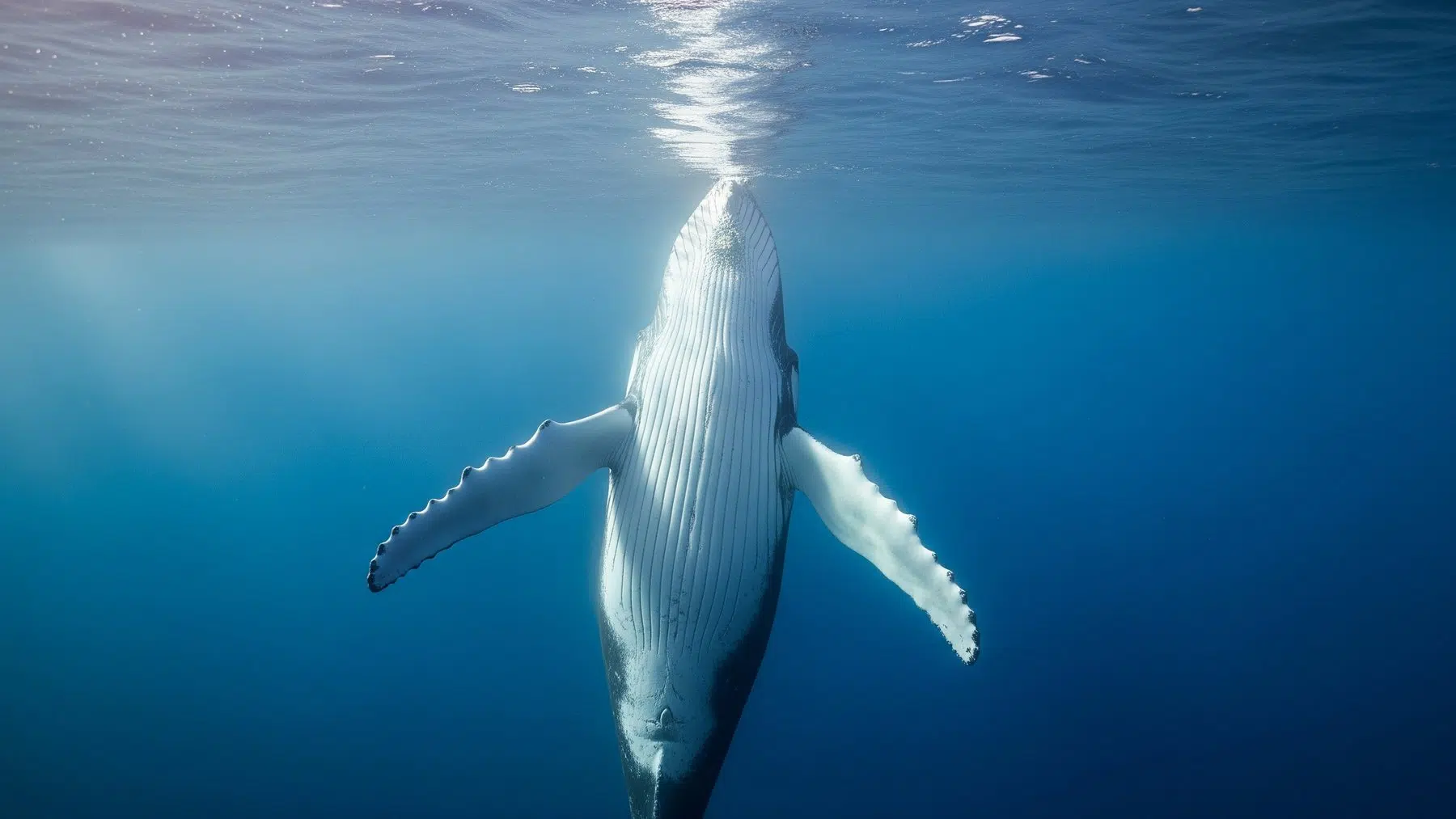
Picture a creature the size of a school bus hanging motionless in dark water, mouth slightly open, body trembling from the inside out. No air escapes. Not a single bubble rises. Yet what leaves that animal is one of the most elaborate signals ever produced by any living thing on Earth, and for a very long time, we had almost no idea what we were actually hearing.
A sound people assumed they understood
Most of us grew up with the idea of whale song as a kind of beautiful mystery, haunting and wild but basically simple. A male calling for a mate somewhere in the blue.
That picture turns out to be almost entirely wrong. The more scientists listen, the stranger and more intricate the story becomes, and the strangeness starts with the sheer physical scale of what these animals broadcast.
Some of the lowest-frequency notes in humpback songs can travel up to 10,000 miles through the ocean without losing energy. That is roughly the distance from New York City to New Zealand, carried on a single breath of sound.
Early researchers assumed the songs were simple mating advertisements, roughly equivalent to a bird call. The idea that something far more layered was embedded in that sound did not gain serious traction until acoustic technology caught up with the biology.
The ocean has a built-in broadcast system
The reason the signal travels so far comes down to physics. The ocean sound channel lets whale songs travel thousands of miles, bouncing between temperature and pressure layers like a natural waveguide.
The whale does not shout louder. The ocean does the work. A humpback singing in the Caribbean has been heard by a fellow whale off the west coast of Ireland, more than 4,000 miles away, without burning any extra energy to get there.
In a world where underwater visibility often runs to just a few feet, sound is effectively the whale’s entire landscape, its map, its social world, and its living culture.
Think of it as a planetary-scale communication network that predates any human technology by millions of years, built from nothing but water, pressure and the physics of moving molecules.
Songs that change like fashion trends
A single performance can last 10 to 20 minutes and be repeated continuously for hours. Some males sing for more than 24 hours straight.
But the content of those performances does not stay fixed. The song continually evolves, being passed from one population to the next, with all males incorporating new changes as populations come into contact.
New phrases spread across oceans the way a hit song spreads across a continent, whale by whale, current by current. A motif heard off the east coast of Australia can appear in French Polynesia and beyond within a few years, carried entirely by listening and imitation, a pattern documented across the entire South Pacific basin.
Researchers recording the same population across successive seasons have watched entirely new passages replace older ones, the way a chorus gets rewritten before the next tour begins.
The grammar no one expected to find in humpback whale song
Here is where the story tips into something genuinely startling. Research published in the journal Science uncovered the same statistical structure that marks human language inside humpback whale song.
Across different languages, the most common word appears roughly twice as often as the second most common word, three times as often as the third, and so on. This pattern, called Zipf’s law, is thought to make language easier to learn, and humpback song follows the same curve. Some researchers in the field have noted that Zipf distributions can also emerge from random fragmentation of any sequential signal, and caution against reading too much into the parallel.
Researchers used the same tools scientists apply to understand how human babies learn to speak, then found those tools, applied to whale recordings, uncovered structures present in all human languages.
Scientists are careful to note this does not prove whales have fixed meanings attached to specific sounds, but the structural parallel is real and independently corroborated.
What the ocean is trying to tell us
This work reveals a deeply unexpected commonality between humans and humpbacks, united by the fact that their communication is culturally transmitted. These animals are not running a hardwired script. They are learning, borrowing and passing songs on across generations.
The sobering thread involves what happens when the broadcast channel gets jammed. As oceans grow noisier with boat traffic, construction and drilling, a song that evolved to carry thousands of miles can be smothered at far shorter range.
A critically endangered sea creature does not get a second chance at communication once that channel goes dark. For an animal whose entire culture travels by sound, losing the signal means losing the thread that holds the whole society together.
The hopeful side is that scientists are now listening with far sharper tools than before. Once we stop treating whale song as mere noise and start treating it as a cultural system worth protecting, the marine mammals that depend on a working, low-noise ocean have a much better case for getting one.
Read the whole thing?
Get the week's signal, not the noise
Our sharpest reporting on energy, climate and nature — free, once a week.