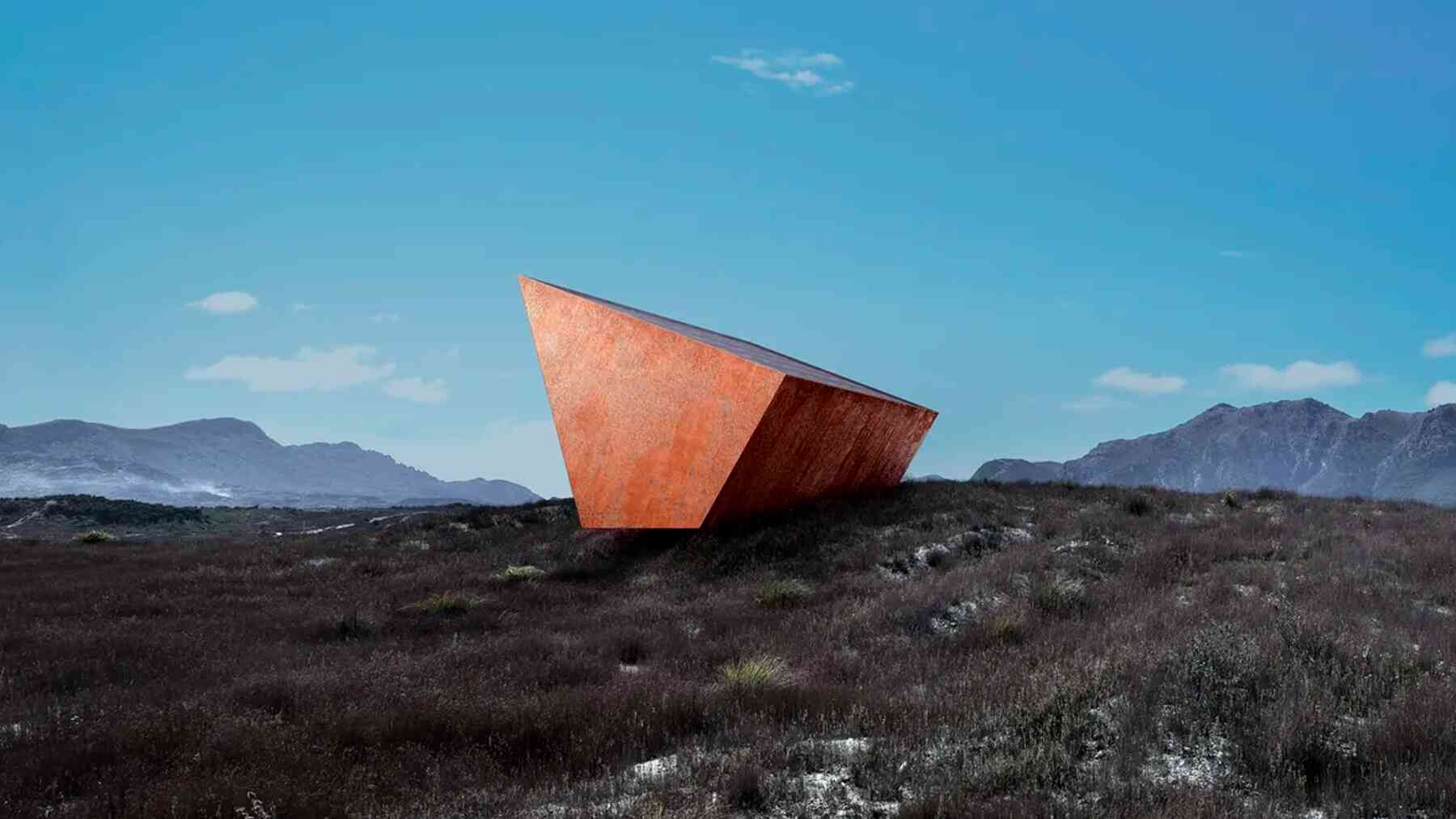
A 52-foot monolith of reinforced steel and concrete is set to rise on the edge of a remote Tasmanian airfield before the end of this year. Built to survive cyclones, earthquakes, floods, and fire, it is engineered to outlast the civilization that created it.
But this is not a monument to human achievement. It is a recorder of human failure — a doomsday archive designed to document Earth’s environmental collapse for whoever, or whatever, comes next.
A flight recorder for the end of the world
The concept behind Earth’s Black Box comes from Rouser Lab, an Australian experimental environmental communications agency that unveiled the project nearly five years ago. The idea is straightforward: just as aviation black boxes survive crashes to explain what went wrong, this structure is meant to survive civilizational collapse and tell the same story on a planetary scale.
At 52 feet long and 13 feet high, built from reinforced steel and concrete, it is engineered to withstand cyclones, earthquakes, floods, fire, and deliberate attack. Rouser Lab describes it as designed to outlast the society that built it — a deliberate inversion of most construction projects, which assume the civilization around them will endure. Installation is planned for December, on the edge of a remote Tasmanian airfield, with parts assembly already underway.
What goes inside — and where it comes from
Power will come from 36 solar panels mounted on the roof, protected by layers of toughened glass, keeping internal drives running continuously. Data streams in via the internet from space agencies, weather agencies, and universities around the world.
That aggregated stream has a name: Earth’s Vital Index. Described as a real-time archive of the planet’s environmental health, it pulls together datasets, measurements, and interactions relating to planetary conditions — not just one type of climate metric, but a comprehensive picture of how Earth’s systems behave over time. There is no planned end date.
Five years of silence — and why it took so long
When Rouser Lab first announced Earth’s Black Box in 2020, the response was significant. Then came years of near-silence, leading some observers to conclude the project was advocacy theater — designed to generate headlines rather than hardware.
Artistic director Jonathan Kneebone pushes back on that reading. He told The Guardian that the team spent those years evolving the design, refining data storage systems, identifying source materials, and developing funding models to sustain the project long-term. Rouser Lab bills itself as an experimental environmental communications agency — a communications project with a technical component, not a research institution. The delay reflected genuine development, not abandonment.
Who is the intended audience — and when?
The most striking version of Earth’s Black Box’s intended audience is one that does not yet exist. Rouser Lab envisions future civilizations accessing the stored data to understand what happened to the society before them and, ideally, to avoid repeating the same mistakes.
In the near term, the box is meant to function as an objective real-time archive for scientists, students, journalists, and the general public. The stated mission is to provide an unbiased account of the events leading to environmental decline, hold current generations accountable, and inspire urgent action. Rouser Lab is also developing a companion project called Climate S.O.S. — a planned 164-foot techno-obelisk topped with a radio telescope, intended to broadcast a distress signal into space.
Useful archive or elaborate symbol?
The honest question is whether Earth’s Black Box adds something that does not already exist. There is already an enormous volume of free, open-source climate data available to anyone with an internet connection. Existing repositories are well-maintained and widely distributed, with no particular reason to assume they will be inaccessible to future generations.
What the box may offer is something harder to quantify: renewed public attention. A massive, permanent, explicitly doomsday-framed structure could re-ignite interest in the climate crisis — at least until the news cycle moves on. Whether that justifies the scale of the undertaking is a separate question entirely.
Rouser Lab frames the project with a line that functions as both a mission statement and an open challenge: “How the story ends is completely up to us.” Whether that story needs a dedicated monolith to be told is worth considering. The more uncomfortable version of that question is whether we are building archives because we have stopped believing we can change the outcome.
Read the whole thing?
Get the week's signal, not the noise
Our sharpest reporting on energy, climate and nature — free, once a week.