

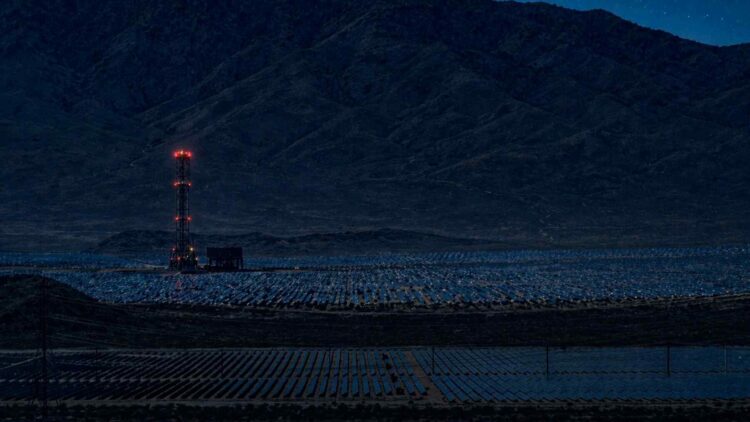
By day, they look quiet.
Endless rows of solar panels, absorbing sunlight and feeding clean energy into the grid. No movement. No noise. Just infrastructure doing its job.
But when night falls, something changes.
The same place becomes active.
Alive.
And according to new research, it turns into a hunting ground for one of the most misunderstood mammals on Earth.
So what’s really happening after dark?
How solar farms are quietly reshaping natural habitats
Solar energy has been expanding rapidly across the world.
Large fields once used for agriculture or left unused are now covered in panels, designed to capture sunlight efficiently. From a distance, they seem like simple, static environments.
But they are not empty.
Once construction ends, these areas often see less human activity than the surrounding land. Over time, vegetation begins to grow beneath the panels—sometimes intentionally planted, sometimes naturally returning.
That vegetation attracts insects. And where insects gather, something else follows.
At first, this shift is easy to miss.
But for one researcher, it became impossible to ignore.
A closer look at what happens when the sun goes down
A student from William & Mary set out to study something specific.
Not the panels themselves—but what happens around them at night.
Her focus was on bats.
To track their presence, she used acoustic monitors, devices that capture the ultrasonic clicks bats use for navigation and hunting. These sounds, normally inaudible to humans, reveal which species are active and how they behave.
The results were unexpected.
Bats weren’t just passing through solar farms.
They were gathering there in significant numbers.
And not just to hunt.
The moment researchers realized something had changed
At first, the explanation seemed simple.
More insects meant more food. Solar panels create shaded, slightly cooler environments that help retain moisture in the soil, encouraging plant growth.
That attracts insects. And insects attract bats.
But the data suggested something more.
Some bats were staying, returning night after night.
Then came the discovery that changed everything.
Inside the structure of the solar panels—within the metal frameworks and supports—there were signs of something much bigger.
The study, “Harnessing the sun to help the night,” published in W&M News, says that bats were using them as shelter.
The “feared and mysterious” mammals revealed
The animals at the center of this shift are bats.
Often misunderstood, sometimes feared, they are actually vital to ecosystems, controlling insect populations and supporting balance in natural environments.
In this case, they found something unexpected in solar farms.
A new habitat.
The panels provided multiple advantages at once.
Food was abundant, thanks to the insects drawn to the vegetation below.
The structures themselves offered protection from predators.
And the residual heat from the panels created a stable, warm environment—ideal for raising young.
Researchers even found evidence of bat nurseries within the solar installations.
Not just temporary use.
Permanent adaptation.
Why solar farms are becoming ideal hunting grounds
What makes this environment so effective is the combination of factors working together.
The physical structure of the panels offers places to rest, hide, and reproduce. It’s a complete ecosystem—built unintentionally.
What started as an energy solution has become something else entirely.
A hunting ground.
And a home.
What this reveals about nature’s ability to adapt
This discovery highlights something important.
Nature doesn’t simply disappear when environments change.
It adapts. Sometimes in ways we don’t expect.
Solar farms were never designed for wildlife. But under the right conditions, they can support it.
That doesn’t mean every impact is positive. Habitat loss and disruption still matter.
But it shows that new environments can create new opportunities.
In this case, for bats.
Animals often seen as mysterious or even threatening are now playing a role in balancing ecosystems within human-made spaces.
And as solar energy continues to expand, these hidden interactions are becoming more common.
Because what looks like a quiet field of panels during the day might be something very different at night.