

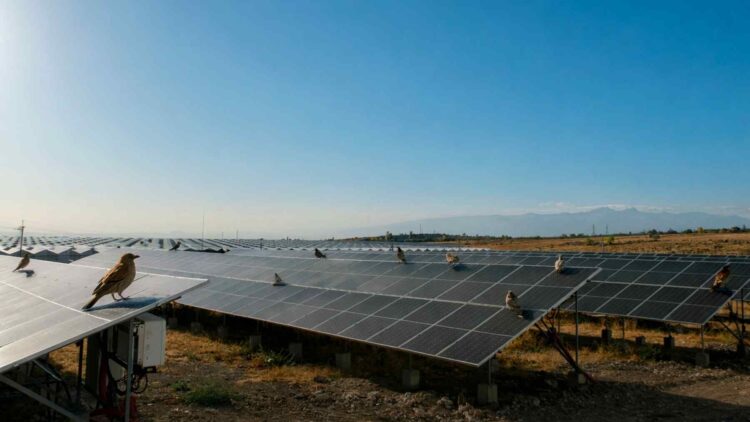
It wasn’t supposed to be about wildlife.
The goal was simple: generate clean energy more efficiently, using large solar installations built on open land.
But when researchers started taking a closer look at what was happening inside these sites, they found something no one expected.
A quiet transformation was already underway—so what exactly was growing inside these solar farms?
How solar plants began changing more than just energy production
As solar power expanded across the world, developers began rethinking how these sites could be used.
Instead of leaving the land barren, some projects introduced native vegetation beneath the panels. Wildflowers, grasses, and low-maintenance plants were added to support pollinators.
At first, it was a small adjustment.
A way to make solar farms more environmentally friendly.
But over time, something shifted.
These areas, often fenced off and protected from human activity, started to behave differently from the surrounding land.
They became quieter. More stable. Less disturbed.
And that created the perfect conditions for something to return.
The soil began to heal.
Without constant tilling or heavy pesticide use, microbial life flourished.
Deep-rooted perennials started sequestering carbon more effectively than traditional turf. This structural stability prevented erosion and improved water filtration.
The panels acted as a shield, cooling the earth and preserving the moisture necessary for growth.
A hidden ecosystem starts to take shape under an industrial energy installation
What researchers began to notice wasn’t immediate.
It took careful observation across multiple sites to understand the pattern.
Solar farms were not just hosting a few insects or isolated plants. They were supporting entire ecosystems.
The combination of shade from the panels, stable soil conditions, and reduced human interference created a unique environment.
Cooler ground temperatures helped retain moisture.
Vegetation had space to grow undisturbed.
And small species—often pushed out of agricultural or urban areas—found a place to settle.
Still, the scale of what was happening wasn’t fully clear.
Until one study brought everything into focus.
What scientists actually found inside these solar sites
A comprehensive study in Germany revealed just how significant the impact had become.
Researchers documented more than 300 plant species thriving within ground-mounted solar farms.
Alongside them, over 30 species of grasshoppers were identified, taking advantage of the diverse vegetation.
And perhaps most surprisingly, 13 different species of bats were also recorded in these areas.
These weren’t isolated cases.
They were part of a broader pattern showing that solar installations, when designed with nature in mind, can support hundreds of species.
A study from Sonne Sammeln reveals that in total, some sites contributed to ecosystems involving more than 500 different forms of life.
What started as an energy project had quietly become a biodiversity refuge.
Why this unexpected effect could reshape future energy projects
Solar farms have often been seen as purely functional—tools to reduce emissions and generate electricity.
But this discovery adds a new dimension.
They can also restore habitats.
By limiting human disruption and introducing native plant life, these sites create safe zones where species can recover and grow.
That doesn’t mean every solar farm has this effect.
Design matters. Management matters.
But the potential is there.
This evolution transforms energy sites into critical corridors for migration.
High-tech sensors now monitor these “solar commons” to track soil health and biomass density.
By integrating ecological goals into the initial blueprints, developers can mitigate the land-use footprint.
The dual-purpose model proves that industrial scale and biological richness can coexist.
And as renewable energy continues to expand, projects like these suggest that the transition to clean power doesn’t have to come at the expense of nature.
In some cases, it may be doing the opposite—quietly bringing it back.