Just after sunset the gravel between the rows starts moving.
Something small and pale slides out from under a steel frame, ears far too big for its head, and stops in the open with one paw lifted.
It weighs about five pounds.
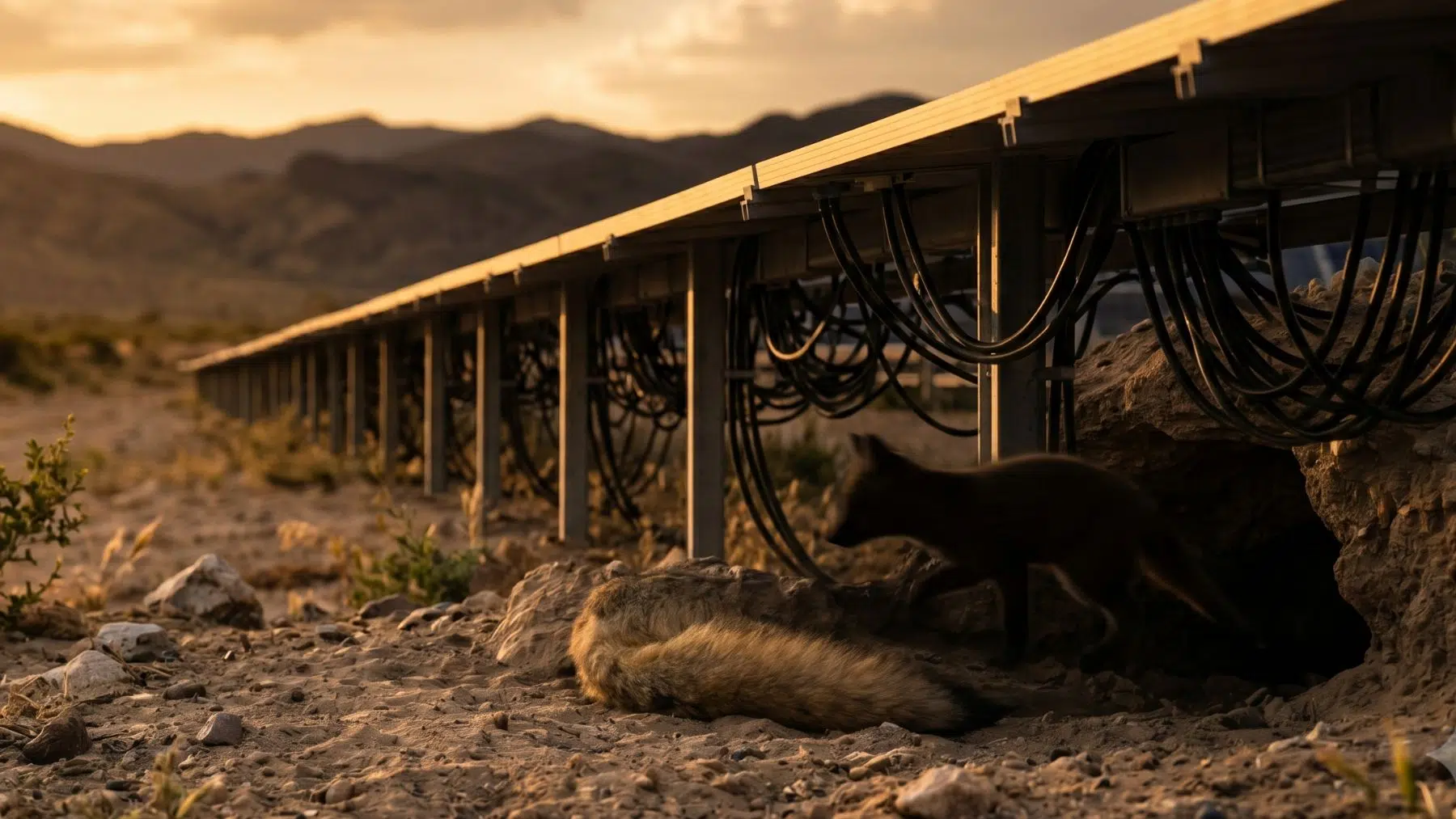
Behind it a hole in the packed dirt runs back into the shade of the array, wide enough for one body and no wider.
Around all of it stands a chain link barrier eight feet tall, built to keep things out.
So how does an animal this small end up living on the inside of it?
What a gap of four inches lets through
The bottom of that fence does not touch the ground.
It stops four to six inches short of the dirt, all the way around, and that clearance was cut into the design on purpose.
A kit fox stands about a foot at the shoulder and slips through it at a walk.
A coyote cannot.
That one dimension splits the local food chain in half. Coyotes are the main predator of this fox and the main competitor for the same rodents, so a fence that admits one animal and refuses the other hands the smaller one a place the bigger one never reaches.
The panels add a second layer. Golden eagles hunt these valleys from overhead, and a row of tilted glass on posts is solid cover against anything coming down.
Grading for construction leaves the ground loose and level, which is easy digging for an animal that dens underground.
The row where the pups came out
A den here is not much to look at.
An oval opening in bare dirt, a fan of pale spoil spilling below it, narrow tracks going in and out.
Some sit in the open lanes between panel rows.
Others run in under the racking itself, so the entrance sits in permanent shade with steel a few feet overhead.
Cameras left on the property recorded what came out of those holes in spring.
Pups, three and four to a litter, tumbling around the posts at dusk while an adult watched from the end of the row.
The site covers 1,245 acres and puts out 130 megawatts, and not one piece of it was arranged with a fox den in mind.
The collars, and what they came back with
The Endangered Species Recovery Program at California State University Stanislaus tracked the animals here for three years.
Seventy four foxes were caught and forty nine wore radio collars, twenty three on the solar property and twenty six on a reference range of open grazing land nearby.
About half of all daytime locations for the solar foxes fell inside the fence, and about a fifth of the nighttime ones, because hunting pulled them back out after dark.
Of 145 dens the collared animals used on the property, 79 sat inside the fence line.
Litters averaged 3.4 pups on the solar site against 4.0 on the reference range.
The mortality index came out at 1.08 against 1.09 per thousand monitoring days.
Body weights did not differ either. By the two measures that decide whether a population holds, breeding and staying alive, the foxes on the industrial site were doing fine.
Where the arrangement starts to cost them
The comfortable version of this story falls apart on the food.
Kangaroo rats, the staple prey, were more abundant outside the fence than inside it, and the tracking report says so plainly.
Foxes on the panels filled the gap with ground squirrels and insects, and they paid for it in mileage.
Their home ranges averaged about 2.4 square miles against well under one square mile for the reference animals.
The same pattern turned up at a much larger array on the Carrizo Plain, where tracked foxes ranged nearly twice as far as their neighbors on open range.
Use of the site thinned over time as well. Dens inside the fence made up 73 percent of the total in the first year and 50 percent by the third.
Cattle broke the fence line repeatedly in that third year and coyotes walked straight in, though fox mortality never rose.
What this changes about building on grassland
Clean power and endangered species are usually argued as a straight trade, acreage against habitat.
The gap under that fence says the argument is really about hardware details.
Four inches of clearance, native seed instead of gravel, a handful of artificial dens, and the same acreage behaves like a different place.
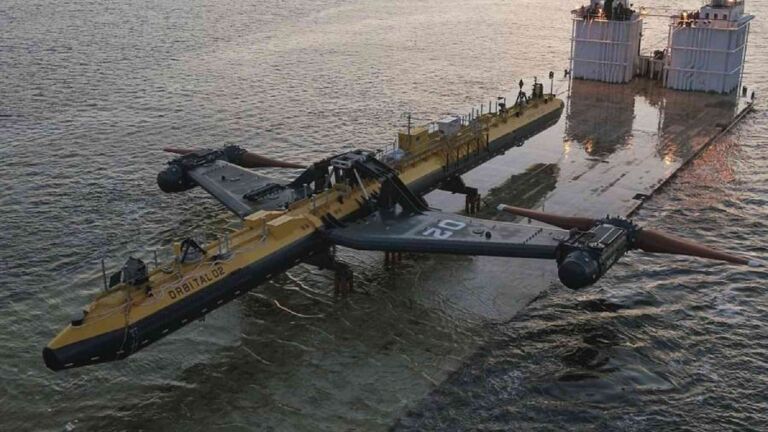
Work around offshore turbines points the same way, that the structure itself is neutral and the fittings decide what lives beside it.
None of that replaces the valley. This animal has lost most of its range to orchards and subdivisions and has carried a federal listing since long before the first panel went up.
What the collars showed is narrower and still worth having.
A place built for electricity turned out to be survivable, and the reason was a few inches someone remembered to leave at the bottom of a fence.
Read the whole thing?
Get the week's signal, not the noise
Our sharpest reporting on energy, climate and nature — free, once a week.