

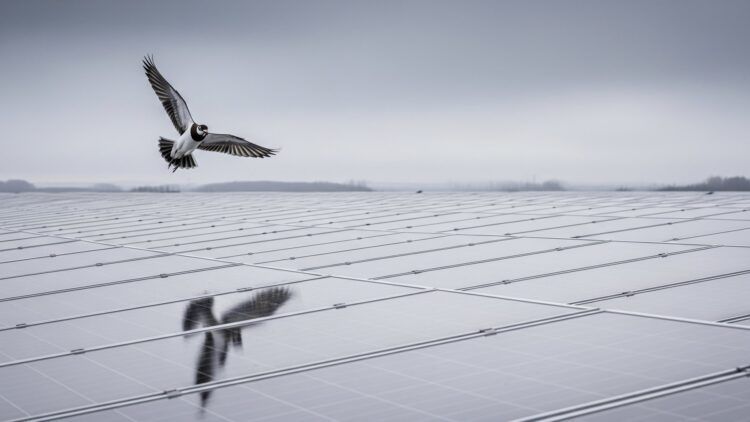
Every autumn, billions of birds pour south across the United States, following rivers, coastlines and the glint of open water far below.
For millions of years, that glint was a reliable signal: water means food, rest, safety.
Now something new is glinting back at them from the ground, and it is changing the journey in ways that took researchers years to notice.
The story starts not with a bird, but with the most powerful solar company on Earth, and a crisis that began long before the first feather fell.
The giant that grew too fast
China’s Longi Green Energy Technology, the world’s largest solar manufacturer, found itself cutting almost one-third of its staff to slash costs in an industry struggling with overcapacity and fierce competition.
Longi’s workforce had totaled about 80,000 people at its peak.
That number alone tells you how enormous this industry became, and how fast.
Since the start of 2022, the spot price of standard solar panels tumbled 70 percent.
The cuts came amid wider redundancies across China’s solar industry after prices for solar cells plunged to an all-time low.
Factories built for record demand were suddenly producing far more panels than the world could absorb.
The workers who lost jobs were assembling the same panels now spreading across the very migration corridors where the bird problem was taking shape.
The world’s fields fill with glass
While boardrooms scrambled, the panels themselves kept going into the ground.
By 2023, solar panels covered approximately 37,886 square kilometers of land, about 0.025 percent of Earth’s entire surface.
That figure keeps climbing every month.
Typically, two to six hectares of land are cleared for every megawatt of solar power generated, resulting in significant habitat disruption.
Most of those hectares were once meadows, scrubland or farmland, the exact kind of open terrain birds have crossed for generations.
Picture a shorebird following the Mississippi flyway southward, scanning below for the glint of a shallow marsh to rest in overnight.
What it sees now, more and more often, is a new mirror stretched across land that used to offer nothing but dry grass.
And the panels sitting on that land have a property that nobody in the energy industry was thinking about when the first arrays went in.
Something strange in the flyway
From a few hundred feet up, a freshly installed solar farm looks almost identical to a lake.
The flat, dark, reflective surface catches the sky at the same angle that water does.
Large-scale solar farms can disrupt wildlife, particularly birds and bats, as the reflective surfaces mimic water and alter migration and foraging behaviors through polarized light pollution.
Polarized light is the same invisible property that lets dragonflies find ponds and lets ducks lock onto rivers from altitude.
For 50 million years, it worked perfectly as a navigation tool.
Then, almost overnight on an evolutionary timescale, glass and silicon started producing the same signal across tens of thousands of acres.
A duck that evolved to trust that signal implicitly has no reason to question it now, and no time to learn.
The birds that land where there is no water
New research from the Harry Butler Institute found that vast, flat surfaces can interfere with animal movements in unexpected ways, a phenomenon scientists now call the “lake effect.”
The reflective glare from solar panels mimics the appearance of water bodies, confusing migrating birds and leading them off course.
A bird that commits to a descent over a solar farm expecting a pond finds nothing it needs: no insects skimming the surface, no cattails, no mud for probing.
For exhausted long-distance migrants, a wasted descent is not a minor inconvenience.
It burns the fat reserves a bird spent weeks accumulating, and in bad weather it can tip the margin between surviving the journey and not.
Yet the same glare that misdirects migrants can concentrate insects and pull in foraging bats and swallows, reshaping local food webs in ways the designers never predicted.
Researchers working on foxes and other mammals at solar sites have found similarly layered outcomes, with some species adapting in ways no one anticipated.
A fix is already growing in the field
A solar facility in Nevada is already offering a model for wildlife-friendly design: native plants and natural washes were preserved, and openings were left in fences to allow desert fauna to pass freely.
Early monitoring shows that animals are using these openings, suggesting that thoughtful design can reduce ecological harm.
Nano-coating solar panels to reduce polarized light pollution is one change researchers say could prevent birds from mistaking panels for water.
The same wind farm lesson learned offshore applies here: when engineers leave room for living things, the living things find ways to belong.
Longi’s crisis and the birds’ confusion are both symptoms of the same breakneck expansion, and the honest fix for both involves slowing down enough to look at what surrounds the panels, not just what they produce.
The solar industry will recover from the price crash; the birds, with a little design ingenuity, may get their flyways back too.