When the sun is shining, you depend on solar panels to function. But when the clouds move in, what happens?
For rooftop systems, rain typically means less power. However, scientists now view downpours as opportunities rather than losses.
There is kinetic energy in every drop of rain.
New materials are being developed to generate electricity from those microscopic impacts. If they are successful, rainy days could become a bonus rather than a weakness.
Even solar panels have an Achilles’ heel
There are drawbacks to even the most sophisticated rooftop solar system.
As costs have decreased and installations continue to rise, solar panels have emerged as the preferred option for homeowners looking to reduce utility costs and power their homes with clean energy. However, they are not flawless sunshine machines.
First of all, they only generate power when the sun is shining; night and overcast days still leave gaps that batteries must fill. And that’s just the start.
Over time, panels may become less effective, particularly if dust, debris, or shade prevent light from reaching the cells.
Wiring problems or premature deterioration can also result from poor installation or inferior materials.
Furthermore, not all roofs are perfect; panels may not function as well as you would like if there are strange angles or excessive shade.
Every time it rains, we waste energy that could power a city
When rain falls on your windows, it sounds serene.
However, to scientists, each and every drop of rain is a source of unrealized potential.
For years, people have dreamed of using rain to generate electricity, and with good reason—rain always falls everywhere and carries mechanical energy with it as it flows and splashes. Although large rivers and waterfalls are already used by hydroelectric plants to turn turbines, it has always been much more difficult to capture energy directly from falling rain.
Why? Because it’s surprisingly difficult to turn tiny droplets into power that can be used. Only very small amounts of electricity could be produced by early systems, sufficient to run distant sensors but insufficient to power a house or a city.
There have been clever experiments, though — like raindrops moving through tubes to light LEDs, or water-integrated floating devices that turn impacts into electrical pulses to power small systems.
But if water could be turned into reliable energy… what would that do to the future of power?
A fabric that produces energy every time a drop of water falls
Imagine transforming each and every raindrop into a tiny electrical spark using your umbrella, tent, or raincoat.
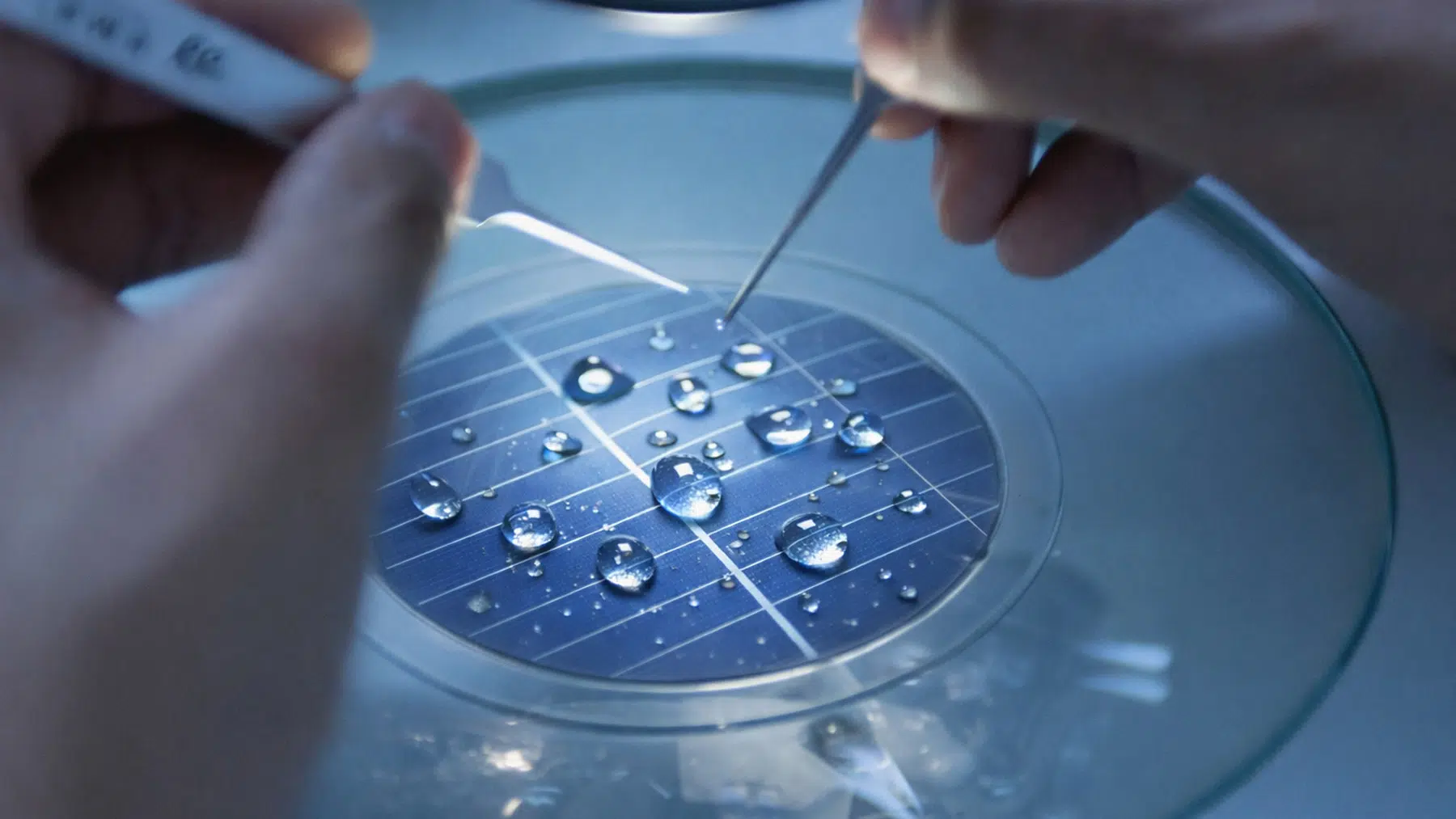
This isn’t science fiction; scientists from all over the world are currently investigating methods to capture energy from rain as well as sunshine. Triboelectric nanogenerators (TENGs), which are materials and textiles that produce electricity when a water droplet strikes or separates from their surface, are among the most intriguing strategies.
These gadgets have the ability to directly transform the kinetic energy of falling drops into electrical pulses.
Researchers have already shown prototype fabrics and surfaces that, when struck by rain, produce a charge exchange, effectively converting every drop of rain into a micro-power source.
Rainy days could actually generate usable electricity rather than merely reducing solar output because, despite the small power of a single drop, the cumulative effect of millions of raindrops over time is significant.
Researchers from the Consejo Superior de Investigaciones Científicas (CSIC) and affiliated institutions in Spain are exploring materials inspired by nature that can achieve this in real-world settings, such as surfaces that repel water but use clever nano-engineering to harvest its energy.
In addition to producing electricity from rain, preliminary research suggests that textiles and surfaces may one day be integrated into infrastructure, clothing, or shelters to power sensors or tiny electronics.
The next time it rains, your clothing may begin to generate energy drop by drop in addition to keeping you dry.
Read the whole thing?
Get the week's signal, not the noise
Our sharpest reporting on energy, climate and nature — free, once a week.