

It started as a simple idea.
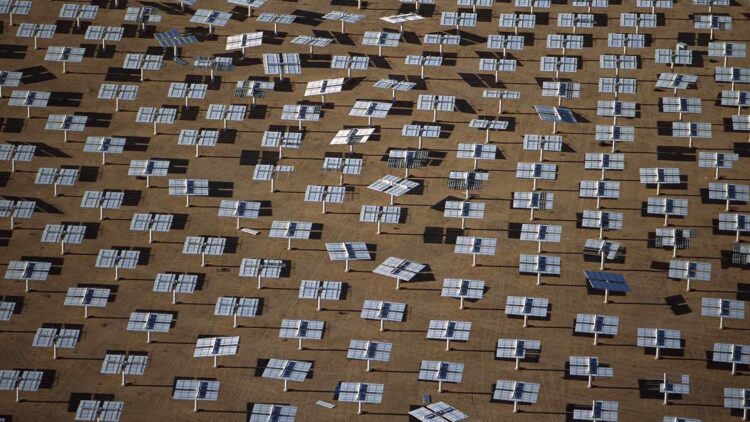
Take one of the sunniest places on Earth—the Sahara Desert—and cover parts of it with solar panels.
Unlimited sunlight. Endless space. Clean energy at a massive scale.
On paper, it looked perfect.
But when scientists began modeling what would actually happen… the desert didn’t stay the same.
It started to change.
And in some areas, something completely unexpected appeared in the sky.
Dark rain clouds.
So how could solar panels create weather in one of the driest places on Earth?
How the Sahara was never supposed to behave this way
The Sahara is defined by one thing.
Dryness.
Rain is rare. Clouds are scarce. The landscape reflects sunlight and heat, keeping atmospheric conditions relatively stable.
That stability is what makes it ideal for solar energy.
But it also means the system is delicate.
Because when you change how energy moves across the surface, you change everything above it.
At first, researchers were only thinking about electricity.
Not climate.
That changed quickly.
A small difference that led to a massive shift
The key detail is color.
Desert sand is light. It reflects a large portion of the sun’s energy back into the atmosphere.
Solar panels are dark.
They absorb that energy instead.
At a small scale, that difference doesn’t seem dramatic.
But across millions of panels, it becomes enormous.
The ground heats up more than it normally would.
And that heat doesn’t stay still.
It rises.
What happens when heat starts to move differently
As solar panels absorb sunlight, they release excess heat into the air above them.
This creates a stronger temperature gradient between the surface and the atmosphere.
Hot air rises faster.
And when it rises, it pulls surrounding air with it.
This process—convection—becomes more intense.
As the air moves upward, it carries moisture along with it.
Even in a desert, there is always some moisture in the air.
Under normal conditions, it’s not enough to form clouds.
But when that air is forced upward quickly, something changes.
The moment clouds begin to form
As the rising air cools at higher altitudes, the moisture it carries begins to condense.
That condensation forms clouds.
Dark, dense, rain-bearing clouds.
Not because the desert suddenly gained more water.
But because the existing moisture was concentrated and lifted in a new way.
In other words, the solar panels didn’t create moisture.
They changed how it moved, says the study, “Massive solar farms could provoke rainclouds in the desert,” published in Science.
And that was enough to create visible weather.
What scientists now believe is happening
Large-scale solar farms in desert regions can alter local climate conditions.
By absorbing more heat than the surrounding land, they increase upward air movement, which enhances cloud formation and, in some cases, rainfall.
Some models even suggest that this effect could lead to long-term changes.
More rain could mean more vegetation.
More vegetation could further change how heat and moisture behave, referred to as a “feedback loop,” according to the Atlantic International University.
One that slowly reshapes the environment.
Why this changes how we think about clean energy
Solar power is designed to reduce environmental impact.
And on a global scale, it does.
But this discovery highlights something important.
Even clean energy changes the systems around it.
Not just visually.
Not just economically.
But physically.
At the level of heat, air, and weather.
A desert that may not stay the same
The Sahara isn’t turning green overnight.
And these effects depend on scale, location, and design.
But the principle is clear.
When you change how the Earth absorbs energy, you change how the atmosphere responds.
In this case, millions of solar panels didn’t just generate electricity.
They created conditions for clouds to form where almost none existed before.
And that raises a question that goes far beyond one desert.
If we reshape the surface of the planet at large enough scales…
What else might we change without realizing it?