
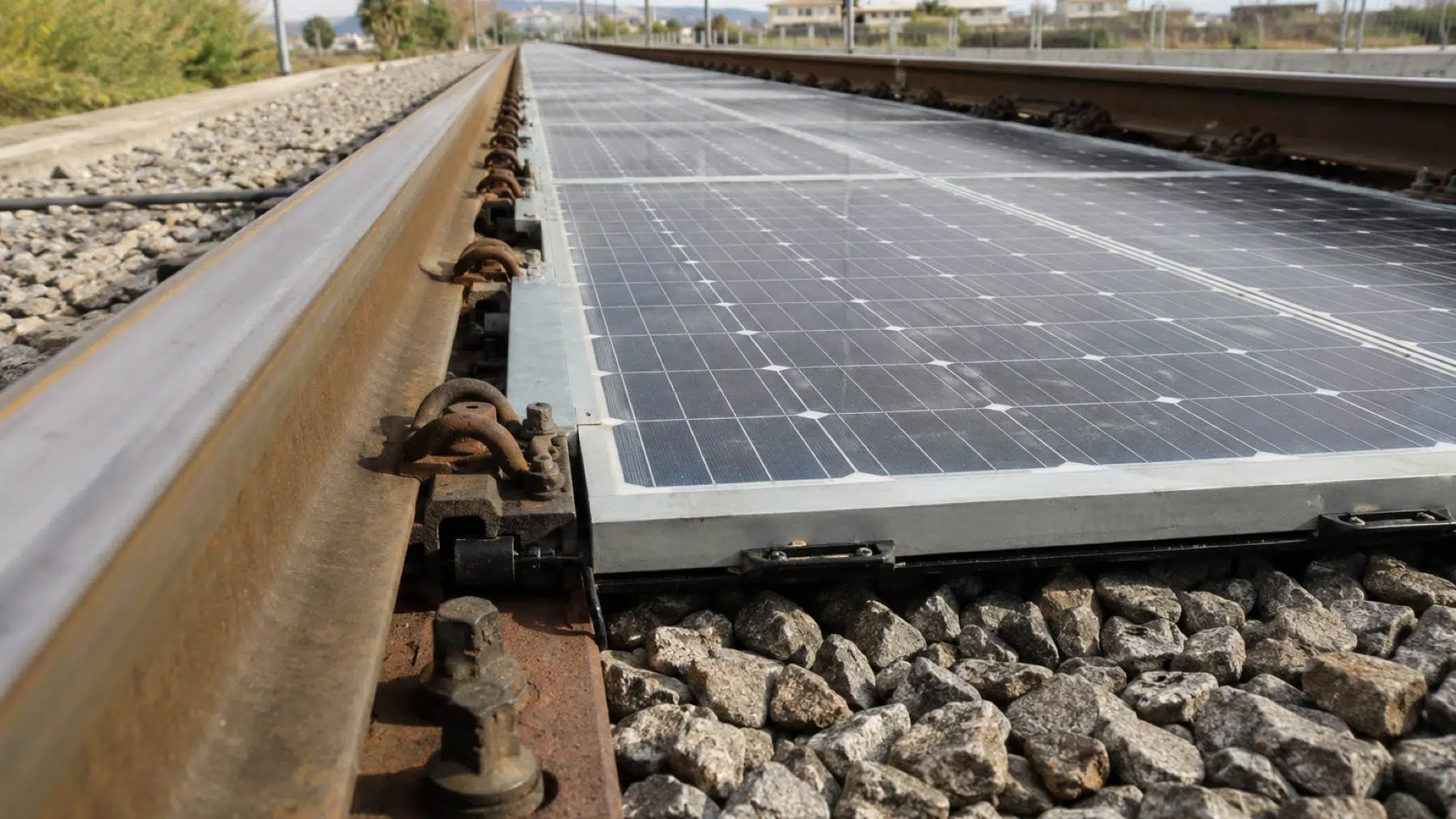
A working train line in western Switzerland is now running over something unusual: solar panels embedded between the rails.
On a 100-meter stretch near the village of Buttes, 48 photovoltaic panels sit flush between the tracks, low enough for trains to pass over them without slowing down. The installation went live on April 24, 2025. It is small — 18 kilowatts of capacity, enough to power a handful of households. But the question it is designed to answer is considerably larger: can solar panels actually hold up under the weight and vibration of active rail traffic?
A Solar Farm Hidden Under the Wheels
The 48 panels at Buttes sit on Line 221, operated by regional rail company TransN in the canton of Neuchâtel. Together they add up to 18 kilowatts of capacity — modest enough to generate roughly 16,000 kilowatt-hours per year, about what a few European households consume. That output is not the point. The point is whether the panels survive at all.
Removability was a non-negotiable design requirement. Railway tracks are critical infrastructure that must be inspected and cleared quickly, so Sun-Ways built the panels so maintenance crews can detach them, do their work, and reinstall them without permanent disruption to the line.
Installation relies on a machine developed with Swiss track maintenance company Scheuchzer — a system that lays the one-meter-wide, preassembled modules “like carpet,” using a piston-unfurling mechanism that rolls panels into position along the track bed. Scheuchzer has indicated the system could eventually cover up to 1,000 square meters per day.
Why Railways Are a Tempting — and Tricky — Solar Frontier
Rail corridors are long, already disturbed, and in most countries publicly owned. That combination makes them attractive for solar in a way that farmland or mountain slopes simply are not. Sun-Ways estimates that equipping Switzerland’s roughly 5,000 kilometers of track could yield about one terawatt-hour of electricity per year — around 2 percent of the country’s total electricity consumption.
The global picture is more striking. Sun-Ways co-founder Baptiste Danichert has suggested that over one million kilometers of railway lines exist worldwide, and that perhaps half could eventually be equipped with the system. That figure should be read as an ambition, not a projection — tunnels, heavily shaded corridors, snow-prone regions, and complex junctions all limit how much rail mileage is actually usable.
The Hard Engineering Problems Regulators Flagged First
The railway environment is punishing in ways a rooftop is not. Panels installed between the rails must endure constant vibration, dust, metal particles from braking, ballast movement, and repeated pressure waves from passing trains — and they must lie nearly flat, a less efficient angle than a tilted rooftop array.
Switzerland’s Federal Office of Transport rejected the Sun-Ways project outright in 2023, citing concerns about railway safety and maintenance. The International Union of Railways separately raised worries about micro-cracks forming in panels over time, elevated fire risk, and reflections that could distract train drivers.
Sun-Ways spent months responding to those objections. The company commissioned an independent scientific study and a safety analysis from Geste Engineering, redesigned the panels with tougher materials, added anti-glare coatings, and incorporated built-in sensors to monitor panel condition. One proposed solution for dirt accumulation: cleaning brushes mounted on trains that sweep the panels as locomotives pass over them.
What the Three-Year Pilot Is Actually Testing
The Buttes installation is scheduled to run through April 2028. Over those three years, Sun-Ways will study glare levels, dirt accumulation, track compatibility, maintenance impacts, and actual energy output — all the variables that looked manageable on paper but need confirmation under live operating conditions.
SNCF’s innovation department and SNCF Réseau, France’s railway infrastructure manager, are monitoring the results. Under a collaboration agreement already signed, France may adopt the system if the data supports it.
Sun-Ways has also described a longer-term ambition: reinjecting power directly into the traction current that runs the trains themselves. CEO Joseph Scuderi has called full self-propulsion the “ultimate” goal — trains partially powered by the track they run on. That vision remains distant. The pilot is not trying to power a train today. It is trying to prove that the panels can survive one.
Solar’s Land Problem — and Why Rail Could Help
As solar capacity expands globally, the question of where to put panels has grown more contested. Large ground-mounted farms can conflict with agriculture, wildlife habitat, and landscapes that communities want to protect. In Switzerland, that tension is especially visible — in 2023, voters rejected a proposal to install solar panels on Alpine mountainsides, a reminder that public support for clean energy does not automatically extend to every proposed site.
Rail solar belongs to a broader category of dual-use infrastructure approaches. Panels over canals, reservoirs, parking lots, and highway margins have all been explored in various countries. The core advantage is that society already built these corridors — no new land acquisition, no rezoning battles. The infrastructure exists. The question, in Buttes at least, is whether the technology can keep up with it.
What to Watch Next
If the three-year pilot produces clean data — panels intact, no safety incidents, measurable energy output — the implications extend well beyond one village in Neuchâtel. SNCF is already watching, and other European rail operators are likely doing the same.
Scaling is the harder question. Even if the engineering holds, rail operators will need to weigh installation costs, maintenance logistics, and energy returns route by route. Promising pilots have stalled before when the economics did not follow the engineering.
The Buttes installation has already cleared one significant barrier: it is running. After a regulatory rejection in 2023, a redesign, an independent safety review, and a new round of approvals, trains are passing over solar panels on a live line. The next milestone is April 2028 — and whatever the data says when the pilot closes.
Read the whole thing?
Get the week's signal, not the noise
Our sharpest reporting on energy, climate and nature — free, once a week.


